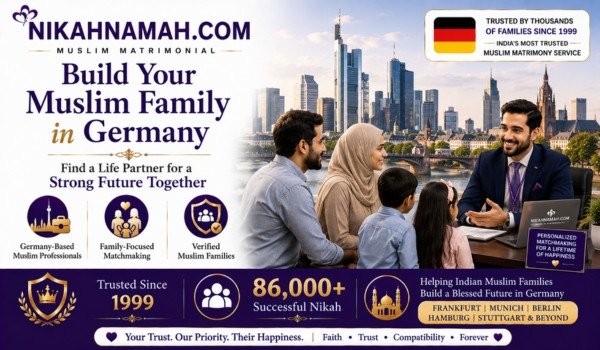
By NikahNamah | India's Most Trusted Muslim Matrimony Platform Since 1999
There's a meaningful difference between finding a groom or bride who happens to live in Germany, and finding a marriage partner with whom you can genuinely build a Muslim family there – raising children, navigating German schools, maintaining Islamic identity in a country whose own relationship with its sizeable Muslim population is still actively evolving, and creating a home that feels rooted rather than merely located.
Germany is home to roughly 5.5 million Muslims, according to 2024 estimates from the Deutsche Islam Konferenz – one of the largest Muslim populations in Western Europe, with mosques, halal infrastructure, and community life present from Hamburg in the north to Munich in the south. But the national picture and an individual family's actual day-to-day experience can be quite different things, and a successful Germany-based Muslim family isn't built on the country's aggregate statistics – it's built on the specific city, the specific community, the specific marriage partner, and the specific, deliberate choices a couple makes about raising children with a strong Islamic identity in a German context.
This guide is about exactly that family-building process – not just finding a Germany-based spouse, but finding the right one to build a genuine Muslim family life with.
Germany's Indian Muslim Community – Where Family Life Actually Happens
A Modest but Established Indian Presence Within a Large Muslim Germany
The Indian community in Germany numbers around 301,000 people, concentrated significantly in Berlin, Munich, Hamburg, Frankfurt, the Rhein-Ruhr and Rhein-Neckar regions, Braunschweig, Nuremberg, and Leipzig. Within this broader Indian community, Indian Muslims form a smaller, distinct presence – professionals in engineering, IT, medicine, and academia – who, like Indian Muslims in France, typically build their primary day-to-day Muslim community connections within Germany's much larger overall Muslim population (heavily Turkish-origin, with significant Arab, Bosnian, and other communities) rather than within a large dedicated Indian Muslim community.
City-by-City, the Texture of Family Life Varies Considerably
Frankfurt: A major financial and corporate hub with a substantial Indian professional community and well-established Muslim infrastructure, making it one of the more naturally comfortable cities for an Indian Muslim family to settle and raise children.
Munich: Home to a notable concentration of Indian engineering and tech professionals, plus the headquarters of the Islamic Community of Germany (Islamische Gemeinschaft in Deutschland), reflecting Munich's long-standing significance in German Muslim institutional life – though as with most German cities, the density and quality of community resources varies considerably by specific neighborhood.
Berlin: Germany's capital and most diverse city, with the Friedrichshain-Kreuzberg district in particular known for a large and diverse Muslim population alongside a notable share of residents from minority backgrounds – offering substantial Muslim community infrastructure, though families should know that the specific neighborhood within Berlin matters considerably for daily access to mosques, halal food, and a comfortable community feel.
Hamburg and the broader Rhein-Ruhr/Rhein-Neckar industrial regions: Significant Indian and Muslim populations connected to Germany's engineering and manufacturing economy, with established but more dispersed community infrastructure than Frankfurt or Berlin.
The honest takeaway for families evaluating a Germany-based proposal: don't evaluate "Germany" as a single entity. Ask specifically which city, and ideally which neighborhood within that city, the groom or bride actually lives in – because the lived experience of building a Muslim family life can differ substantially even between two German cities of similar size.
What Building a Family in Germany Actually Requires – The Practical Picture
The Family Reunification Visa (Ehegattennachzug) and the A1 Language Requirement
For an Indian spouse joining a Germany-based partner, the relevant pathway is the family reunification visa. Unlike some destinations where a spouse visa is relatively procedural, Germany's process includes a requirement that genuinely shapes family planning: spouses typically must demonstrate basic German language proficiency at the A1 level before the visa is granted, with exemptions available for spouses of EU Blue Card holders, highly qualified professionals in specific circumstances, or citizens of a short list of exempted countries (which does not currently include India).
This means, practically, that an Indian bride or groom joining a Germany-based spouse should generally expect to begin German language study – often through the Goethe-Institut or similar certified programs – well before the wedding, not after arrival. This is a genuinely useful piece of family-planning information that too many matchmaking conversations skip entirely.
Income, Accommodation, and Documentation Requirements
Beyond the language requirement, the sponsoring spouse in Germany must demonstrate sufficient income to support the family without relying on public funds (a guideline figure often cited is around €1,200 per month for two people, plus additional amounts per dependent, though this should be verified against current requirements), sufficient living space, and valid health insurance coverage for the incoming spouse. Processing for the visa itself typically takes one to three months, with an additional period for the residence permit application after arrival in Germany.
The Path to Settlement and Citizenship
After holding a residence permit for a qualifying period (commonly around three years, sometimes shorter with strong language proficiency and integration), a spouse becomes eligible to apply for a settlement permit (Niederlassungserlaubnis), and eventually for German citizenship through naturalization – a meaningfully more structured and achievable long-term path than several Gulf destinations, though it requires sustained language learning and integration effort over several years.
Important Notes
German immigration law, including the specific A1 exemption categories and income thresholds, is subject to periodic revision, and individual circumstances (employer category, specific visa held by the sponsoring spouse, and so on) significantly affect the exact requirements. Families should verify current rules directly through the relevant German embassy or consulate in India, or a registered immigration adviser, before finalizing wedding and relocation plans.
Raising a Muslim Family in Germany – What Actually Matters
Childcare and Schooling: Kita, Kindergarten, and Religious Education
Germany's childcare system (Kita, for children from infancy through preschool age) and its school system are largely secular and state-run, though religious education is, in most German states, offered as part of the standard curriculum, including Islamic religious education in a growing number of schools and states – a genuinely positive and distinctive feature compared to France's strict laïcité environment. Families building a life in Germany should research, specifically for their city and state (German education policy is set at the state, or Land, level), what Islamic religious education options exist in local schools, and what halal food provisions are available in school and Kita settings, since this varies considerably across Germany's sixteen states.
Halal Food and Daily Religious Practice
Given Germany's large overall Muslim population, halal food infrastructure is generally excellent in cities with substantial Muslim communities – halal butchers, restaurants, and grocery stores are widely available, particularly in cities like Frankfurt, Berlin, Cologne, and the Rhein-Ruhr region. As with one experienced Indian Muslim resident's account of searching three Fridays running for a Jumu'ah prayer in Wolfsburg that felt like genuine community rather than mere obligation, the specific city and neighborhood matter enormously here – a family relocating to a smaller German city or town with a less developed Muslim community infrastructure should research this specifically before committing, rather than assuming Germany's strong national Muslim population numbers guarantee a comfortable local experience everywhere.
The Real, Documented Challenge of Discrimination
Honest family-planning for a Germany-based life requires acknowledging a documented reality: research has found that people with Muslim backgrounds in Germany are less likely to be hired, may not receive a job interview if their name is recognizably non-German, and face documented difficulty finding housing for similar reasons – a pattern that German policymakers have actively studied and worked to address since approximately 2006. This is not unique to Germany among Western destinations, but it's a real, documented factor that deserves honest acknowledgment when evaluating what building a Muslim family life in a specific German city and professional context will actually involve, rather than glossing over it with generic reassurance.
A Genuinely Positive Counterpoint: Strong Islamic Institutional Presence
Set against this, Germany's Muslim community has built substantial, sophisticated institutional infrastructure – established mosque networks (including DITIB, the Turkish-German mosque association, and the Islamic Community of Germany headquartered in Munich), growing provision for Islamic religious education in state schools, and an active policy conversation (the Deutsche Islam Konferenz, or German Islam Conference) specifically dedicated to integrating Muslim community needs into German civic and educational life. For a family genuinely committed to building Islamic identity within a German context, this institutional foundation is considerably more developed than in several other Western European destinations.
What This Means for Choosing the Right Marriage Partner
Shared Commitment to Active Language and Integration Effort
Because the A1 language requirement and the longer integration journey toward citizenship require real, sustained effort, genuine compatibility for a Germany-bound match includes both partners' shared seriousness about this commitment – not just the Germany-based partner's existing situation, but the incoming spouse's genuine willingness to learn German, beginning before the wedding, as a foundational part of family-building rather than an afterthought.
Alignment on How Islamic Identity Will Be Actively Maintained
Given Germany's secular but religiously pluralistic environment, a genuinely compatible match for family-building in Germany includes real, specific conversation about how both partners intend to maintain and pass on Islamic identity to children – which mosque community they'll be part of, what Islamic education options they'll pursue, how Eid, Ramadan, and other practices will be maintained within German school and work schedules. This deserves the same specificity as the visa and language conversation, not vague assurance.
Honest Engagement With the Specific City's Community Reality
A match should come with a clear, honest picture of the specific German city and neighborhood's Muslim community infrastructure – not "Germany has 5.5 million Muslims" as a generic reassurance, but "here is what the mosque, school, and halal food situation actually looks like in the specific area we'd be living in."
Real Stories: Indian Muslim Families Building a Life in Germany Through NikahNamah
Story 1: The Frankfurt Engineer – When Language Commitment Was Established Early
Imran was 30, a mechanical engineer in Frankfurt on a Blue Card (exempt from the A1 requirement himself, but aware his future wife would not be), from a Hyderabad Muslim family. His family's previous matchmaking conversations had treated "Germany" as simply a good, stable Western posting, without addressing the specific language commitment a bride would need to undertake.
NikahNamah's Relationship Manager made this central to every conversation: she explained the A1 requirement specifically, discussed what German language study would realistically involve before the wedding, and specifically looked for families where the prospective bride was genuinely willing to begin this study seriously, rather than viewing it as a bureaucratic afterthought.
"Previous conversations just said 'Germany is great' without anyone mentioning she'd need to learn German before even applying for the visa," Imran said. "The RM made that the first practical thing every family understood. The bride who said yes had already started looking into A1 courses by the time we had our first call."
The match was a 26-year-old from a Hyderabad family who began German language classes during the matchmaking process itself, demonstrating exactly the proactive commitment the RM had specifically sought.
Story 2: The Munich Family – When Islamic Education Specifics Made the Difference
Sana was 28, a software professional in Munich, from a Lucknow Muslim family whose own matrimony search had stalled repeatedly on a single recurring question from prospective grooms' families: how would children be raised Islamically in Germany?
The Relationship Manager addressed this with real specificity rather than reassurance: she researched and presented the actual Islamic religious education options available in Munich's school system, the mosque communities Sana was already connected to (including resources connected to the city's long-standing Islamic Community of Germany institutional presence), and Munich's halal food infrastructure – giving prospective families a genuine, evidence-based picture rather than asking them to simply trust that "it would work out."
"Every previous conversation got stuck on 'but how will the children be raised Muslim there,' asked in a worried, abstract way," Sana said. "The RM actually researched the specific answer for Munich and presented it concretely. That specificity is what finally satisfied a family enough to move forward."
The match was a 31-year-old IT consultant from a Lucknow family whose own cousin had successfully raised children in Frankfurt, giving the family direct, lived reference points that complemented the RM's research.
Story 3: The Berlin Couple – When Neighborhood-Level Honesty Built Trust
Yusuf, 29, lived in Berlin, working in a corporate finance role, from a Bangalore Muslim family. His family's matchmaking conversations had repeatedly run into a vague but persistent concern from prospective brides' families: general unease about "Europe" and discrimination, without anyone engaging with Yusuf's actual, specific experience.
The Relationship Manager took a direct, honest approach: she discussed the documented reality of discrimination challenges some Muslims in Germany have faced in employment and housing, alongside Yusuf's own specific, positive experience in his particular Berlin neighborhood and professional context – presenting both sides honestly rather than either dismissing the concern or letting it dominate the conversation unaddressed.
"Most conversations either ignored the discrimination question entirely or treated it as scary and unaddressed," Yusuf's mother said. "The RM acknowledged it was real, explained what Yusuf's actual experience had been specifically, and let the family weigh both honestly. That balance – not pretending a real issue doesn't exist, but also not letting it overshadow a genuinely good situation – built real trust."
The match was a 25-year-old from a Bangalore family who engaged with this honest framing directly and felt confident moving forward with full information rather than either naive optimism or excessive fear.
Testimonials: Indian Muslim Families Building Lives in Germany on NikahNamah
"Previous conversations just said 'Germany is great' without mentioning the A1 language requirement at all. NikahNamah made it the first practical thing we understood, and found a bride who'd already started her German classes before our first call." – Engineer, Frankfurt
"Every previous conversation got stuck on vague worry about raising children Muslim in Germany. NikahNamah actually researched Munich's specific Islamic education options and presented real answers. That specificity is what finally worked." – Software Professional, Munich
"NikahNamah didn't ignore the real discrimination concerns or let them dominate unfairly. They were honest about both the challenges and my actual, specific, positive experience. That balance built real trust with families considering my profile." – Finance Professional, Berlin
"NikahNamah understood that building a family in Germany means more than finding someone who lives there – it means a shared commitment to language, integration, and actively maintaining Islamic identity for the next generation." – Family of the Bride, Lucknow
How NikahNamah Helps Families Build a Genuine Muslim Family Life in Germany
We explain the A1 language requirement and family reunification process proactively. Before serious interest develops, we make sure families understand the language commitment, the income and documentation requirements, and the realistic visa timeline – so wedding and relocation planning accounts for this from the start.
We research specific, city-level Islamic community and education infrastructure. Rather than generic reassurance about Germany's large Muslim population, we provide concrete information about mosque communities, Islamic religious education options, and halal infrastructure in the specific city and neighborhood relevant to each match.
We address the real, documented challenges honestly, alongside genuine positives. Discrimination in employment and housing is a documented reality in Germany that we discuss openly, alongside Germany's substantial Muslim institutional infrastructure and the structured path to citizenship – giving families a complete, balanced picture.
We look for shared commitment to active family-building, not just individual eligibility. Genuine compatibility for a Germany-bound match includes both partners' shared seriousness about language learning, Islamic education planning, and community-building – not just one partner's existing settled situation.
We serve families across Germany's full geography. Frankfurt, Munich, Berlin, Hamburg, and the Rhein-Ruhr and Rhein-Neckar regions, with city- and even neighborhood-specific understanding for each.
For Families: What to Ask About a Germany-Based Proposal
Ask specifically about the A1 language requirement and timeline. Has the incoming spouse begun, or are they prepared to begin, German language study before the wedding? This is a genuine practical commitment, not a minor formality.
Ask for specifics about the local Islamic community, not generalities. Which mosque, which Islamic education options for future children, what the halal food access actually looks like in the specific neighborhood – concrete answers here are far more valuable than "Germany has a big Muslim population."
Discuss discrimination realities honestly, without either dismissing or catastrophizing. It's a documented factor in German employment and housing for some Muslim residents – worth understanding specifically for the individual's actual experience and city, rather than either avoided or treated as disqualifying.
Discuss the long-term path to settlement and citizenship. Germany offers a genuinely structured, achievable path to permanent residency and citizenship – understanding the realistic multi-year timeline helps set accurate expectations for family planning.
Frequently Asked Questions: Building a Muslim Family in family reunification visaGermany
Q: Does an Indian spouse really need to learn German before getting the family reunification visa? In most cases, yes – spouses typically need to demonstrate A1-level German language proficiency before the visa is granted, with exceptions mainly for spouses of EU Blue Card holders or certain highly qualified professionals. This should be planned for well before the wedding, with language study through a certified program like the Goethe-Institut.
Q: Is it realistic to raise children with a strong Islamic identity in Germany? Yes, and Germany's institutional infrastructure for this is genuinely more developed than several other Western destinations – including growing provision for Islamic religious education in state schools (which varies by German state), established mosque networks, and a national policy conversation (the Deutsche Islam Konferenz) specifically focused on Muslim community integration. The specific city and school district matter considerably, and should be researched concretely rather than assumed.
Q: How real is the discrimination Muslims face in Germany, and should it affect a marriage decision? It's a documented reality – research has found Muslims in Germany face measurable disadvantages in hiring and housing in some contexts. This shouldn't be ignored, but it also shouldn't be treated as uniformly disqualifying; individual experience varies considerably by city, profession, and personal circumstances. The honest approach is direct, specific conversation about the individual's actual situation, not generic alarm or generic reassurance.
Q: How long does it take to get permanent residency or citizenship in Germany after marriage? Typically around three years of holding a residence permit with demonstrated integration (including language proficiency) makes a settlement permit (Niederlassungserlaubnis) achievable, with full citizenship through naturalization following a further structured process. This is a genuinely realistic, multi-year but achievable path compared to several Gulf destinations where citizenship is essentially unavailable to expatriates.
Q: Are there good Indian Muslim communities in Germany, or is the community mostly non-Indian Muslims? Indian Muslims form a relatively small, professional-class presence within Germany's much larger overall Muslim population (heavily Turkish-origin, with significant Arab and other communities). Most Indian Muslim families in Germany build their daily community connections within this broader German Muslim landscape rather than a large dedicated Indian Muslim community – which is generally a positive, given Germany's well-developed Islamic institutional infrastructure, but worth understanding accurately rather than expecting an Indian-specific community comparable to the Gulf or UK.
A Family Built on Honest Foundations
Building a genuine Muslim family life in Germany – not just relocating there, but actually raising children with strong Islamic identity, navigating the language and integration journey together, and finding real community – requires a marriage partner who shares that specific, sustained commitment, and a matchmaking process honest enough to address the practical realities (the A1 requirement, the documented discrimination challenges, the city-specific community infrastructure) before the wedding, not after.
At NikahNamah, we provide exactly this – specifically, honestly, and with the particular care that building a family in a new country deserves, built on 27 years of NRI matrimony service.
Register for free on NikahNamah today. Whether you are in Frankfurt, Munich, Berlin, or anywhere across Germany – or are a family in India considering a Germany-based proposal – speak with our team. Building a family is a long-term commitment. The right match starts with an honest, complete picture of what that commitment actually involves.
May Allah bless every Indian Muslim family building a life in Germany – raising the next generation with strong faith while navigating a new language and a new land – and write for each of them a Nikah that brings the companion who is genuinely, specifically, joyfully right for the family they are building together. Ameen.
Also Read on NikahNamah Blog
- Germany Based Muslim Grooms: Premium Matrimony Services
- Muslim Matrimony in France: Finding the Right Life Partner
- Muslim Matrimony in the UK: Finding the Right Life Partner for Nikah
- USA Based Muslim Grooms: Premium Matchmaking Services
- Muslim Matrimony in Australia: A Complete Guide for Families
- Explore all Muslim matrimony guides
About NikahNamah
NikahNamah is India's #1 Muslim Matrimony platform, trusted since 1999. With over 86,000 successful Nikah completed and 96,461+ registered members across India, UAE, Saudi Arabia, Qatar, Kuwait, UK, USA, Canada, Australia, Germany, and beyond – we help Indian Muslim families build genuine family lives in Germany with the language-aware, community-specific, honestly-researched matrimony guidance that raising the next generation abroad requires.
📍 Main Branch: Jayanagar 9th Block, Bengaluru – 560069 📍 Other Branch: Frazer Town, Bengaluru – 560005
📞 +91 98451 30331 | +91 90360 22522
✉️ support@nikahnamah.com ⏰ Monday to Sunday, 10:00 AM – 8:00 PM IST (Friday Off)

💬 Comments