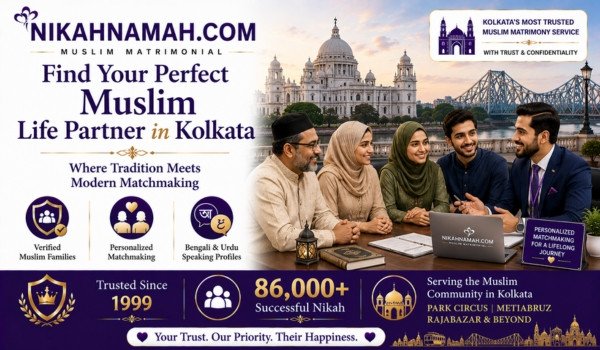
By NikahNamah | India's Most Trusted Muslim Matrimony Platform Since 1999
Kolkata's Muslim community carries a particular kind of layered history that shapes its matrimony landscape in ways genuinely distinct from any other major Indian city – a history written into the city's neighborhoods themselves, in the difference between a Bengali-speaking Muslim family rooted in the soil of West Bengal for centuries and an Urdu-speaking family descended from the entourage of an exiled Nawab, settled in Kolkata not by choice of homeland but by the accident of royal banishment.
This is, in many ways, the central tension and the central richness of Muslim matrimony in Kolkata: tradition here isn't singular. There are multiple traditions, layered atop each other, and a successful matrimony search in this city means understanding the difference – while also engaging honestly with how Kolkata's modern, often highly educated, often professionally accomplished Muslim families are navigating matchmaking today, balancing real respect for these layered traditions with genuinely modern expectations about partnership, career, and personal choice.
This guide is for exactly that navigation.
Kolkata's Muslim Community – A City of Layered Traditions
The Bengali-Urdu Divide That Defines Kolkata's Muslim Landscape
Unlike most major Indian cities, where the local Muslim community shares a single dominant regional language and cultural identity, Kolkata's Muslim population is meaningfully split between Bengali-speaking Muslims, whose roots in Bengal predate the colonial and Mughal periods and who are linguistically and culturally Bengali first, and Urdu-speaking Muslims – often called, sometimes pejoratively, "up-country" Muslims – whose ancestors arrived from North India, particularly through specific historical migrations tied to Mughal-era trade, the aftermath of 1857, and most distinctively, the exile of Nawab Wajid Ali Shah of Awadh to Kolkata in the 1850s, which brought a substantial community of Lucknawi nobles, craftsmen, and retainers (the khidmatgars who gave Khidirpur its name) who settled in what is now the Metiabruz area.
For matrimony purposes, this is not a trivial distinction. A Bengali-speaking Muslim family from, say, Murshidabad-origin roots settled in North Kolkata has a genuinely different cultural register – cuisine, festival practice, family structure, even religious practice nuance – from an Urdu-speaking family in Metiabruz whose identity still carries traces of Lucknow's nawabi culture. Both are authentically, fully Bengali Muslim families in the sense of having lived in Kolkata for generations – but the specific cultural compatibility question this raises deserves honest acknowledgment rather than being glossed over as "both Muslim, should be fine."
Kolkata's Distinct Muslim Neighborhoods
Park Circus: Central-east Kolkata's most prominent and cosmopolitan Muslim neighborhood, historically home to a more affluent, professionally accomplished Muslim population, including many Bihari and Urdu-speaking families alongside Bengali Muslims, with strong educational institutions and a reputation as the area most associated with Kolkata's Muslim professional and business class.
Metiabruz and Garden Reach: Built around the legacy of Nawab Wajid Ali Shah's exile court, Metiabruz developed into a major hub for the readymade garment trade – a business tradition directly descended from the textile and tailoring skills the Nawab's entourage brought with them – and remains one of Kolkata's largest and most distinctively Urdu-cultured Muslim concentrations.
Khidirpur (Kidderpore): Adjacent to Metiabruz, historically linked to the same nawabi-era settlement, with continuing strong Urdu-speaking Muslim community presence near Kolkata's port area.
Rajabazar, Beniapukur, Topsia, Tiljala, and the Park Street-Ripon Street corridor: A broader band of central and east Kolkata neighborhoods with significant, longstanding Muslim populations, ranging from working-class to solidly middle-class, generally featuring a substantial Urdu-speaking presence.
North Kolkata and Murshidabad-linked communities: Bengali-speaking Muslim families with roots tracing to rural Bengal and districts like Murshidabad, Malda, and Nadia, who form a distinct cultural community within Kolkata's broader Muslim population, often maintaining stronger Bengali cultural and linguistic identity than the Urdu-speaking neighborhoods.
What Tradition Means in Kolkata Muslim Matrimony
Family-Led Introduction Remains the Backbone
For most Kolkata Muslim families, marriage remains fundamentally a family-led process – not because younger members lack agency, but because the family network, extended community ties, and the weight of multi-generational relationships within Kolkata's Muslim community genuinely matter to how trust and compatibility are established. A proposal that comes through a respected family connection, a known community elder, or an established matchmaking service carries a different, more substantial kind of credibility than one that arrives through an anonymous app profile.
The Cuisine and Cultural Register Matters More Than Outsiders Realize
Kolkata's Muslim culinary and cultural traditions – the specific Mughlai-Awadhi-inflected biryani culture of Metiabruz, distinct from the Bengali Muslim home cooking traditions of fish and rice that echo broader Bengali cuisine – are genuine markers of identity that factor into how families evaluate compatibility. A bride raised in a Bengali-speaking Muslim household where fish curry and rice define daily meals may find a genuinely different daily domestic culture in an Urdu-speaking Metiabruz household built around a different culinary and linguistic register – not a problem, but a real adjustment worth discussing honestly.
Religious Observance Traditions Vary Across the Two Communities
Kolkata's Bengali-speaking and Urdu-speaking Muslim communities, while united in core Islamic faith and practice, sometimes carry different traditions around specific religious and cultural observances, shaped by their distinct regional and historical origins. Honest, specific conversation about a family's particular religious and cultural practices – rather than assuming uniformity across "Kolkata Muslim" as a single category – is part of what genuine compatibility assessment requires here.
What Modern Matchmaking Means for Kolkata's Muslim Families Today
A Highly Educated, Professionally Diverse Community
Kolkata's Muslim community today includes a substantial and growing professional class – doctors, engineers, academics, civil servants, lawyers, and a strong entrepreneurial presence particularly connected to Metiabruz's garment trade, which has evolved from a traditional craft economy into a modern, often quite sophisticated manufacturing and export business. Many of today's marriage-age Muslim professionals in Kolkata are highly educated, often with degrees from Kolkata's strong university system or beyond, and their expectations of marriage increasingly include the kind of genuine compatibility, career support, and partnership-based relationship that earlier generations' more suitability-focused matchmaking didn't always prioritize.
Bridging Bengali and Urdu Cultural Identity Through Honest Matchmaking
Modern matchmaking in Kolkata increasingly means being willing to look across the Bengali-Urdu divide when genuine compatibility exists – not erasing the real cultural differences, but engaging with them honestly rather than defaulting to same-community matches purely out of inertia. Many of today's most successful matches in Kolkata's Muslim community are exactly these cross-community pairings, where both families approach the cultural difference with curiosity and respect rather than treating it as a barrier.
The Working Bride and Career-Partnership Question
As in other major Indian cities, Kolkata's educated Muslim families are increasingly navigating honest conversations about whether and how a bride's career continues after marriage – a question that modern matchmaking addresses directly and specifically, rather than through the vague reassurances that characterized earlier generations' more suitability-focused approach.
Respecting Community Standing While Embracing Individual Choice
Modern matchmaking in Kolkata often means finding the balance between the genuine value of family and community-vetted introductions – which carry real social weight and provide real due diligence – and meaningful individual choice and compatibility assessment for the two people actually getting married. The most successful contemporary matches tend to combine both: family-level introduction and vetting, paired with real space for the couple to build genuine rapport and have meaningful say in the final decision.
Real Stories: Kolkata Families Finding the Right Match Through NikahNamah
Story 1: The Park Circus Professional – When Crossing the Bengali-Urdu Divide Worked
Rukhsar was 27, a chartered accountant from a Bengali-speaking Muslim family with roots in Murshidabad, now settled in Park Circus. Her family's previous matchmaking attempts had stayed within Bengali-speaking Muslim circles, with limited success – the pool of professionally compatible matches within that specific linguistic-cultural community in Kolkata was smaller than the family had assumed.
NikahNamah's Relationship Manager raised, directly and respectfully, the possibility of an Urdu-speaking Metiabruz family for Rukhsar – a 30-year-old garment business professional with an MBA who had modernized his family's export business. She was explicit with both families about the cultural difference – the linguistic household register, the different culinary traditions, the different specific community history – and asked both families to engage with this honestly rather than dismiss the proposal on cultural-distance grounds alone.
"We'd never have considered an Urdu-speaking Metiabruz family on our own – it felt like a different world," Rukhsar's mother said. "The RM explained the difference honestly, didn't pretend it wasn't real, and asked us to actually meet the family instead of ruling it out from a distance. That openness is what found Rukhsar the right match."
The marriage has, by both families' account, been a genuine bridging of two of Kolkata's distinct Muslim traditions – with Rukhsar's family embracing aspects of Metiabruz's culinary and cultural world while maintaining her own Bengali Muslim identity within the marriage.
Story 2: The Metiabruz Garment Family – When Modern Career Support Was Made Explicit
Imran, 29, was part of his family's well-established garment export business in Metiabruz, the third generation to run what had grown from his great-grandfather's tailoring trade into a substantial modern manufacturing operation. His family wanted a daughter-in-law who would be a genuine partner in both family life and, potentially, the business – but previous matchmaking conversations had defaulted to traditional "suitability" framing without addressing this specific, modern expectation explicitly.
The Relationship Manager made this expectation an explicit, central part of how Imran's profile was presented – not just "established business family" but specifically: a family actively looking for a bride with genuine interest and capability in business, who would be welcomed as a partner in the enterprise's continued modernization, not simply a traditional daughter-in-law role.
"Previous conversations treated 'good business family' as the whole picture," Imran's father said. "The RM understood we wanted something more specific and modern – a partner for the business's future, not just a wife for the household. That specific framing found us a match who actually wanted that role."
The match was a 25-year-old commerce graduate from a Park Circus family with her own interest in business and finance, who has since become genuinely involved in the family's export operations.
Story 3: The Rajabazar Family – When Honest Career Conversation Prevented a Mismatch
Sadia was 26, a junior doctor in a Kolkata teaching hospital, from a Rajabazar family. Her previous matrimony conversations had repeatedly hit the same unspoken gap: families expressed pride in her medical qualification but didn't engage specifically with what continuing her medical career after marriage would actually require – the irregular hours, the ongoing training commitments, the possibility of postings outside Kolkata.
The Relationship Manager made this the explicit center of every conversation about Sadia's profile, asking prospective families directly what their support for a working doctor daughter-in-law would actually look like in daily practice, and specifically seeking families with direct experience of professional women's career demands.
"Every previous family said the right words about supporting my career without engaging with what it actually requires," Sadia said. "The RM's specific questions found a family that had genuinely thought it through – not just agreed to a general idea."
The match was a 30-year-old engineer from a Park Circus family whose own sister was a practicing physician, giving direct, lived family understanding of exactly what supporting Sadia's career would involve.
Testimonials: Kolkata Muslim Families on NikahNamah
"We'd never have considered crossing the Bengali-Urdu divide on our own. NikahNamah's RM was honest about the real cultural differences and asked us to actually meet the family instead of ruling it out. That openness found us the right match." – Mother of the Bride, Park Circus
"Previous conversations treated 'good business family' as the whole picture. NikahNamah understood we wanted a genuine partner for the business's future, not just a traditional daughter-in-law. That specific understanding made all the difference." – Father of the Groom, Metiabruz
"Every previous family said the right words about supporting my medical career without engaging with what it actually requires daily. NikahNamah's specific questions found a family that had genuinely thought it through." – Doctor, Rajabazar
"NikahNamah understood Kolkata's Muslim community isn't one thing – Bengali-speaking, Urdu-speaking, Park Circus, Metiabruz, all genuinely different traditions. That specific, respectful understanding is rare and made the search feel real." – Family of the Groom, North Kolkata
How NikahNamah Serves Kolkata's Muslim Community
We understand and respect the Bengali-Urdu cultural distinction. Rather than treating Kolkata's Muslim community as monolithic, we present the genuine cultural, linguistic, and culinary differences between Bengali-speaking and Urdu-speaking Muslim families honestly, while actively exploring cross-community matches where genuine compatibility exists.
We know Kolkata's specific neighborhoods and their character. Park Circus, Metiabruz, Khidirpur, Rajabazar, and North Kolkata's Bengali Muslim communities each have their own history and social texture, which we present specifically rather than generically.
We ask explicit, modern compatibility questions. Career continuation, business partnership expectations, and genuine day-to-day support – discussed concretely with prospective families, not left as vague traditional reassurances.
We balance family-led tradition with genuine individual choice. Thorough family-level introduction and vetting, paired with real space for the couple to build their own rapport and have meaningful say in the final decision.
We serve Kolkata's full professional and cultural spectrum. From Metiabruz's garment trade families to Park Circus's professional class to Rajabazar's working and middle-class community to Bengali Muslim families across North Kolkata.
For Kolkata Families: A Practical Approach to the Search
Be honest about your family's specific linguistic and cultural identity. Whether your household is primarily Bengali-speaking or Urdu-speaking, and how central that identity is to your daily life, is worth stating clearly rather than assuming every Kolkata Muslim family shares your specific tradition.
Consider cross-community matches with genuine openness. Some of Kolkata's most successful contemporary matches bridge the Bengali-Urdu divide – approached honestly, this isn't a problem to avoid but a real possibility worth exploring.
Discuss career and partnership expectations specifically. Whether for a working bride's career continuation or a groom's expectation of a business partner, vague traditional language should be replaced with concrete, specific conversation.
Respect the value of family-led introduction while making room for individual voice. Kolkata's tradition of family and community-vetted matchmaking carries real value – pairing it with genuine space for the couple's own compatibility assessment tends to produce the strongest, most modern matches.
Frequently Asked Questions: Muslim Matrimony in Kolkata
Q: What's the real difference between Bengali-speaking and Urdu-speaking Muslim families in Kolkata? Beyond language, the differences trace to genuinely distinct historical origins – Bengali-speaking Muslim families generally have roots in Bengal stretching back centuries, while many Urdu-speaking families descend from North Indian migrations, including the notable settlement of Nawab Wajid Ali Shah's exiled Lucknow court in the Metiabruz area in the 1850s. These different origins show up in cuisine, household language, cultural practice nuances, and community identity, even though both communities share core Islamic faith and a deep, generations-long connection to Kolkata itself.
Q: Should families only consider matches within their own linguistic community (Bengali or Urdu-speaking)? Not necessarily – many successful, happy matches in Kolkata cross this divide, particularly among the city's modern, educated professional class. What matters is that both families approach the cultural difference honestly and with genuine curiosity rather than either dismissing it or pretending it doesn't exist.
Q: Is Metiabruz only known for the garment trade, or is there more to the community? While the readymade garment trade – tracing back to the tailoring traditions of Nawab Wajid Ali Shah's court – remains central to Metiabruz's economic identity, the community today includes professionals across many fields, alongside multi-generational business families who have modernized and grown their enterprises significantly, including into export-oriented and increasingly sophisticated operations.
Q: How does NikahNamah handle the career-continuation conversation for Kolkata's professional Muslim women? We ask specific, concrete questions rather than accepting general reassurances – what does supporting a working doctor, engineer, or business professional actually mean in daily practice for a particular family? We seek families who can demonstrate genuine, lived understanding of this, not just stated agreement with the principle.
Q: Does NikahNamah serve Kolkata's Bengali Muslim community outside the city itself, such as Murshidabad or Malda-origin families now in Kolkata? Yes. Many of Kolkata's Bengali-speaking Muslim families trace roots to districts like Murshidabad, Malda, and Nadia, and we serve this community alongside the city's Urdu-speaking and broader Muslim population with the same specific, respectful understanding of their particular cultural identity.
A City of Layered Traditions, A Matrimony Search Built for All of Them
Kolkata's Muslim community is genuinely unlike any other in India – a living layering of Bengal's deep regional Muslim heritage and a distinctive North Indian, nawabi-descended community whose history of exile became permanent settlement. Finding a Muslim life partner here means honoring both traditions specifically, while embracing the genuinely modern expectations – around career, partnership, and personal compatibility – that today's educated Kolkata Muslim professionals rightly bring to the matrimony conversation.
At NikahNamah, we provide exactly this – specifically, honestly, and with the particular respect that Kolkata's richly layered Muslim community deserves, built on 27 years of matrimony service.
Register for free on NikahNamah today. Whether your family's roots are in Park Circus, Metiabruz, Rajabazar, or the Bengali Muslim communities of North Kolkata – speak with our team. Tradition and modern matchmaking aren't opposites here. The right match honors both.
May Allah bless every Muslim family in Kolkata searching for the right life partner – holding their distinct traditions with pride while embracing genuine compatibility and partnership – and write for each of them a Nikah that brings together two people who are genuinely, specifically, joyfully right for each other. Ameen.
Also Read on NikahNamah Blog
- Muslim Matrimony in Delhi for Doctors, Engineers and Business Professionals
- Building a Successful Nikah in Mumbai: A Guide for Modern Muslim Families
- Muslim Matrimony in the UK: Finding the Right Life Partner for Nikah
- USA Based Muslim Grooms: Premium Matchmaking Services
- Muslim Matrimony in Australia: A Complete Guide for Families
- Explore all Muslim matrimony guides
About NikahNamah
NikahNamah is India's #1 Muslim Matrimony platform, trusted since 1999. With over 86,000 successful Nikah completed and 96,461+ registered members across India, UAE, Saudi Arabia, Qatar, Kuwait, UK, USA, Canada, Australia, Germany, and beyond – we serve Kolkata's Muslim community, in all its rich linguistic and cultural diversity, with the neighborhood-aware, tradition-respecting, modern-compatibility-focused matrimony guidance the city deserves.
📍 Main Branch: Jayanagar 9th Block, Bengaluru – 560069 📍 Other Branch: Frazer Town, Bengaluru – 560005
📞 +91 98451 30331 | +91 90360 22522
✉️ support@nikahnamah.com ⏰ Monday to Sunday, 10:00 AM – 8:00 PM IST (Friday Off)

💬 Comments