By NikahNamah | India's Most Trusted Muslim Matrimony Platform Since 1999
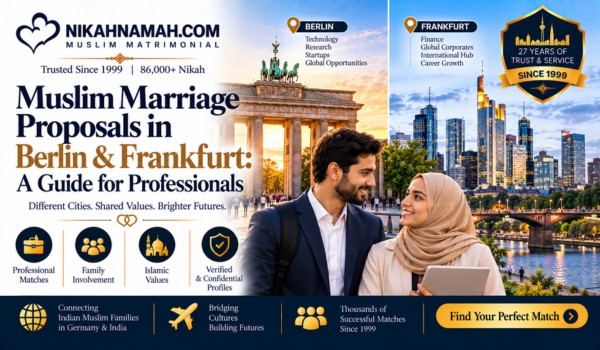
Berlin and Frankfurt represent two distinctly different experiences of professional life in Germany - and two distinctly different contexts for the Indian Muslim matrimony search.
Frankfurt is Germany's most internationally oriented city. The European Central Bank, Deutsche Bundesbank, and the global banks that have made Frankfurt's financial district one of Europe's most important are the reason Frankfurt exists in the way it does. The airport - Europe's third busiest - makes Frankfurt the physical hub through which much of continental Europe's international connectivity flows. The city's professional culture is financial, international, and specifically transactional in character. English is genuinely the working language of Frankfurt's financial and corporate ecosystem. Indian Muslim professionals in Frankfurt often came specifically for the jobs and have found in the city's international character a professional environment that is genuinely accessible.
Berlin is something more complex and more interesting. Germany's reunified capital is the city that Europe's creative class chose - the artists, the technologists, the researchers, the startup founders, the academics who found in Berlin's specific combination of affordable space, intellectual energy, historical depth, and cultural vitality something that no other European city quite offered. Berlin's Startup ecosystem is one of Europe's largest. Its research university network - Humboldt University, Free University of Berlin, Technical University of Berlin, Charité medical university - is genuinely world-class. Its Turkish Muslim community, among the largest and most established Turkish communities outside Turkey itself, has built an Islamic infrastructure that makes Muslim professional life in Berlin meaningfully more supported than in most European capitals.
For Indian Muslim professionals in these two cities - and for the families in India evaluating their proposals - this guide addresses the specific dimensions of the Berlin-Frankfurt matrimony landscape.
Berlin's Indian Muslim Professional Community
The City and the Muslim Infrastructure
Berlin's Muslim community - estimated at approximately 300,000-350,000 people in a city of 3.7 million - is predominantly of Turkish origin, but includes Arab, Balkan, and growing South Asian components. The Turkish Muslim community of Berlin, concentrated in Neukölln, Kreuzberg, Wedding, and Tempelhof, has built decades of Islamic community infrastructure: mosques, halal food establishments, Islamic cultural organisations, and the specific social institutions that sustain a Muslim minority community in a European capital.
For Indian Muslim professionals in Berlin, this established Turkish Muslim infrastructure provides practical Islamic support - halal food is genuinely accessible in Berlin's Muslim-concentrated neighbourhoods, mosques serve the community across the city, and Ramadan in Berlin has a communal energy that reflects the size and the establishment of the Muslim population.
The Indian Muslim component of Berlin's Muslim community is smaller and growing - primarily professionals drawn by the technology sector (Zalando, Delivery Hero, HelloFresh, N26, and the broader Berlin startup ecosystem employ Indian professionals in significant numbers), researchers at Berlin's universities and research institutes (Charité is one of Europe's largest university hospitals), and academics who have found in Berlin's intellectual culture a genuinely stimulating research environment.
Key Berlin neighbourhoods for Indian Muslim professionals: Neukölln (with its established Turkish-Arab Muslim community infrastructure and its specific multicultural character), Mitte (central Berlin, near the technology companies and startups), Prenzlauer Berg and Friedrichshain (favoured by the technology and creative professional community), and Charlottenburg (the western Berlin professional residential area).
The Berlin Professional Character
Berlin's professional culture is distinctly different from Frankfurt's. Where Frankfurt is financially transactional and internationally oriented, Berlin is intellectually curious, slightly countercultural in its professional values, and specifically ambivalent about the pure financial professional ethos.
Indian Muslim professionals who thrive in Berlin typically have a specific combination: genuine professional accomplishment in technology, research, or academia alongside a genuine appreciation for Berlin's intellectual and cultural vitality. The Indian Muslim PhD researcher at Charité who attends the Berlin Philharmonic. The Indian Muslim startup engineer whose team is building a product that has genuine social impact. The Indian Muslim academic at TU Berlin whose research is internationally cited. Berlin rewards genuine intellectual seriousness alongside professional accomplishment.
Frankfurt's Indian Muslim Professional Community
The City and the Professional Landscape
Frankfurt's Indian Muslim professional community is concentrated in the city's financial and corporate ecosystem - in the banks and investment firms of the Westend financial district, in the multinational corporations with European headquarters near the airport, and in the consulting firms and professional services companies that serve this corporate ecology.
The Indian Muslim professional in Frankfurt came, typically, because a job was specifically available in the European financial or corporate ecosystem - a role at Deutsche Bank, or at a global consulting firm, or at an industrial conglomerate with European headquarters. The city itself was less the draw than the specific professional opportunity.
Frankfurt's South Asian Muslim community - smaller than Berlin's in absolute terms, and without the same depth of Turkish Muslim infrastructure - has built its own community life across the city's residential areas (Sachsenhausen, Niederrad, Bergen-Enkheim, and the residential suburbs accessible from the financial district) and through the mosque communities that serve Frankfurt's Muslim population.
Frankfurt's Islamic community infrastructure: The Islamic Centre Frankfurt (IZF) in the Sachsenhausen area is one of Germany's significant mosque institutions. Halal food is available through Turkish-owned restaurants and butchers across Frankfurt's residential areas. South Asian halal food is more limited than in Berlin but available in specific areas.
The Frankfurt Professional Character
Frankfurt's professional culture is international, formal, and specifically financial in its orientation. English is genuinely the working language of the major financial institutions. The working hours are long. The professional hierarchy is more formal than Berlin's. The social culture is more reserved and less immediately open than Berlin's multicultural character.
For an Indian Muslim bride from India considering Frankfurt, the professional environment is recognisable in its structure - the formal hierarchy, the long working hours, the importance of professional credentials - while the cultural environment (German formality, Frankfurt's specific social culture) requires genuine adjustment.
The German Marriage Proposal - What Both Cities Share
The A1 Language Requirement - The Critical Common Element
Both Berlin and Frankfurt share the defining characteristic of German marriage proposals: the A1 German language requirement for the spouse visa.
As covered in the Germany blog earlier in this series, the German Family Reunion Visa (Familienzusammenführung) requires the overseas applicant to demonstrate basic German language proficiency at A1 level (CEFR) before the visa is issued. The Goethe-Institut conducts A1 examinations in India's major cities (New Delhi, Mumbai, Bengaluru, Chennai, Kolkata, Pune).
The A1 requirement is the most practically important Germany-specific fact for families in India evaluating Berlin or Frankfurt proposals. It needs to be communicated proactively - before families develop emotional investment - and the search should specifically target families whose daughters have the genuine language-learning enthusiasm or prior foreign language experience that makes A1 German a manageable milestone rather than an unexpected obstacle.
The honest A1 picture: A1 German is genuinely the most basic level of the CEFR scale. Goethe-Institut's preparatory materials and courses are widely available. Most educated Indian candidates with a genuine few months of focused preparation can reach A1 level. The challenge is genuine but not prohibitive for motivated learners.
The Blue Card and Spouse Visa - Common to Both Cities
For both Berlin and Frankfurt:
The EU Blue Card (Blaue Karte EU): Germany's primary immigration pathway for highly qualified professionals. Requires a recognised university degree and a German employment contract meeting the minimum salary threshold (verify current threshold at the Federal Employment Agency or the relevant German immigration authority). Provides a pathway to permanent settlement (Niederlassungserlaubnis) after 27 months (21 months with B1 German language proficiency).
The Family Reunion Visa: The spouse visa for the groom's partner. Requires the A1 German language certificate, proof of the groom's valid residence and sufficient income, evidence of adequate housing, and German health insurance coverage. Processing time typically 2-4 months from India.
Permanent Settlement (Niederlassungserlaubnis): Available after 27 months on Blue Card (with B1 German) or 5 years of legal residence. Employer-independent permanent residence.
Always consult a German immigration attorney for advice specific to your situation.
What Families in India Need to Know About Berlin and Frankfurt Proposals
The City Difference - Why It Matters for Evaluation
A family evaluating a Berlin proposal is evaluating a different life from a family evaluating a Frankfurt proposal - despite both being in Germany. The honest city-specific differences:
Berlin - larger, more diverse, more culturally alive, lower cost of living (Germany's most affordable major city), stronger Turkish Muslim community infrastructure, more accessible halal food, technology and research professional culture, more international in social character. For a bride who values intellectual and cultural vitality, community diversity, and affordability, Berlin offers a genuinely good European life.
Frankfurt - smaller in population, more expensive in housing, financial and corporate professional culture, slightly more formal social environment, good but less deep halal food infrastructure, more international English-speaking professional bubble. For a bride who will be in the international corporate bubble of Frankfurt's financial district and whose social world is primarily international professional, Frankfurt works well. For a bride building an independent life outside the corporate bubble, the community infrastructure requires more deliberate effort.
Families in India should ask specifically which city and which neighbourhood - not "Germany."
The German Winter - Both Cities
Germany's winter is genuine - Berlin typically drops to -5°C to -10°C in January and February, Frankfurt is slightly milder but still genuinely cold. Both cities have good indoor heating infrastructure. Winter clothing is a real requirement. The German cultural relationship with winter - Christmas markets, heated indoor social life, the specific rhythm of a northern European city in winter - is something a bride from India will be adjusting to genuinely.
The Language Reality - Daily Life Beyond A1
The A1 requirement is for the visa. Daily life in Germany beyond the international professional bubble requires genuine German investment. A bride who arrives in Berlin or Frankfurt at A1 level will find that grocery shopping, healthcare appointments, neighbourhood social interaction, and most of daily life outside the international professional ecosystem occurs in German.
German integration services - language courses, social integration programmes - are widely available in both cities and are often subsidised for new arrivals. The language investment is a genuine commitment that requires honest anticipation.
Real Stories: Indian Muslim Professionals in Berlin and Frankfurt Finding Their Matches
Story 1: The Berlin Startup Engineer - When the Cultural Life Was the Match Criterion
Arjun was 31, a software engineer at a Berlin-based fintech startup - EU Blue Card holder, from a Bangalore Muslim family. He had been in Berlin for four years and had genuinely absorbed the city's specific intellectual culture. The museums, the research community around his office in Mitte, the specific Berlin character that combined professional seriousness with genuine cultural curiosity.
His matrimony requirement was specific: he was not looking for a bride who would come to Berlin and build an Indian social bubble. He was looking for a bride who would genuinely engage with Berlin - who found its cultural richness interesting, whose own intellectual engagement was genuine enough that the city's specific vitality would be something she entered with enthusiasm rather than with displacement anxiety.
The Relationship Manager's search was built around this specific quality. She assessed it through the quality of potential match families' engagement with the question: "What does your daughter find interesting outside her professional domain?" Families whose daughters had genuine intellectual interests - a genuine engagement with literature, history, design, science communication, or any domain of genuine curiosity - gave specific, enthusiastic answers. Families whose daughters' interests were more generally professional than genuinely curious gave different answers.
The match was from a Bangalore Muslim family - a 28-year-old who worked at a science communication organisation, whose own professional engagement was with making research accessible to the public, and whose intellectual curiosity was active and specific. She had studied German language for one year before the matrimony conversation began - not because anyone required her to, but because she had decided she wanted to.
"The RM found someone whose curiosity was genuine," Arjun said. "Not someone who would be politely displaced. Someone who would genuinely be interested in Berlin. The German study she had already started was the signal - she was already choosing Berlin before she had met me."
The A1 test she took three months later was a milestone in a language journey she had already begun.
Story 2: The Frankfurt Bank Professional - When the International Bubble Was Honestly Described
Khalid was 33, a risk analyst at a major bank in Frankfurt's Westend financial district - EU Blue Card holder, from a Hyderabad Muslim family. His professional world was almost entirely English-language - his team was international, his work was conducted in English, and his daily professional life was more similar to a London or New York financial professional's experience than to a stereotypical German work culture.
His Relationship Manager presented Frankfurt honestly to every family she approached. The English-language professional bubble was specifically described - the international character of the financial district workplace, the genuine cosmopolitan professional world that Frankfurt's banking ecosystem created. But she also described honestly what was outside the bubble: the German city whose daily life required German language, whose residential areas had a specifically German character, and where the Indian Muslim community infrastructure was present but not as deep as in some other cities.
She specifically targeted families whose daughters had genuine English language fluency at professional register - for whom the international professional bubble was immediately accessible - combined with the genuine adaptability that building a life outside the bubble requires.
The match was from a Hyderabad Muslim family whose daughter was a financial professional herself - a credit analyst at an Indian bank, with professional English fluency and genuine financial sector familiarity. The Frankfurt financial world was immediately comprehensible to her in professional terms. Her prior French study (she had reached B1 French in university) demonstrated the language learning capability that German would require.
"The RM described the international professional bubble honestly," Khalid said. "And she found a bride for whom the bubble was familiar from her own professional world and who had the language learning capability the German life beyond the bubble would require. Both dimensions addressed simultaneously."
Story 3: The Berlin Researcher - When Islamic Community Was Documented Specifically
Dr. Priya was 30, a postdoctoral researcher at Charité Berlin - Blue Card holder, from a Tamil Nadu Muslim family. Her family in Chennai was specifically concerned about Islamic life in Berlin. They had a general impression that Germany was secular and that Muslim life there would be difficult.
The Relationship Manager's approach: document Berlin's Islamic community specifically. The Dar as-Salam mosque in Neukölln - within 20 minutes of Charité's campus - and its specific community character. The halal food infrastructure of Neukölln and Kreuzberg (Turkish-owned halal butchers and restaurants within walking distance of the residential areas where Charité researchers typically live). The South Asian Muslim community organisations that had established themselves in Berlin. And Dr. Priya's own documented Islamic practice in Berlin - the mosque she attended, the Ramadan community she participated in, the halal food her household maintained.
This specific, documented Islamic community picture replaced the family's general impression with a specific, evaluable reality.
The match was from a Chennai Tamil Muslim family - a 32-year-old physician in Chennai whose own planned USMLE preparation demonstrated his interest in international careers, and whose family had specifically engaged with the Berlin Islamic community documentation and found it genuinely reassuring. The Tamil Muslim community alignment was immediate. The healthcare professional world was shared across Charité (Dr. Priya's) and the groom's clinical medical background.
"The RM documented Islamic Berlin specifically," Dr. Priya said. "My family's concern was real and legitimate. The specific documentation answered the specific concern. The family she found had engaged with the documentation rather than with a general reassurance."
Story 4: The Frankfurt-Berlin Duo - When the Search Spanned Two German Cities
A Muslim family in Kerala had a daughter - 27 years old, a data analyst - who had received two German proposals simultaneously. One from a groom in Berlin (startup data scientist), one from a groom in Frankfurt (bank technology professional). Both qualified, both practicing Muslims, both with Blue Cards. The family asked NikahNamah to help them evaluate both.
The Relationship Manager facilitated the comparison honestly. She presented both cities specifically and without advocacy for either - the Berlin picture (larger, more diverse, lower cost, stronger Muslim community, startup culture) and the Frankfurt picture (more compact, higher cost, financial corporate culture, English-professional bubble). She described both grooms' specific situations - the Berlin groom's Islamic practice (specifically assessed), the Frankfurt groom's Islamic practice (specifically assessed). She facilitated separate family calls with each groom's family.
The family's decision: Berlin. The specific reasons the family articulated were clear - the stronger Muslim community infrastructure, the lower cost of living (relevant for a young couple starting out), and the daughter's own intellectual orientation (she had studied design alongside data science and found Berlin's creative-intellectual culture genuinely appealing).
"The RM gave us both cities honestly and completely," the family said. "No advocacy. Both pictures, both grooms, both communities. We could actually decide because we had two complete, honest pictures to compare."
The Berlin groom's proposal was accepted. The A1 German examination was booked.
Testimonials: Indian Muslims in Berlin and Frankfurt on NikahNamah
"The RM found someone whose curiosity was genuine. The German language study she had already begun before we met was the signal - she was already choosing Berlin before she had met me. That specific enthusiasm was what I was looking for."
- Software Engineer, Berlin Fintech Startup (Blue Card)
"The RM described the Frankfurt international professional bubble honestly - and found a bride for whom the bubble was familiar from her own financial career. Both dimensions - professional familiarity and language capability - addressed simultaneously."
- Risk Analyst, Frankfurt Banking District (Blue Card)
"The RM documented Islamic Berlin specifically - the mosque, the halal food, the community. My family's concern was legitimate. The specific documentation answered the specific concern. General reassurance would not have been enough."
- Postdoctoral Researcher, Charité Berlin (Tamil Nadu family)
"The RM gave us both cities honestly and completely. No advocacy. Two complete pictures. We could actually decide because we had two genuine comparisons rather than two promotional pitches."
- Tamil Nadu Muslim Family (evaluated Berlin and Frankfurt proposals simultaneously)
"NikahNamah understood Berlin and Frankfurt as distinctly different professional worlds. The A1 requirement, the Blue Card pathway, the Turkish Muslim community infrastructure in Berlin, the English-bubble in Frankfurt - specific knowledge for two specific cities."
- Indian Muslim Professional, Germany
How NikahNamah Serves Indian Muslims in Berlin and Frankfurt
We present both cities specifically and honestly. Berlin and Frankfurt are not interchangeable German cities - they have genuinely different professional cultures, community infrastructures, cost of living profiles, and daily life characters. We describe each specifically rather than using "Germany" as an abstraction.
We communicate the A1 German language requirement proactively. The A1 requirement is communicated in the first contact with every potential match family - before identifying information about the groom is shared. We specifically target families whose daughters have genuine language-learning enthusiasm or prior foreign language experience.
We document Islamic community life specifically. For families in India concerned about Islamic practice in Germany, we provide the specific picture - the mosque community accessible from the groom's address, the halal food infrastructure, the Ramadan community, and the groom's own documented Islamic practice.
We facilitate honest city comparison when needed. For families evaluating proposals from multiple German cities (or comparing Germany to other NRI locations), we present each honestly and without advocacy - giving families the complete pictures they need to make genuine decisions.
We assess genuine cultural readiness for the specific city. Berlin requires genuine intellectual curiosity and genuine community-building capacity. Frankfurt requires adaptability to the international corporate bubble alongside the German daily life outside it. We assess these specifically rather than generically.
We manage the India-Germany time zone. Germany is 3.5 to 4.5 hours behind IST (CET/CEST depending on season). Indian evenings and German evenings create a workable overlap window. We schedule all coordination at these overlap times.
Frequently Asked Questions: Muslim Marriage Proposals in Berlin and Frankfurt
Q: How different are Berlin and Frankfurt for an Indian Muslim bride - which city is better?
Neither city is universally better - the right answer depends on the bride's specific temperament, professional background, and personal values. Berlin offers: larger Muslim community (predominantly Turkish), more accessible halal food, lower cost of living, more diverse and culturally alive social environment, technology and research professional culture. Frankfurt offers: more compact city scale, international English-language professional bubble, financial and corporate professional world, stronger international professional community. For a bride with genuine intellectual curiosity who will build her own life in the city - Berlin. For a bride whose primary social world will be the international professional community and who has strong professional English - Frankfurt. The specific neighbourhood within each city also matters significantly.
Q: The A1 German requirement sounds difficult. How should we think about it for our daughter?
A1 German is genuinely the most basic level on the CEFR language scale - understanding simple sentences and familiar everyday expressions, introducing yourself, asking and answering simple questions about personal details. The Goethe-Institut provides preparatory materials and courses that most motivated learners can work through in 2-4 months of genuine effort. For families whose daughters have prior experience with a foreign language (French, Arabic, even English as a studied language), the A1 level is an achievable milestone. The more important question is genuine motivation - a bride who is genuinely choosing Germany will approach A1 German as an interesting beginning. A bride who is accepting Germany as a compromise will find A1 German an annoying obstacle. The bride's genuine enthusiasm is the best predictor of success.
Q: My son is a researcher/PhD student in Berlin with a modest stipend. How does NikahNamah present this?
With the trajectory narrative - the same approach used for researchers in other cities in this series. The institution (Charité, Humboldt, TU Berlin, Free University of Berlin - all genuinely world-class), the research field, the career paths available after the postdoc (academic positions in Germany or internationally, industry roles in Germany's research-intensive economy), and the realistic income range post-postdoc. Germany's Blue Card pathway also means that many researchers transition directly from PhD/postdoc to Blue Card employment with a salary step-change that significantly closes the gap between stipend and full professional compensation. We target families with research career exposure who can evaluate this trajectory correctly.
Q: What is the halal food situation in Berlin and Frankfurt specifically?
Berlin has genuinely comprehensive halal food infrastructure, particularly in the Turkish-Muslim community areas of Neukölln, Kreuzberg, and Wedding. Turkish-owned halal butchers and restaurants are widely accessible. South Asian halal food is available in specific areas. For a bride from India living in Berlin's central or southern residential areas, halal food is genuinely accessible rather than requiring special effort. Frankfurt's halal food infrastructure is good in the Turkish-community residential areas (Sachsenhausen, Gallus, Bockenheim) and includes both Turkish halal butchers and some South Asian options. Neither city has halal food as universally default in the way that Qatar or Kuwait do, but both have genuinely good halal food access for professional families who know where to look.
Q: Can my daughter practice her profession (nursing, engineering, teaching) in Germany?
German professional qualification recognition varies by profession and federal state. For nurses: the process of recognising Indian nursing qualifications for German nursing registration is generally possible but requires assessment, may require bridging education, and can take 12-24+ months. German language proficiency is required for nursing practice (typically B2 level). For engineers: German qualification recognition for engineering is generally achievable for Indian-degree engineers, though the process of becoming a Chartered Engineer in Germany requires assessment. For teachers: German teaching qualifications are highly regulated and international teachers face significant barriers to classroom practice in the German public school system. Private international schools (of which there are several in both Berlin and Frankfurt) are a more accessible pathway for international educators. Always research the specific profession's recognition pathway before the matrimony commitment.
Berlin and Frankfurt - Two German Chapters, One Indian Muslim Story
The Indian Muslim professionals who have built their careers in Berlin's startup ecosystem and Frankfurt's banking towers are part of the same broader story - the Indian Muslim diaspora's extension into Western Europe's professional landscape, arriving later than in the UK but building genuine professional lives with the same combination of ambition, capability, and Islamic commitment that characterises Indian Muslim professionals everywhere.
What distinguishes the German chapter from the UK and US chapters is its specific character: the German language that requires genuine investment, the Blue Card pathway that provides faster permanent settlement than America's Green Card queue, the Turkish Muslim community infrastructure that makes Islamic practice meaningfully supported, and the specific professional cultures of two very different German cities.
The right match for an Indian Muslim professional in Berlin or Frankfurt is the match that is right for the full person - not just for the Blue Card holder or the Germany-based professional, but for the person who has chosen this specific city, this specific professional world, and this specific Islamic minority life in a European country where Islam is genuinely present but not the social default.
At NikahNamah, we find this match. With the city-specific knowledge, the A1-proactive communication, and the Islamic community documentation that the German matrimony search specifically requires.
Register for free on NikahNamah today. Whether you are a professional in Berlin or Frankfurt - or a family in India evaluating a German proposal - speak with our team.
May Allah bless every Indian Muslim professional who has built their career in Berlin's intellectual vitality or Frankfurt's financial world - through the German language learning and the winter adjustments and the halal food found in Turkish neighbourhoods - and write for each of them a Nikah that brings the companion who is genuinely right for the specific German life they have chosen. Ameen.
Also Read on NikahNamah Blog
- Germany Based Muslim Grooms: Premium Matrimony Services
- Finland Based Muslim Grooms and Brides: Finding the Right Match
- Muslim Matrimony in the UK: Finding the Right Life Partner for Nikah
- Muslim Grooms in Manchester and Birmingham: Finding Compatible Marriage Matches
- NRI Muslim Grooms with International Degrees: Complete Matrimony Guide
- Muslim Matrimony Toronto: Connecting Professional Families for Marriage
- How to Find the Perfect Muslim Life Partner: A Complete Guide
- From Profile to Nikah: Real Success Stories of Muslim Couples Who Found Love Through NikahNamah
About NikahNamah
NikahNamah is India's #1 Muslim Matrimony platform, trusted since 1999. With over 86,000 successful Nikah completed and 96,461+ registered members across India, UAE, Saudi Arabia, Qatar, Kuwait, UK, USA, Canada, Australia, Germany, and beyond - we serve Indian Muslim professionals in Berlin, Frankfurt, and across Germany with the city-specific, A1-proactive, Islamic-community-documented matrimony guidance that the India-Germany corridor requires.
📍 Main Branch: Jayanagar 9th Block, Bengaluru - 560069 📍 Other Branch: Frazer Town, Bengaluru - 560005 📞 +91 98451 30331 | +91 90360 22522 🌐 www.nikahnamah.com | ✉️ support@nikahnamah.com ⏰ Monday to Sunday, 10:00 AM - 8:00 PM IST (Friday Off)

💬 Comments