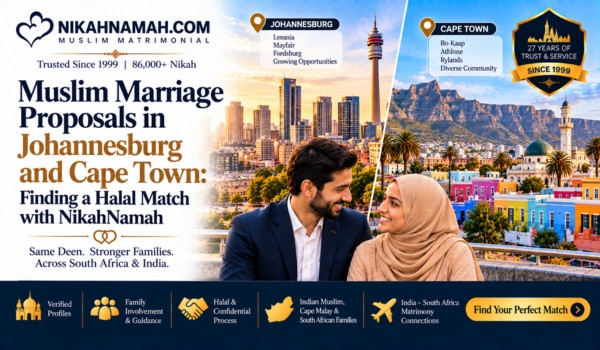
By NikahNamah | India's Most Trusted Muslim Matrimony Platform Since 1999
There is a particular quality to the Muslim marriage search in Johannesburg and Cape Town.
It is an experience shaped by history - by the Indian indenture and trader migrations that built communities in Natal and the Transvaal; by the Cape Malay heritage that made Bo-Kaap one of the oldest continuous Muslim neighbourhoods in southern Africa; by apartheid's Group Areas Act that forcibly concentrated Indian families into places like Lenasia and Rylands; and by the post-1994 professional generation that has rebuilt careers, mosques, madrasahs, and family life across two of Africa's most distinctive cities.
It is an experience shaped by geography - by Lenasia's thirty-plus mosques and the Friday crowds at Kerk Street Mosque in downtown Johannesburg; by Mayfair and Fordsburg's dense South Asian Muslim street life; by Bo-Kaap's colourful houses and the Auwal Mosque; by Athlone, Gatesville, Rylands, and Surrey Estate on the Cape Flats, where Masjidul Quds and Habibia Soofie Masjid anchor daily worship and community life.
And it is an experience shaped by a specific matrimony challenge: finding a partner who shares deen, family values, and cultural rootedness - whether that partner is already in Johannesburg or Cape Town, elsewhere in South Africa, or in India - through a process that remains fullyhalal, family-involved, and serious about Nikah rather than casual dating.
This guide is for Indian Muslim and South African Muslim families in Johannesburg and Cape Town who are searching for Muslim marriage proposals with dignity. It is also for families in India evaluating proposals from Gauteng or the Western Cape - and for families who want a Relationship Manager who understands both the India-South Africa corridor and the local texture of Lenasia, Mayfair, Bo-Kaap, and Athlone.
At NikahNamah - India's trusted Muslim matrimony platform and marriage bureau since 1999, with offices in Bangalore's Jayanagar 9th Block and Frazer Town - we have guided families across India and the global diaspora through exactly this kind of search: verified profiles, personal Relationship Managers, offline and online support, and a 100%halal process from the first call to the Nikah.
Johannesburg's Muslim Community - Neighbourhoods, Mosques, and Professional Life
Johannesburg's Muslim landscape is one of the most institutionally developed on the African continent. It is not a single community. It is a layered set of communities - Indian Muslim families with roots going back generations, newer South Asian arrivals, Cape Muslim connections, East African Muslim professionals, and converts - living across distinct neighbourhoods that each carry their own character.
Lenasia - The Heart of Johannesburg's Indian Muslim Life
Lenasia, south of Johannesburg, was proclaimed an Indian Group Area under apartheid and became the primary residential destination for Indian families forced out of older urban settlements. What began as a township with inadequate infrastructure grew into one of South Africa's most recognisable Indian Muslim communities - with more than thirty mosques essentially one in each neighbourhood, madrasahs, Islamic schools, and community organisations that have served families for decades.
The Lenasia Muslim Association, founded in the 1960s soon after Group Areas removals, built English-based Islamic education, teacher training, and mosque administration into the fabric of daily life. Mosques such as Saaberie Jumma, Saaberie Chishty, Nur-ul-Islam, and Jaamia reflect both Deobandi and Barelvi traditions within the broader Sunni landscape. Trade Route Mall and local business corridors mean Lenasia is no longer a place families must leave for every errand - it is a regional economy with its own professional and commercial class.
For matrimony purposes, Lenasia represents a community where Islamic practice is visible and institutional - where Friday prayer, madrasah education, and family-oriented Muslim social life are not something one has to invent, but something one inherits and continues. A proposal from a Lenasia family often comes with deep community rootedness, multi-generational South African Indian Muslim identity, and clear expectations around deen, family involvement, and cultural continuity.
Mayfair, Fordsburg, and the Inner-City Corridor
West of Johannesburg's CBD, Mayfair, Homestead Park, Mayfair West, Crosby, and Fordsburg form a dense, dynamic Muslim corridor. Fordsburg's trading history and Mayfair's residential density have long made this area a hub for South Asian Muslim life - Indian, Pakistani, Bangladeshi - alongside newer East African (especially Somali) Muslim communities.
Mosques and musallahs here are fine-grained: Mayfair Jumma Masjid, street-level prayer rooms, and madhhab-specific congregations sit close to one another. Halal restaurants, grocery stores, and Islamic bookshops make the azaan and the rhythms of Ramadan part of the streetscape. For professionals who work in Sandton, Rosebank, or the CBD but want to live within a Muslim-majority or Muslim-dense neighbourhood, Mayfair and its surrounds remain a practical and spiritually meaningful choice.
Kerk Street Mosque and Downtown Johannesburg
The historic Jumu'ah Masjid on Kerk Street - Johannesburg's iconic Friday mosque - has served downtown worshippers for generations. Its contemporary building, completed in the early 1990s, stands as both a place of prayer and a symbol of Muslim presence in the commercial heart of the city. For many Johannesburg Muslim professionals, Friday at Kerk Street is a weekly anchor that ties office life to faith.
Johannesburg's Professional Muslim Landscape
Johannesburg is South Africa's economic engine. Indian Muslim professionals here work across medicine, law, accountancy, engineering, finance, retail, logistics, IT, and family businesses that have operated for decades. Universities such as the University of the Witwatersrand (Wits), the University of Johannesburg, and private institutions feed a steady stream of graduates into Gauteng's professional economy.
The matrimony implication is specific: many Johannesburg Muslim marriage proposals involve educated, career-focused men and women whose families expect a match that respects both professional ambition and Islamic practice. Compatibility is not only about community and sect - it is about whether two people can build a household that holds deen, family duty, and contemporary professional life together without contradiction. For a deeper look at why that matters, see our guide on the importance of compatibility in Nikah.
Cape Town's Muslim Community - Cape Malay Heritage, Cape Flats Institutions, and Indian Muslim Neighbourhoods
Cape Town's Muslim story is older, and differently textured, than Johannesburg's.
Bo-Kaap - Heritage, Faith, and Continuity
Bo-Kaap, on the slopes of Signal Hill above the city centre, is one of the most recognisable Muslim heritage neighbourhoods in the world. Its colourful houses, cobbled streets, and mosque skyline tell a story that begins in the seventeenth and eighteenth centuries - when enslaved people, political exiles, and free Blacks from East Africa, India, Indonesia, and Sri Lanka built Islam at the Cape under conditions of severe restriction.
The Auwal Mosque on Dorp Street - widely recognised as South Africa's first mosque - was established around the turn of the nineteenth century with the leadership of Tuan Guru (Abdullah ibn Qadi Abdus Salaam). Today Bo-Kaap still holds multiple mosques - including institutions associated with both Cape Muslim and later Indian Muslim Hanafi traditions, such as Quwatul Islam on Loop Street - and remains a living community, not only a heritage postcard.
For matrimony, Bo-Kaap and the broader Cape Muslim / Cape Malay identity represent a community with deep local rootedness, distinctive culinary and cultural traditions, and a strong sense of Islamic continuity across centuries. Families searching from within this heritage often seek partners who respect Cape Muslim practice, family closeness, and the specific social world of the Western Cape - whether the match is local or from India / elsewhere in South Africa.
Athlone, Gatesville, Rylands, Surrey Estate, and Cravenby
Much of Cape Town's contemporary Muslim residential life sits on the Cape Flats and in former Group Areas neighbourhoods. Athlone has hosted mosque, madrasah, cemetery, and welfare institutions for well over a century. Gatesville is home to Masjidul Quds - often called the Gatesville Mosque - one of the largest mosques in the Southern Hemisphere, known for its capacity, education programmes, and community outreach.
Rylands developed as a major Indian residential area under apartheid planning; Habibia Soofie Masjid and related institutions anchor spiritual and social life there. Surrey Estate and Cravenby sustain dense Muslim residential patterns with mosques such as Darul Islam and Husami Masjid, Islamic schools, and cultural societies that have educated generations.
These neighbourhoods are not exclusive "Muslim suburbs" in a rigid sense - Cape Town's Muslim population is ethnically diverse and residentially mixed - but they concentrate the mosque infrastructure, madrasah networks, and family networks through which Muslim marriage proposals have traditionally travelled.
Cape Town's Professional and Lifestyle Context
Cape Town attracts professionals in medicine, tourism and hospitality, finance, creative industries, academia (University of Cape Town, Stellenbosch nearby, University of the Western Cape), and growing tech and remote-work communities. For Indian Muslim and Cape Muslim families, the matrimony search often balances:
- Desire for a practicing Muslim partner
- Openness to a match within Cape Town vs Gauteng vs India
- Practical questions about where the couple will live after Nikah
- Respect for Cape Malay / Indian Muslim / mixed heritage dynamics that are uniquely South African
A Cape Town proposal and a Johannesburg proposal may both be "South African Muslim" on paper - but the daily life, community texture, and family expectations can differ significantly. NikahNamah's role is to present those differences honestly so families make informed decisions.
What "Muslim Marriage Proposals" Means in Johannesburg and Cape Town
In Johannesburg and Cape Town, a serious Muslim marriage proposal is rarely a dating-app conversation. It is a family-mediated, faith-aware process that typically includes:
Educated, Career-Focused Compatibility
Many active seekers are doctors, engineers, accountants, teachers, business owners, IT professionals, and civil servants. Families look for educational parity or complementary ambition - not as status theatre, but as a practical foundation for a shared life in cities where professional work shapes schedules, income, and social circles.
Family Involvement as the Norm
Parents, siblings, and often extended family participate in shortlisting, introductions, and discussions around mehr, living arrangements, and timelines. This is not "old-fashioned" in the pejorative sense - it is how Muslim marriages in these communities have been conducted with dignity for generations. A platform that sidelines family involvement will feel culturally wrong to many Johannesburg and Cape Town families.
Halal Process - Not Casual Dating
Serious proposals mean intention toward Nikah, chaperoned or RM-facilitated communication, respect for hijab and gender boundaries where families request them, and no recreational chatting culture. NikahNamah was built for exactly this standard: verified intention of marriage, Relationship Manager mediation, and Islamic etiquette throughout.
Community, Sect, and Cultural Nuance
Sunni Hanafi practice is widespread among Indian Muslim families; Cape Muslim communities have their own scholarly and madhhab histories; Deobandi and Barelvi orientations both appear in Johannesburg mosque life. Families may also care about Gujarati, Memon, Kokni, Hyderabadi, Tamil Muslim, or Cape Malay cultural worlds. Matching these nuances requires human knowledge - not only filters.
Local Match vs India-South Africa Corridor
Some families prefer a within-Johannesburg or within-Cape Town match - eliminating cross-border relocation. Others specifically want a partner from India (community of origin, family ties, or broader Indian Muslim pool) or are open to Gauteng-Western Cape matches. Each path has different logistics, visa realities, and adjustment curves. Honest matchmaking names those differences early.
How to Read Profiles - Gaps, Red Flags, and India-South Africa Immigration Realities
Reading Profiles with Care
When evaluating Muslim marriage proposals from Johannesburg or Cape Town - or for someone moving there - look beyond photos and job titles:
- Deen in practice: Daily salah, Ramadan, hijab/beard preferences, Islamic education, openness to Islamic parenting - discussed in real conversation, not only checkboxes.
- Community and cultural fit: Indian Muslim, Cape Malay / Cape Muslim, mixed heritage, language (English, Afrikaans, Gujarati, Urdu, etc.), and family expectations around joint vs nuclear living.
- Professional trajectory: Current role vs five-year path; for business families, clarity on business ownership and stability.
- Relocation honesty: Who will move - Cape Town to Johannesburg, Johannesburg to India, India to South Africa - and whether both sides have genuinely accepted that plan.
- Verification: Prefer profiles that have passed manual ID, education, and employment verification. NikahNamah's verified badge exists for this reason - more on why verified matrimony profiles make Nikah safer.
Gaps That Deserve Questions
- Profiles that avoid discussing Islamic practice in concrete terms
- Unclear marital history or unexplained gaps
- Reluctance to involve family when family involvement is expected on your side
- Vague answers about where the couple will live after Nikah
- Income claims that cannot be supported with employment or business documentation
India-South Africa Marriage Pathways - High-Level Notes (Verify Officially)
Cross-border India-South Africa marriages involve immigration steps that families should understand early - this is general information only, not legal advice. Rules change. Always verify with the South African Department of Home Affairs (DHA), VFS Global (official DHA partner), the nearest South African mission, and Indian missions (High Commission of India, Pretoria; Consulate General in Johannesburg / Cape Town as applicable), and consult a qualified immigration practitioner for your specific case. For general temporary-residence visa orientation, see the South African Government visa services page and DHA's ePermits portal.
If the South African partner is a citizen or permanent resident and the overseas spouse will join them in South Africa:
- A common route discussed in current guidance is a Visitor's Visa under Section 11(6) of the Immigration Act for spouses / life partners of South African citizens or permanent residents - sometimes described as a spousal / visitor visa with possible work, study, or business endorsements when correctly applied for.
- A separate Relative's Visa (Section 18) pathway also exists in South African immigration practice for certain family relationships, with different conditions and financial thresholds. Spouses and partners should confirm with DHA / VFS which category applies to their situation and what endorsements they need.
- Typical document themes (confirm current lists): valid passport, marriage certificate (or life-partnership evidence meeting DHA standards), South African partner's ID / PR proof, police clearances, medical reports, proof of financial support / relationship, and forms such as DHA-1738 where required.
- Processing times, fees (DHA vs VFS service fees), and whether application must be lodged abroad or can be done in-country have changed over time - including after court rulings affecting change-of-status options. Do not rely on informal WhatsApp summaries.
If the couple marries in India or needs Indian consular documentation in South Africa:
- The High Commission of India, Pretoria, publishes guidance on marriage-certificate related consular services (including requirements such as spouse's name in the passport where applicable). Consulates may also issue documents such as non-impediment letters through prescribed processes involving Indian authorities and attestation - check the relevant Indian mission website for the exact checklist.
- Civil registration requirements in South Africa and Islamic Nikah requirements are related but not identical. Couples should plan both the Nikah (with a qualified imam / scholar) and any civil marriage registration needed for legal recognition, with local legal advice.
Practical matrimony guidance from NikahNamah's experience with diaspora corridors:
- Tell the other family the immigration pathway before emotional investment peaks - the same honesty we apply for UK Spouse Visa and US spouse processes (see also our guides on Muslim matrimony in the UK and Muslim matrimony in the USA).
- Budget time for police clearances, medicals, and document attestation.
- Decide early whether the Nikah will be in India, Johannesburg, or Cape Town, and how that interacts with visa timing.
- Never treat a Relationship Manager's summary as a substitute for DHA / mission / lawyer confirmation.
Success Stories
Story 1: The Lenasia Professional - When India Understood Johannesburg
Imran, 32, is a chartered accountant in Johannesburg, living with his family in Lenasia. Second-generation South African Indian Muslim, deeply practicing, Friday at a local masjid, strong ties to a Gujarati Muslim family network. His parents had searched within Gauteng community channels for two years without finding the right match - the pool that met both their deen expectations and his professional peer group felt narrow.
His NikahNamah Relationship Manager expanded the search to Gujarat and Maharashtra in India, specifically targeting families who already had relatives in South Africa or who had demonstrated genuine readiness for Johannesburg life - not abstract willingness. She explained Lenasia's mosque density, cost of living, and the reality of settling into Gauteng's Indian Muslim social world.
The match was a 28-year-old teacher from Surat whose family had cousins in Lenasia and who had visited South Africa twice. Her readiness was tested, not theoretical. The RM ensured immigration conversations (Section 11(6) / DHA process themes) happened before the families became emotionally locked in.
Outcome pattern: Nikah in India during a family visit; South African spousal / visitor visa pathway initiated with professional immigration help; couple settling in Lenasia.
Story 2: The Cape Town Doctor - When Bo-Kaap Values Met a Within-City Match
Dr. Amina, 30, is a physician in Cape Town from a Cape Muslim family with roots near Bo-Kaap and Athlone. She wanted a practicing Muslim spouse who understood Cape Town life - the pace, the family closeness, the Western Cape Muslim social calendar - and who would not insist on immediate relocation to Johannesburg or overseas.
Her Relationship Manager searched within Cape Town and Johannesburg's Muslim professional communities, assessing deen compatibility and lifestyle fit with equal weight. The match came from within Cape Town - a Muslim professional from Rylands, of Indian heritage, whose family practiced with similar seriousness and who already lived the same city rhythms.
Outcome pattern: No cross-border visa; Nikah facilitated through a Cape Town scholar; both families local; the RM's value was cross-community reach within one metro that mosque-network searching alone had not unlocked.
Story 3: The Mayfair Engineer - When the India Pool Was the Right Pool
Yusuf, 31, is a civil engineer working between Johannesburg CBD projects and family life in Mayfair. First-generation professional links to India remained strong; his parents in Hyderabad were actively searching while he worked Gauteng hours. The coordination gap - time zones (SAST is 3.5 hours behind IST), annual India visits as meeting windows, and mismatched briefs between "Hyderabad community expectations" and "Johannesburg professional life" - had stalled serious proposals.
NikahNamah's RM unified the brief: Hyderabad Sunni Muslim family requirements plus honest presentation of Mayfair living, Johannesburg work culture, andhalal infrastructure. She shortlisted families who asked concrete questions about South Africa rather than treating it as a vague "abroad."
Outcome pattern: Match from Hyderabad; video introductions across the 3.5-hour gap; Nikah in Hyderabad; South African immigration process planned with verified timelines.
Story 4: The Cape Flats Family Searching for Roots in India
A Muslim family in Gatesville / Athlone - Cape Muslim heritage, three generations in Cape Town - wanted a bride for their son from an Indian Muslim community that shared their emphasis on Islamic education and modest household culture. The son, 29, worked in logistics, prayed regularly at Masjidul Quds, and felt that a partner from India could strengthen the Islamic intellectual life of their home.
The RM conducted a community-of-origin style search in India - focusing on practicing families open to Cape Town life, including the specific social texture of the Cape Flats Muslim community (not only tourist Bo-Kaap imagery). She prepared the India-side family with honest notes on neighbourhood life, schooling options, and the dual Cape Malay / Indian Muslim social worlds their daughter would navigate.
Outcome pattern: Match from a practicing family in India; proactive visa education; Nikah timed around a Cape Town visit or India ceremony per mutual agreement.
Testimonials
"We needed someone who understood Lenasia - not 'Africa' as a vague idea. The Relationship Manager spoke about mosques, schools, and family expectations specifically. That specificity is what made our family in India trust the process." - Johannesburg Indian Muslim family
"Cape Town is not Johannesburg. Our RM never blurred them together. She searched with Bo-Kaap and Athlone realities in mind, and she was honest when a Gauteng proposal would have meant relocation we were not ready for." - Cape Town Cape Muslim parent
"The immigration conversation came before the emotional peak. That honesty saved us from a yes that would have turned into a visa shock." - India-based family evaluating a South Africa proposal
"We had mosque-network search fatigue. NikahNamah's cross-city and India-SA reach found a professional match our local channels had not surfaced." - Mayfair professional
How NikahNamah Serves Johannesburg and Cape Town Families
Personal Relationship Managers Who Translate Both Worlds
Every premium member is assigned a dedicated Relationship Manager - a trained human matchmaker, not an algorithm. Learn more about personalized matchmaking for Nikah. For South Africa-linked searches, the RM's job includes:
- Understanding whether you want a local SA match, a Gauteng-Western Cape match, or an India-South Africa corridor match
- Presenting Johannesburg vs Cape Town life accurately to families in India (Lenasia vs Mayfair vs Bo-Kaap vs Athlone / Gatesville / Rylands)
- Assessing deen, temperament, education, and family expectations with the same depth we use for California, UK, Gulf, and India searches
- Coordinating across the SAST-IST time difference (about 3.5 hours - one of the more manageable diaspora gaps)
Verified Profiles and Halal Process
NikahNamah manually verifies government ID, education, and employment documentation where applicable, and conducts verification calls. Communication can be routed through the RM or family until both sides are comfortable - aligned with Islamic norms of modesty. Female members retain control over photo visibility.
Offline Bangalore Bureau + Online Global Reach
Families can work with our Bangalore offices in Jayanagar 9th Block and Frazer Town for in-person consultations, while South Africa-based members complete the process remotely with the same RM care. Many diaspora members travel to India only for the Nikah once families are aligned.
Local Knowledge of the SA Muslim Diaspora and India Links
South Africa's Indian Muslim communities maintain deep commercial, educational, and family ties to Gujarat, KwaZulu-Natal origins, and broader India. Cape Muslim families may seek different cultural fits. We do not flatten these into one "African Muslim" profile. We search with the specificity the family actually needs - the same way our California guide distinguishes Bay Area from Los Angeles from San Diego, and our UK guide distinguishes Birmingham from Manchester from Leicester.
Proven Scale - Only Confirmed Figures
Since 1999, NikahNamah has completed 86,000+ successful Nikah and serves 96,461+ registered members across India and internationally (figures as published on nikahnamah.com). We cite only these live-site confirmed stats - we do not invent South Africa-specific success counts.
How to Work with a NikahNamah Relationship Manager for a Johannesburg or Cape Town Search
A Relationship Manager is not a call-centre agent reading from a script. At NikahNamah, the RM is the human centre of the search - the person who learns your non-negotiables, protects your privacy, and presents only proposals that deserve family time.
For a Johannesburg or Cape Town brief, a strong first RM conversation usually covers:
- Geography preference: Within Johannesburg only; within Cape Town only; Gauteng-Western Cape open; India-South Africa corridor; or a ranked combination.
- Community texture: Indian Muslim (and which regional / linguistic heritage), Cape Malay / Cape Muslim, openness to cross-community matches, madhhab or maslak preferences if your family holds them.
- Deen in daily life: Salah regularity, Qur'an relationship, hijab / beard expectations, Islamic schooling for future children, social boundaries around mixed gatherings.
- Professional and lifestyle architecture: Dual-career household or one primary earner; joint family vs nuclear home; willingness to live in Lenasia vs northern suburbs vs Athlone vs southern suburbs; comfort with South African cost-of-living realities.
- Immigration and timeline honesty: If one side is in India, who relocates, approximate visa pathway awareness, and whether the family wants Nikah in India or in South Africa first.
Your RM then builds a curated shortlist - typically a small number of seriously screened profiles rather than a flood of contacts - and facilitates family-to-family introduction in ahalal manner. Communication can stay RM-mediated or move to parent-led calls once mutual interest is clear. Female members control photograph visibility throughout.
This is the same operating model we use for California tech professionals and UK skilled-worker families: local specificity first, corridor logistics second, never the reverse.
What Families in India Should Ask About a Johannesburg Proposal
- Which neighbourhood does the family live in - Lenasia, Mayfair / Fordsburg corridor, or elsewhere - and what does Islamic life look like there on a normal week?
- Is the groom / bride a South African citizen, permanent resident, or on another status - and what does that mean for a spouse joining from India?
- What is the realistic household plan after Nikah: living with parents, nearby flat, or another city?
- Has the family visited India recently, and do they maintain active ties to a specific Indian Muslim community?
- Are expectations around mehr, wedding scale, and post-Nikah financial responsibility stated clearly?
What Families in India Should Ask About a Cape Town Proposal
- Is the family's identity primarily Cape Muslim / Cape Malay, Indian Muslim, or a blend - and what does that mean for language, food, and social life?
- Which mosque and neighbourhood networks shape their week - Bo-Kaap, Athlone, Gatesville, Rylands, Surrey Estate, Cravenby, or elsewhere?
- Is the preference to remain in Cape Town long-term, or is Johannesburg / overseas relocation on the table?
- How will an India-raised spouse be supported through the first year of Western Cape life - schooling context for children later, women's community circles, transport, andhalal food access (generally strong in the Muslim neighbourhoods named above)?
What Johannesburg and Cape Town Families Should Ask About an India Proposal
- Is the India-side family genuinely prepared for South African life, or agreeing in theory?
- Has anyone from that family lived in or visited South Africa?
- What is their concrete plan for the spouse's first year - language comfort (English is essential in professional SA life), driving, work aspirations, and extended-family boundaries?
- Are they ready for the DHA / VFS document marathon without resentment?
NikahNamah's RMs are trained to surface these questions early - the same proactive honesty we describe in our UK Muslim matrimony guidance for Manchester and Birmingham families.
Reading the Difference Between Johannesburg and Cape Town on a Profile
Two profiles can both say "South Africa" and describe entirely different marriages.
A Johannesburg professional profile often implies Gauteng work intensity, Indian Muslim institutional density (especially in Lenasia), and Friday access to a large urban ummah. A Cape Town profile may imply stronger Cape Muslim cultural continuity, a different social calendar, and a city lifestyle shaped by the mountain, the ocean, and Cape Flats community networks as much as by CBD careers.
Neither is "better." They are different. Families who blur them create avoidable friction after Nikah. Families who name the difference - with RM help - choose with eyes open.
Frequently Asked Questions - Muslim Marriage Proposals in Johannesburg & Cape Town
Q1: Does NikahNamah have members in Johannesburg and Cape Town? NikahNamah's network is strongest across India and major NRI hubs (Gulf, UK, USA, Canada, and other countries listed on our site). South Africa-linked families use our platform both to search within diaspora-connected pools and to connect with compatible matches in India. Tell your Relationship Manager your preferred geography - local SA, pan-SA, or India - so the search brief is accurate. Membership composition evolves; your RM will work with the active verified pool available for your criteria.
Q2: Can we find a match within Johannesburg or within Cape Town only? Yes - when compatible profiles exist in your preferred city, that is often the simplest path (no cross-border visa). Your RM can prioritise local or within-South-Africa preferences. If the right match is in India or the other metro, we present that option with full honesty about relocation and immigration.
Q3: What visa does an Indian spouse need to join a South African citizen or permanent resident? Often families explore a Section 11(6) visitor / spousal pathway and/or other DHA family categories such as a Relative's Visa, depending on circumstances and whether work rights are needed. Requirements typically involve marriage documentation, police clearances, medical reports, and proof of the relationship and support - but you must verify the current checklist with DHA, VFS Global, and a qualified immigration adviser. NikahNamah does not provide legal immigration services; we help families ask the right timing questions during matchmaking.
Q4: Should the Nikah be in India or in South Africa? Both patterns are common. India-based Nikah during a visit, followed by a South African visa application, is frequent for corridor matches. Local Nikah in Johannesburg or Cape Town with a qualified imam, plus civil registration as required by South African law, suits within-SA matches. Confirm Islamic and civil requirements with a scholar and a family-law / immigration professional.
Q5: How do Cape Malay / Cape Muslim and Indian Muslim matches work? They can work beautifully when both families enter with open eyes - shared deen first, cultural differences named early (food, language, family customs, social calendars). Our RMs facilitate those conversations explicitly rather than assuming "both Muslim" is enough.
Q6: What makes NikahNamah different from a dating app? We are a Muslim matrimony platform and marriage bureau since 1999 - verified profiles, personal Relationship Managers, family participation, chaperoned introductions, and a 100%halal process. There is no swipe culture and no casual-intent membership model. Families comparing platforms can also read how to choose the right Muslim matrimony platform.
Q7: How do we start? Register at www.nikahnamah.com, complete your profile honestly, and request a Relationship Manager. You may also contact us, call or WhatsApp +91 98451 30331 or +91 90360 22522, or email support@nikahnamah.com / info.nikahnamah@gmail.com.
Closing Reflection - Two Cities, One Sacred Search
Johannesburg and Cape Town ask something specific of Muslim marriage.
Johannesburg asks whether you can hold professional intensity and institutional deen together - whether Lenasia's mosque streets and Mayfair's density and Kerk Street's Friday congregation can be the backdrop of a marriage that is more than a career arrangement.
Cape Town asks whether you can honour one of the oldest Muslim continuous communities in southern Africa - Bo-Kaap's inheritance, Athlone and Gatesville's institutions, Rylands and Surrey Estate's family networks - while remaining open to the India links and professional futures that many young Muslims now navigate.
In both cities, the right proposal is not the most glamorous profile. It is the one where deen aligns, families can speak honestly, immigration realities are faced early, and two people can imagine a home with sukoon - tranquillity - under the same sky.
That is the search NikahNamah conducts: for Indian Muslims and South African Muslims in Johannesburg and Cape Town, for families in India evaluating SA proposals, and for every household that wants Nikah with dignity.
Register today at www.nikahnamah.com. Speak to a Relationship Manager via our contact page. Take the next step with clarity and tawakkul.
May Allah bless the Muslim communities of Johannesburg and Cape Town - who have preserved faith through forced removals, built mosques on difficult ground, and raised children who still seek marriage thehalal way - and may He write for every sincere seeker a Nikah filled with rahmah, sakīnah, and lasting companionship. Ameen.
Also Read
- Finding the Right Muslim Life Partner in South Africa
- Muslim Matrimony in the UK: Finding the Right Life Partner for Nikah
- Highly Educated Muslim Grooms in California: Trusted Matrimony Services
- Muslim Matrimony in USA | Verified Muslim Matches
- The Importance of Compatibility in Nikah
- Benefits of Choosing a Personalized Matchmaking Platform for Nikah
- How Families Can Choose the Right Muslim Matrimony Platform
- Why Verified Matrimony Profiles Make Nikah Safer & Easier
- Best Muslim Matrimony | NikahNamah
- Indian Muslim Grooms in Riyadh and Jeddah: Finding the Right Marriage Proposal
- Contact NikahNamah
About NikahNamah
NikahNamah is India's trusted Muslim matrimony platform and marriage bureau since 1999. Headquartered in Bangalore with offices in Jayanagar 9th Block and Frazer Town, we combine offline marriage-bureau care with online reach across India and the global Muslim diaspora. Our service is built on halal matchmaking, manually verified profiles, personal Relationship Managers, and support until Nikah.
Confirmed track record (as published on our website): 86,000+ successful Nikah completed · 96,461+ registered members · 27+ years of matchmaking experience.
We serve educated professionals, business families, NRI households, and first-marriage as well as remarriage seekers - with privacy, Islamic etiquette, and family involvement at the centre of every search.
Contact / Office Footer
📍 Main Branch: Jayanagar 9th Block, Bengaluru - 560069 📍 Other Branch: Frazer Town, Bengaluru - 560005
📞 +91 98451 30331 | +91 90360 22522
🌐 www.nikahnamah.com | Contact Us
✉️ support@nikahnamah.com | info.nikahnamah@gmail.com
⏰ Monday to Sunday, 10:00 AM - 8:00 PM IST (Friday Off)

💬 Comments