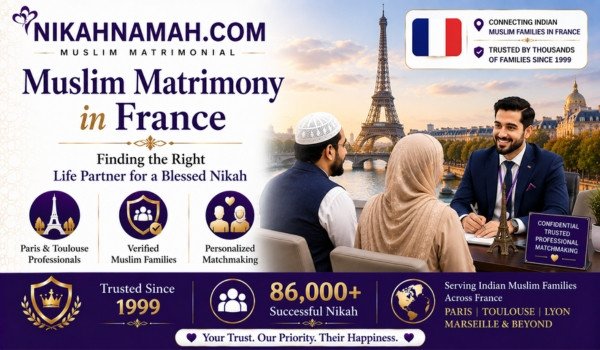
By NikahNamah | India's Most Trusted Muslim Matrimony Platform Since 1999
France occupies an unusual place in the Indian Muslim matrimony landscape – a country with one of Europe's largest Muslim populations overall, and yet one where the specifically Indian Muslim presence is genuinely small, historically distinctive, and easy to misunderstand if approached with assumptions borrowed from the UK or the Gulf.
Most discussions of "Muslim life in France" are really discussions about France's large North African (Maghrebi) Muslim community – a community with its own deep, decades-long history, but a different one from India's. The Indian Muslim presence in France is a separate, smaller, and in some ways older story – tied to France's specific colonial history in Pondicherry, to a more recent wave of IT and engineering professionals, and to France's particularly strict approach to secularism (laïcité), which shapes daily Muslim life there in ways that genuinely differ from Britain, Germany, or the Gulf.
This guide is for Indian Muslim families navigating a France-based proposal, or for France-based Indian Muslims searching for the right life partner – with the specific, honest context that this distinctive corner of the diaspora story requires.
The Indian Muslim Presence in France – A Portrait
A Small Community Within a Larger, Different Muslim France
France is home to one of Western Europe's largest Muslim populations, but this population is overwhelmingly of North African (Algerian, Moroccan, Tunisian) and West African origin, with its own distinct history tied to French colonialism in the Maghreb and decades of post-war migration. Within this much larger Muslim France, the Indian Muslim community is small and easy to overlook – present, but a minority within a minority.
The total Indian community in metropolitan France has historically been estimated in the tens of thousands, a modest figure compared to the UK's hundreds of thousands of Indian-origin residents, and within that modest Indian community, Muslims sit alongside larger Hindu and Christian segments, and a notable Sikh presence as well.
The Pondicherry Connection – France's Distinctive Indian Story
France's relationship with India has a unique colonial dimension that doesn't exist for the UK, USA, or Gulf countries in the same way: Pondicherry (Puducherry) and several other small French trading enclaves in India were French territory until 1954, and at the time of their transfer to India, residents were given a choice between French and Indian citizenship. A significant number chose French nationality, and many of their descendants – along with later migrants from Pondicherry – settled in France, particularly in Paris, where this community has built a lasting presence over multiple generations. While Pondicherry's population is predominantly Tamil and largely Hindu or Christian, this historical migration channel is part of the broader Indian-French story that families should understand, since some Indian Muslim families in France trace their connection to France through exactly this route rather than through recent skilled migration.
Who Is Building a Life in France Today
Beyond the historic Pondicherry connection, the more recent Indian Muslim presence in France includes:
IT and engineering professionals: France's technology and engineering sectors, particularly around Paris and Toulouse (France's aerospace hub), have drawn a modest but growing number of Indian Muslim professionals, often through multinational employers or France's various skilled-worker visa categories.
Postgraduate students and researchers: Indian Muslim students pursue postgraduate study at French universities and grandes écoles, particularly in engineering, business, and the sciences, with France's relatively affordable higher education and post-study work options drawing increasing interest.
Business and finance professionals: A smaller cohort works in Paris's financial and corporate sector, often with prior experience in the UK, Gulf, or India before relocating to France specifically.
Descendants of the Pondicherry migration: Families whose French citizenship traces back to the 1954 transfer of French India, some of whom maintain Muslim faith and Indian cultural identity alongside full French citizenship – a genuinely distinct profile worth understanding on its own terms.
France's Spouse Visa and Residency System – What Families Need to Know
For families in India evaluating a France-based proposal, understanding how French immigration law treats marriage – and how it treats the lesser-known PACS civil partnership – is essential, because the two are treated very differently, and this distinction matters more in France than in most other destinations.
Marriage to a French Citizen or Resident: The Vie Privée et Familiale (VPF) Visa
France's main pathway for a foreign spouse is the Vie Privée et Familiale (VPF) visa and residence permit – literally, "private and family life." For a spouse of a French citizen, this is treated as a right under French law, not a discretionary decision, provided the marriage is genuine and properly documented. The VPF visa allows full work authorization from the outset, is initially issued for one year, and renews toward a longer-term residence card and, eventually, a path to French nationality.
The PACS Civil Partnership – A Different and More Limited Pathway
France also has the PACS (pacte civil de solidarité), a civil union short of marriage that grants some legal and tax benefits. Crucially for matrimony planning, the PACS does not by itself grant a right to a French visa or residence permit the way marriage does – a PACS is taken into account by French authorities but does not guarantee approval, and a non-EU partner can only apply for the VPF residence card after at least one year of documented joint life in France, with the Prefecture retaining discretion over approval. For Indian Muslim families, where marriage (Nikah, followed by registration as appropriate) is the relevant institution rather than a civil partnership, this distinction is largely academic – but it's useful for families to understand why "marriage" carries more legal certainty in the French system than other forms of partnership.
The Practical Sequence
A bride or groom from India marrying a France-based spouse typically applies for the VPF long-stay visa at the French consulate in India, which then functions as a residence permit upon arrival (registration with OFII, France's immigration office, is required within three months of arrival). From there, the holder can work without restriction, and the residence permit renews over subsequent years toward eventual long-term residency and citizenship eligibility.
Important Notes
French immigration procedures, required documentation, and processing times vary by individual circumstance and consulate, and rules are periodically updated. Families should verify current requirements directly through France-Visas (the official French government visa portal) or a registered immigration professional, rather than relying solely on this guide, particularly given how specific and document-heavy the French process can be.
What Makes a France-Based Match Genuinely Different
Laïcité – France's Strict Secularism Is a Real, Distinctive Factor
France's particular approach to secularism (laïcité) is stricter and more actively enforced in public life than in the UK, Germany, or most other Western destinations – including bans on religious symbols, such as headscarves, in public schools and certain public-sector workplaces. For a practising Muslim family evaluating a France-based proposal, this is a genuinely important and distinctive consideration: daily religious practice that would be unremarkable in London or Toronto may require more active navigation in France, particularly around children's schooling and certain public-sector careers. This deserves honest, specific discussion rather than either alarmist exaggeration or being glossed over.
A Reported, Documented Difficulty for Visibly Muslim Professionals
Recent reporting and academic study have documented a pattern of highly qualified French Muslims – often the children or grandchildren of earlier immigrants – choosing to leave France for other countries, citing professional discrimination and a difficult social climate, particularly intensified after the 2015 Paris attacks. This is a real, documented phenomenon that families considering a France-based proposal should be aware of as part of a complete picture – not to discourage a genuine match, but so that any groom's or bride's own experience and outlook on this question can be discussed honestly as part of compatibility.
A Small Community Means Building Connections Takes Intention
Because the Indian Muslim community in France is genuinely small, a France-based Indian Muslim typically builds their primary Muslim community connections within France's much larger and more established Maghrebi Muslim community – through mosques, halal food infrastructure (generally excellent and widely available in France, given the scale of the broader Muslim population), and broader Muslim social and professional networks – rather than within a dedicated Indian Muslim community of meaningful size.
Excellent Halal Infrastructure, Despite the Small Indian-Specific Community
One genuine point in France's favour: because France's overall Muslim population is so large, halal food, mosques, and Islamic practice infrastructure are extensive and easy to access in most French cities – a notably different picture from destinations like Brazil or Argentina, where halal infrastructure is comparatively thin. The "smallness" that applies in France is specifically about the Indian Muslim community, not about Muslim infrastructure generally.
Real Stories: Indian Muslim Families Finding the Right Match in France
Story 1: The Paris Engineer – When the Laïcité Conversation Happened Honestly and Early
Zoya was 29, a structural engineer working for an aerospace-adjacent firm near Paris, on a skilled-worker residence permit, from a Lucknow Muslim family. Her family's previous matchmaking attempts had treated "France" the way they might treat any Western country – glossing over specifics – and Zoya herself had found this frustrating, since her daily experience navigating laïcité (including decisions about how she presented at work) was a real and ongoing part of her life that she wanted any future spouse to understand and engage with, not be surprised by.
NikahNamah's Relationship Manager made this a deliberate, upfront part of every conversation: she described honestly what laïcité meant in practice for Zoya's daily and professional life, and specifically sought families whose son had either direct experience with similar environments or a genuinely open, informed attitude toward discussing it rather than dismissing it as a non-issue.
"Most conversations either ignored this completely or treated it as scary and exotic," Zoya said. "The RM treated it as what it actually is – a real factor, navigable, worth discussing honestly. The family that engaged with that conversation thoughtfully, instead of brushing past it, was the family that turned out to be right for me."
The match was a 32-year-old IT professional from Hyderabad with prior work experience in Germany, whose own cross-cultural professional experience made him genuinely engaged with, rather than alarmed by, the realities Zoya described.
Story 2: The Pondicherry-Connected Family – When Historical Context Made All the Difference
Karim was 33, a French citizen by birth, descended from a Pondicherry family that had opted for French nationality at the 1954 transfer, living in Paris and working in finance, from a family that, while culturally distinctively Indian-French, had been Muslim for generations within that specific community history.
His family's challenge in matchmaking had been straightforward but persistent: most platforms and families in India simply didn't understand the Pondicherry-French citizenship story, often assuming "French citizen" meant a recent migrant or, confusingly, that the family's history was somehow less authentically Indian because of their citizenship.
The Relationship Manager took time to explain this history clearly and respectfully to interested families – the 1954 transfer, the citizenship choice, and what it meant that families like Karim's had maintained Indian Muslim identity and practice across generations while holding French nationality from birth.
"Families kept either being confused by our background or assuming it meant we were 'less Indian,'" Karim's mother said. "The RM was the first person who explained our specific history accurately and presented it as what it is – a distinguished, century-old Indian story, just one that happened to involve French citizenship. That respect made all the difference in how families approached us."
The match was from a Chennai Muslim family with cultural familiarity with Pondicherry's specific history, who engaged with Karim's profile through genuine understanding rather than confusion.
Story 3: The Toulouse Student-Turned-Professional – When Family Sponsorship Honesty Built Trust
Imran was 28, having completed a master's degree in aerospace engineering in Toulouse and subsequently secured a skilled-worker residence permit with a major aerospace employer, from a Bangalore Muslim family. His family wanted a bride who would genuinely understand that his current status, while stable and on a clear path, was not yet the long-term French residency or citizenship that some families assumed "Europe-based" implied.
The Relationship Manager presented Imran's situation with full transparency: his current visa category, his timeline toward longer-term residency, and what the VPF marriage visa pathway would specifically mean for a bride joining him – including the one-year initial visa, the OFII registration requirement, and full work authorization from the start.
"We didn't want any family to think 'France' meant something settled and finished when it was actually a clear, good, but still-developing situation," Imran's father said. "The RM's honesty about exactly where things stood meant the family that said yes understood precisely what they were saying yes to."
The match was a 24-year-old from Bangalore whose own cousin had gone through a similar France relocation process, giving her family a realistic, informed frame of reference for evaluating the proposal.
Testimonials: Indian Muslim Families in France on NikahNamah
"Most conversations either ignored the realities of being a visibly Muslim professional in France or treated it as frightening. NikahNamah's RM discussed it honestly and found a family who engaged with that honesty thoughtfully. That's exactly what was needed." – Engineer, Paris
"Families kept misunderstanding our Pondicherry-French history or assuming it made us less Indian. NikahNamah's RM was the first to explain it accurately and with real respect. That changed everything about how families approached us." – Family of the Groom, Paris
"We didn't want anyone to assume 'France' meant settled and finished when his situation was still developing. NikahNamah's complete honesty about the visa pathway meant the right family said yes with full understanding." – Father of the Groom, Toulouse
"NikahNamah understood that France isn't 'just another Western country' – the laïcité reality, the small Indian Muslim community within a much larger Muslim France, the specific visa system. That granular honesty is rare and made the search genuinely useful." – Indian Muslim Professional, France
How NikahNamah Serves Indian Muslims in France
We explain laïcité honestly, without exaggeration or dismissal. France's strict secularism is a real, distinctive factor in daily Muslim life there, and we discuss it openly with families so that a France-based match is approached with informed eyes, not surprise.
We understand and respect the Pondicherry-French connection. For families with this distinctive history, we present it accurately and with the respect it deserves – a genuine, century-old chapter of the Indian story, not a confusing anomaly.
We communicate France's marriage-versus-PACS visa distinction clearly. The VPF visa as a right for spouses of French citizens, versus the more limited and discretionary PACS pathway, is explained so families understand exactly what legal certainty a marriage provides in the French system.
We're honest about the small Indian Muslim community size, while highlighting France's strong general Muslim infrastructure. Halal food and mosques are widely available in France given its large overall Muslim population – but a specifically Indian Muslim community of meaningful size is not, and we present this distinction clearly.
We present each individual's specific immigration status and timeline. Whether a groom or bride is a French citizen, on a skilled-worker permit, a student visa, or another status, we establish this clearly before serious interest develops, so families understand the realistic path and timeline involved.
For Families in India: The Honest France Picture
France offers a genuinely interesting, distinctive life – but not the same one as the UK or Gulf. Excellent food, culture, and quality of life, alongside a particular social and professional climate around religious visibility that deserves honest engagement rather than assumption.
The Indian Muslim community is genuinely small, even though France's overall Muslim population and Muslim infrastructure (mosques, halal food) is large – the smallness is specifically about Indian-origin community, not about being Muslim in France generally.
Laïcité is a real, distinctive factor worth discussing specifically – not a reason to dismiss a France-based proposal, but a genuine consideration around daily practice, schooling, and certain careers that benefits from honest, specific conversation.
Marriage and PACS are treated very differently under French law – marriage to a French citizen is a right-based visa pathway (VPF); PACS is more limited and discretionary. For Indian Muslim families, marriage (Nikah, properly registered) is the relevant institution, and it carries the stronger, right-based legal pathway.
The Pondicherry-French citizenship connection is a genuine, century-old part of the Indian story for some families, and deserves to be understood and respected accurately rather than treated as confusing or "less Indian."
Frequently Asked Questions: Muslim Matrimony in France
Q: Is there a large Indian Muslim community in France the way there is in the UK or Gulf countries? No – the Indian Muslim community in France is genuinely small, both relative to the UK's much larger Indian Muslim population and relative to France's own much larger Maghrebi (North African) Muslim population. France's broader Muslim infrastructure (mosques, halal food) is extensive, but a dedicated Indian Muslim community of meaningful size is not.
Q: What is the Pondicherry connection, and why does it matter for some France-based proposals? Pondicherry and a few other small territories were French colonial possessions in India until 1954, and residents were given a choice of French or Indian citizenship at that time. Many chose French nationality, and their descendants form a distinctive, multi-generational Indian-French community, particularly in Paris. Some Indian Muslim families in France trace their connection to this specific historical migration rather than recent skilled-worker migration, and this history deserves to be understood and presented accurately.
Q: Does marrying a France-based Indian automatically mean a bride or groom from India can move to France? If the France-based partner is a French citizen, marriage grants a right to the Vie Privée et Familiale (VPF) visa, which functions as a residence permit and allows full work authorization, renewing toward longer-term residency and citizenship. If the France-based partner is not yet a French citizen (e.g., on a skilled-worker permit), the incoming spouse's situation depends on the sponsoring partner's own status, and should be assessed specifically rather than assumed.
Q: What is laïcité, and how does it affect daily Muslim life in France? Laïcité is France's strict approach to secularism in public life, including bans on visible religious symbols (such as headscarves) in public schools and certain public-sector roles. It is more strictly enforced in France than in most comparable Western countries, and is a genuine, distinctive factor that practising Muslim families should discuss honestly when considering a France-based proposal – neither exaggerated nor ignored.
Q: Is a PACS the same as marriage for visa purposes in France? No. Marriage to a French citizen is treated as a right under French law for visa purposes. A PACS (civil partnership) is taken into account but does not guarantee a visa, and a non-EU partner can only apply for residency through PACS after at least one year of documented joint life in France, at the Prefecture's discretion. For Indian Muslim families, marriage (Nikah, properly registered) is the relevant institution and the one that carries the stronger legal pathway.
The Right Partner for France's Distinctive Story
France's Indian Muslim community is small, historically distinctive, and genuinely different from the larger NRI destinations families in India are more used to hearing about. It deserves a matchmaking approach that understands its specifics – the laïcité reality, the Pondicherry-French citizenship history, the marriage-versus-PACS distinction, and the small-but-real community navigating a much larger French Muslim landscape – rather than treating France as simply "another Western country."
At NikahNamah, we provide exactly this – specifically, honestly, and with the particular care that France's distinctive corner of the diaspora story deserves, built on 27 years of NRI matrimony service.
Register for free on NikahNamah today. Whether you are in Paris, Toulouse, or anywhere else in France – or are a family in India considering a France-based proposal for the first time – speak with our team. France's particular chapter of your family's story deserves the right partner to share it.
May Allah bless every Indian Muslim building a life in France – navigating its particular challenges while holding firmly to their faith and their connection to India – and write for each of them a Nikah that brings the companion who is genuinely, specifically, joyfully right for the life they are building. Ameen.
Also Read on NikahNamah Blog
- Germany Based Muslim Grooms: Premium Matrimony Services
- Muslim Matrimony in the UK: Finding the Right Life Partner for Nikah
- Finland Based Muslim Grooms and Brides: Finding the Right Match
- Muslim Matrimony in Australia: A Complete Guide for Families
- USA Based Muslim Grooms: Premium Matchmaking Services
- Explore all NRI Muslim matrimony guides
About NikahNamah
NikahNamah is India's #1 Muslim Matrimony platform, trusted since 1999. With over 86,000 successful Nikah completed and 96,461+ registered members across India, UAE, Saudi Arabia, Qatar, Kuwait, UK, USA, Canada, Australia, Germany, and beyond – we serve Indian Muslims in France with the laïcité-aware, history-informed, visa-specific matrimony guidance that this distinctive corner of the diaspora search requires.
📍 Main Branch: Jayanagar 9th Block, Bengaluru – 560069 📍 Other Branch: Frazer Town, Bengaluru – 560005 📞 +91 98451 30331 | +91 90360 22522 🌐 www.nikahnamah.com | ✉️ support@nikahnamah.com ⏰ Monday to Sunday, 10:00 AM – 8:00 PM IST (Friday Off)

💬 Comments