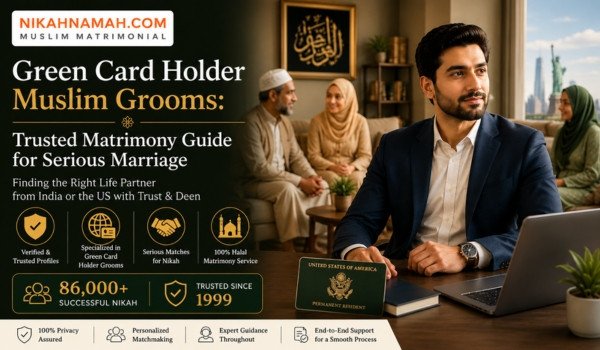
By NikahNamah | India's Most Trusted Muslim Matrimony Platform Since 1999
The Green Card sits in a drawer somewhere — or in a wallet, or in a file folder with other important documents. It has a photo on it that you probably do not love, taken on an unremarkable day, and a number that represents years of paperwork, waiting, and the particular anxiety that only people who have navigated the US immigration system truly understand.
You got it. After the H-1B lottery, the priority date queue, the employer sponsorship or the family petition or the decade-long process that eventually resolved into that single laminated card — you got it.
And now, with Lawful Permanent Residence established and the pressure of immigration status removed from your daily life, a different question arrives with its own weight.
Who will I marry?
Not because you have not thought about it before. You have. But before, the answer was complicated by the immigration timeline — the sense that making a major life decision while your own status in the country was uncertain would be adding difficulty on top of difficulty. Now the immigration complication has been resolved. The path to citizenship is visible. The long-term American future is, for the first time, genuinely settled.
And the matrimony question — which was always present, always important — can finally receive the attention it deserves.
This guide is for that moment.
The Green Card Holder's Matrimony Landscape — What Is Specifically Different
The Status Has Changed — and So Has the Calculation
The difference between a Green Card holder and an H-1B visa holder in the matrimony context is significant and often underappreciated.
An H-1B holder's immigration status is tied to their employer. Their ability to remain in the United States depends on maintaining that specific job. This creates a real, legitimate reason to delay major personal decisions — including marriage — until the immigration situation is more settled. Many Indian Muslims on H-1B visas have experienced this: the matrimony search that was deprioritised not from lack of interest but from the genuine uncertainty of an immigration status that could change.
A Green Card holder's situation is fundamentally different. Permanent residence is not employer-dependent. It cannot be revoked without specific cause. It provides the stability to make long-term personal commitments without the shadow of potential status disruption. For the matrimony search, this matters: a Green Card holder is in the most practical position of any Indian Muslim in the US to make a genuine, fully committed matrimony decision.
The Immigration Timeline for Bringing a Spouse to the US
This is where the practical difference between a US citizen and a Green Card holder matters most in the matrimony context — and it requires honest understanding before the search begins.
For US citizens: Spouses are "immediate relatives" and process through the IR-1 visa pathway with no waiting queue. Processing takes 12-24 months currently (check USCIS for current estimates). K-1 fiancé visa is also available.
For Green Card holders (LPRs): Spouses are in the "F2A" preference category — not immediate relatives. This means they are subject to a preference visa quota, and processing times are longer. Current wait times for F2A can range from approximately 2 to 4 years depending on the applicant's country of birth and the current priority date movement. Check travel.state.gov for the current Visa Bulletin to understand the F2A priority date for India-born applicants.
The critical practical implication: A Green Card holder marrying a spouse in India should expect the spouse to remain in India for a longer period after the Nikah than the spouse of a US citizen would. This is a real, significant consideration that both the groom and the potential bride's family need to understand clearly before the Nikah.
The I-130 petition: The Green Card holder files an I-130 (Petition for Alien Relative) after the Nikah. Once approved, the case enters the F2A preference queue. The bride remains in India (or another country) until the priority date is current and the immigrant visa interview can be scheduled.
Your path to US citizenship: Many Green Card holders are on the path to US citizenship — eligible to apply for naturalization after 5 years of permanent residence (or 3 years if married to a US citizen). Once you naturalize, your spouse's visa category changes from F2A to IR-1, potentially accelerating the process significantly. If citizenship is near, this timeline consideration may shape the matrimony planning strategically.
Always consult a licensed US immigration attorney for advice specific to your individual situation. Check the current Visa Bulletin at travel.state.gov for current F2A priority dates.
Who Specifically This Guide Serves
Green Card holder Indian Muslim men in the United States are not a single, uniform group. Here is the range of people this guide is written for.
The recently approved Green Card holder: You have just received your Green Card — perhaps after years on H-1B, or through the employment-based second preference (EB-2) or third preference (EB-3) category. The immigration stress is resolved. The matrimony question, which you have been deferring, is now fully available for your attention.
The long-term Green Card holder approaching citizenship: You have had your Green Card for several years. Citizenship is approaching — perhaps you are already eligible to apply, or will be within a year. The matrimony search conducted now, timed with the naturalization timeline, may allow you to convert your spouse's visa category to IR-1 before or shortly after the Nikah, which significantly improves the post-Nikah waiting period.
The Green Card holder from a diverse origins program: Some Green Card holders received their status through the Diversity Visa Lottery (DV-1) program — a random allocation program for nationals of underrepresented countries. DV-1 recipients are typically earlier in their US journey and may be weighing the matrimony decision alongside the establishment of their American life.
The Green Card holder who has already been searching: You have been on matrimony platforms or through community channels for some time — perhaps starting the search when you were still on H-1B, perhaps continuing it after the Green Card arrived. The search has produced some leads, some conversations, and perhaps some near-misses, but not the right match yet.
All of these are the people this guide serves.
What Makes the Green Card Holder's Matrimony Search Specifically Challenging
The F2A Timeline Is the Elephant in the Room
For a Green Card holder seeking a bride from India, the F2A visa timeline — potentially 2 to 4 years from the I-130 petition to the immigrant visa interview — is a reality that shapes everything about the search.
A potential bride from India and her family need to understand this clearly and genuinely accept it before the Nikah. A bride who agrees to a Green Card holder match without genuinely engaging with what a 2-4 year post-Nikah separation from her husband involves — a period during which she will be in India, he will be in the US, and they will be conducting a marriage across time zones — is a bride who may find the reality significantly more difficult than she anticipated.
This is not a reason to avoid marrying a Green Card holder. Many Indian Muslim brides and their families specifically seek Green Card holder grooms — understanding that the eventual permanent residence the match leads to is worth the processing timeline. But the timeline must be honestly communicated, genuinely understood, and specifically accepted by both parties before the Nikah.
One strategy some couples pursue: the Green Card holder accelerates his naturalization application (if eligible) so that his status changes to US citizen before or shortly after the Nikah, converting the spouse's visa category to IR-1 and reducing the post-Nikah separation period. If this is your situation, tell your Relationship Manager — it may inform the timing of the matrimony search.
The "Almost US Citizen" Perception
Green Card holders are sometimes perceived by potential brides' families as being in a liminal status — not quite the "settled" security of a US citizen, not quite the precariousness of an H-1B holder. This perception is understandable and somewhat inaccurate — permanent residence is, as its name suggests, permanent.
Your Relationship Manager helps present your status accurately to families — explaining what permanent residence means practically, what it enables, how it differs from H-1B, and what the path to citizenship looks like. Families who understand the status clearly will assess it correctly. Families who remain uncertain are ones whose Relationship Manager will provide additional context.
The India Visit Coordination
Like all US-based NRI grooms, the Green Card holder's most critical logistical challenge is coordinating the matrimony search around limited annual leave. The annual India visit is the primary opportunity for in-person family meetings, and the Relationship Manager's job is to have the right families shortlisted and prepared before the groom arrives — so that the visit produces specific, purposeful outcomes.
For Green Card holders approaching citizenship, there may also be a specific reason to time the matrimony search — and the Nikah itself — relative to the naturalization timeline. A groom who expects to naturalize within the next 12-18 months may choose to begin the search now, time the Nikah to coincide with or shortly after naturalization, and take advantage of the IR-1 visa pathway for his spouse. This strategic timing is something your Relationship Manager can help you think through.
What to Look For — The Qualities That Matter Most
The qualities that make a bride right for a Green Card holder are similar to those for any NRI groom — with one specific addition: the genuine, tested capacity to sustain a long-distance marriage through a multi-year visa process.
Deen — The Foundation
For a Muslim groom who has maintained his Islamic practice in the United States — who prays, who fasts, who has found ways to sustain his faith in a non-Muslim majority environment — finding a wife whose deen is equally genuine and owned is the foundational requirement.
As with all NRI searches, "practicing" is an insufficient answer. The question is whether the practice is genuine, consistent, and personally owned — not environmentally conditioned and likely to attenuate when the Indian family environment is removed.
The Capacity for Long-Distance Marriage
This quality is specific to the Green Card holder's situation, and it deserves honest assessment.
The bride who will sustain a 2-4 year long-distance marriage without resentment, without escalating family pressure to bring her to the US faster, and without the emotional erosion that sustained separation can cause — she has specific characteristics that are visible before the Nikah if you know what to look for.
She has genuine independence — the capacity to build her own life and manage her own circumstances without requiring constant spousal proximity for emotional stability. She has family support for the separation — parents who understand the timeline and who will not put increasing pressure on her to accelerate a visa process that cannot be accelerated. She has her own professional or purposeful engagement — a career, a study program, a role that gives her the structure and meaning during the separation years that the marriage alone cannot provide.
Your Relationship Manager assesses these qualities specifically — looking for brides whose family and personal situation genuinely supports the long-distance marriage that the F2A process requires, rather than brides who agree to it abstractly without having thought it through.
The Enthusiasm for American Life — Tested Not Assumed
Everything discussed in the US Citizen groom's guide applies here too: the bride from India who is moving to America needs to genuinely want that life — not just accept it. For the Green Card holder's bride, this enthusiasm will be tested for 2-4 years while she waits in India for the visa. A bride who is genuinely enthusiastic about the eventual American life will sustain that enthusiasm through the wait. A bride who was primarily motivated by the match itself — and for whom America was secondary — may find the wait period increasingly difficult.
Real Success Stories: Green Card Holder Muslim Grooms Who Found Their Match Through NikahNamah
Story 1: The EB-2 Green Card Holder — When Timing Was Everything
Amir was 33, a data scientist in Seattle. He had received his EB-2 Green Card two months before registering with NikahNamah — after four years on H-1B and a lengthy PERM labor certification process. He was already eligible for naturalization in three years. He was genuinely ready for marriage and — for the first time — in a position where his immigration status was not a complicating factor.
His first conversation with the Relationship Manager was frank. He told her about the F2A timeline — that his wife would likely spend 18-24 months in India after the Nikah before the visa was processed. He wanted families who had genuinely thought through this, not families who would discover it as a surprise.
The RM made this a specific screening criterion. Every family she approached was given accurate information about the F2A timeline before the match was presented to Amir. Families who engaged specifically and thoughtfully — asking about the timeline, discussing how they would support their daughter through the separation, asking about video call schedules and India visit frequency — were the families who moved forward.
The match was from a Hyderabad family. The daughter was a software engineer — working at a Hyderabad tech company — whose professional situation would sustain her meaningfully during the separation period. Her family had a cousin in the United States and had discussed the visa reality specifically before the introduction.
Their first conversation addressed the timeline directly. Both sides were honest. The Nikah was in Hyderabad during Amir's annual leave. His wife continued at her Hyderabad job. The I-130 was filed the week after the Nikah.
He is now completing the naturalization application. His wife's case is progressing through the F2A queue.
"The RM found a family that had done its homework," Amir said. "That homework is what makes the separation sustainable."
Story 2: The Long-Term Green Card Holder — Near Citizenship, Timed It Right
Rashid had had his Green Card for four years when he registered with NikahNamah. He was 35, an engineer in Houston, nine months away from his citizenship eligibility date. His family in Karnataka had been searching on his behalf through community channels with limited success.
His Relationship Manager's first observation was strategic: "You are nine months from citizenship. If we time the Nikah right, you will be a US citizen before or shortly after the wedding — and your wife's visa category changes from F2A to IR-1. This could cut the post-Nikah processing time significantly."
Rashid had not thought about this specifically. The RM had.
They designed the search accordingly: active proposal development in the next six months, with the formal meeting and Nikah timed to coincide with either his citizenship approval or the period shortly after. The RM managed the India-side search from Bangalore, coordinating with Rashid's Karnataka family while he remained in Houston.
The match emerged four months into the search — from a Mangalore family, a practicing woman from a Karnataka Muslim family whose brother had been in the US for years and who understood the American situation from personal family experience.
Rashid's citizenship application was approved two weeks before the Nikah. His wife's visa was filed as an IR-1 — immediate relative of a US citizen — rather than F2A. The processing timeline was significantly shorter.
"The RM turned my citizenship timing into a matrimony strategy," Rashid said. "That thinking found me the right wife at exactly the right moment."
Story 3: The Second Marriage — Green Card, New Beginning
This story belongs to a 37-year-old divorced Green Card holder in New Jersey — a marketing professional from a Hyderabad Muslim family who had been through a difficult first marriage that had ended two years earlier.
He came to NikahNamah specifically because he needed confidentiality. His professional profile was partially public. The New Jersey Indian Muslim community was close-knit enough that his search becoming known prematurely was a genuine concern. And his divorce, while legally clear and well-documented, needed to be handled with specific sensitivity in the search.
NikahNamah's confidential second-marriage service addressed all of these concerns. His profile was shown only to families who were specifically open to second marriages. The divorce was disclosed at the appropriate stage, with the RM's specific guidance on framing and timing. His Green Card status was presented accurately — with honest explanation of the F2A timeline for a second-marriage match.
The match was from a Hyderabad family — a 33-year-old divorced woman whose own first marriage had been brief. Both families had processed their respective divorces with equanimity. Both parties had genuine, honest readiness.
Their first conversation addressed both the divorce and the immigration timeline directly — because the RM had structured it to. Neither side was surprised. Both sides were genuinely comfortable.
The Nikah was quiet and right.
Story 4: The DV Lottery Green Card Holder — Building a Life With a Foundation
Omar was 29 — a recent DV-1 Green Card holder who had won the Diversity Visa Lottery from India and had been in the United States for two years. He was building his American life from a relatively early stage — establishing his career, his housing, his professional trajectory. He was also, in the middle of this building, thinking seriously about marriage.
His Relationship Manager was honest with him at the start: "Your situation is earlier in the US journey than many of our members. Let us think together about what kind of match makes sense for where you are right now."
They discussed it honestly. Omar wanted a wife from India — from his Karnataka Muslim community. He was clear that the F2A timeline was a reality he could not change, that his current income was modest but growing, and that he was committed to building something real rather than something that looked impressive on a profile.
The RM found the match in a Karnataka family who valued exactly what Omar had to offer: genuine deen, honest character, clear direction, and a sincere commitment to the marriage despite the immigration complexity. The potential bride's family was a modest, practicing Karnataka Muslim family who had no illusions about Green Card glamour and every intention of making the marriage work from a foundation of character.
The Nikah was in Karnataka during Omar's annual India visit. His wife remained in India in their Karnataka household while he worked in America and the F2A petition moved forward.
"The RM did not try to make my situation look better than it was," Omar said. "She found a family that valued what it actually was. That honesty is what found me the right match."
Testimonials: What Green Card Holder Muslim Grooms Say About NikahNamah
"The Relationship Manager made the F2A timeline a screening criterion from the beginning — finding families who had genuinely thought it through rather than families who would discover it as a surprise after the Nikah. That preparation is what makes the separation sustainable." — Data Scientist, Seattle
"I was nine months from citizenship eligibility. The RM turned that timing into a matrimony strategy — timing the search and the Nikah so that my citizenship was approved before the wedding and my wife's case filed as IR-1 instead of F2A. I had not thought about this. She had." — Engineer, Houston
"NikahNamah's second-marriage service gave me the confidentiality I needed as a divorced Green Card holder in New Jersey. My divorce was handled with specific sensitivity. The F2A timeline was explained honestly to the match's family. Both complications were managed professionally, not glossed over." — Marketing Professional, New Jersey
"The RM did not dress up my situation. She presented it honestly — DV Green Card, early in the US journey, modest income, real commitment. She found a family that valued the honest reality rather than a manufactured impression. That family and their daughter were the right match." — DV-1 Green Card Holder, Karnataka-origin, USA
"NikahNamah explained what a Green Card holder's status means — permanent, stable, the path to citizenship — to families in India who were uncertain about the difference between a Green Card and an H-1B. That explanation changed how families engaged with my profile." — IT Professional, Chicago
How NikahNamah Specifically Serves Green Card Holder Muslim Grooms
We explain the Green Card accurately to families in India. Many families in India are uncertain about the practical difference between a Green Card and an H-1B visa, and between a Green Card and citizenship. Your Relationship Manager explains the Green Card specifically — permanent residence, employer independence, the path to citizenship — so that families engage with your status from an accurate understanding rather than confusion or assumption.
We make the F2A timeline a transparent, upfront discussion. We do not let this be a surprise. Before any match progresses to a serious stage, the F2A timeline is accurately communicated to the potential bride's family — what it involves, what the typical processing duration is, what it requires of a bride waiting in India, and what support structures need to be in place. Families who engage with this honestly are the right families to take forward.
We assess bride-readiness for long-distance marriage specifically. The capacity to sustain a 2-4 year long-distance marriage is a specific quality that your Relationship Manager specifically looks for in every proposed match — assessing independence, professional engagement, family support, and genuine enthusiasm for the eventual American life.
We advise on citizenship timing when relevant. For Green Card holders approaching citizenship eligibility, your Relationship Manager can help think through how the naturalization timeline intersects with the matrimony timeline — potentially enabling a Nikah that is timed to coincide with citizenship, improving the spouse's visa pathway.
We manage the full India-US coordination. Every logistical complexity of the NRI matrimony search — the time zone gap, the India visit coordination, the family communication across geographies, the India-side search management — is handled by your Relationship Manager. You focus on the decisions that require you.
We serve every Indian Muslim community. Whether you are from Karnataka, Kerala, Hyderabad, Gujarat, UP, or any other Indian Muslim background — our Relationship Managers know your community's matrimony norms and match accordingly.
A Practical Roadmap: The Green Card Holder's Matrimony Search
Step 1: Understand your immigration timeline clearly. Know your current Green Card issue date, your citizenship eligibility date, and the current F2A priority date for India-born applicants (check the Visa Bulletin at travel.state.gov). Share this information with your Relationship Manager. It informs the search strategy — particularly whether timing the Nikah relative to your citizenship application makes strategic sense.
Step 2: Plan your India visit. Identify your next India visit or plan one specifically for the matrimony process. Your Relationship Manager will plan the search timeline to have shortlisted, primed families ready for your visit window.
Step 3: Be honest about the F2A timeline. Do not let this be a surprise for anyone. Your Relationship Manager will ensure the timeline is communicated to potential match families before the match progresses. Your job is to be honest about it upfront and consistent in your account of it.
Step 4: Register with NikahNamah and brief your Relationship Manager completely. Your community background, your deen and level of practice, your Green Card status and citizenship timeline, your current income and trajectory, your India visit timing, your requirements for the match, and any second-marriage or other specific considerations. Completeness produces quality.
Step 5: Trust the RM's specific screening of F2A readiness. Your Relationship Manager's most important specific job for your search is identifying families who have genuinely thought through the F2A reality. Trust her assessment of this. Families she brings forward have been screened for it. Those she sets aside have not passed this specific test.
Frequently Asked Questions: Green Card Holder Muslim Grooms
Q: What is the F2A visa category and what does it mean for my matrimony search?
F2A is the preference visa category for spouses of Lawful Permanent Residents (Green Card holders). Unlike the spouses of US citizens (who are "immediate relatives" with no quota), F2A applicants are subject to annual visa number limits. This creates a waiting period — currently approximately 2 to 4 years for India-born applicants — between the filing of the I-130 petition and the visa interview. Check the current Visa Bulletin at travel.state.gov for the current F2A priority date for India. Always consult a licensed US immigration attorney for advice specific to your situation.
Q: Should I wait until I have US citizenship before beginning the matrimony search?
Not necessarily — and the answer depends on where you are in the citizenship timeline. If citizenship is 3-4 years away, waiting that long may not make sense. If citizenship is 6-12 months away, timing the Nikah to coincide with naturalization is a strategy worth considering. Your Relationship Manager can help you think through this specifically based on your individual timeline.
Q: How does NikahNamah ensure that potential match families understand the F2A timeline?
Before any match progresses to a serious stage, your Relationship Manager specifically communicates the F2A reality to the potential bride's family. She does not leave this for the families to discover themselves. Families who engage thoughtfully and specifically with this information — asking about the timeline, discussing how they would support their daughter during the separation period — are the families she takes forward. Families who acknowledge it vaguely without genuine engagement are ones she approaches with additional probing before proceeding.
Q: Can I search within the US as well as in India?
Yes. For Green Card holders who prefer to find a bride already in the US — another Indian Muslim woman settled in America — NikahNamah's US membership includes active verified members across all major American cities. An within-US match eliminates the F2A process entirely. Tell your Relationship Manager your preference — India only, US only, or both — and the search will be targeted accordingly.
Q: I am a Green Card holder who was also divorced. Does this significantly complicate the search?
Both dimensions — the Green Card status and the divorce — require honest communication and specific handling. NikahNamah's second-marriage service specifically addresses the divorce dimension. Your Relationship Manager handles both the divorce disclosure and the F2A timeline communication professionally and sensitively. The combination is more specific than either alone, but it is handled regularly by our experienced Relationship Managers.
Q: How long does the matrimony search typically take for Green Card holder members?
Most NikahNamah premium members with a dedicated Relationship Manager receive their first curated proposals within 2-4 weeks. A completed Nikah typically follows within 5-9 months. The India visit timing and the Nikah-to-citizenship strategic timing (where relevant) are the variables that most affect the timeline for Green Card holder members specifically.
The Green Card Was the Hard Part. The Right Match Is Worth Taking Your Time.
The Green Card took years. The H-1B lottery. The priority date waiting. The PERM process or the family petition or the DV lottery chance that eventually came through. The particular relief — after all of it — of receiving the laminated card and knowing that this part, at least, is settled.
The matrimony search deserves at least the same quality of serious, patient, well-prepared effort that got you the Green Card. Not because it is as complicated — it is not. But because it matters at least as much. Because the right wife, found carefully, with the right support, at the right time — is the addition to your American life that completes what the career and the immigration status cannot.
At NikahNamah, we have been helping Green Card holder Indian Muslims in America find exactly this — for 27 years, 86,000+ completed Nikah, across every Indian Muslim community and every American city.
Register for free on NikahNamah today. Speak with our team. Tell us where you are in the immigration journey and what you are looking for. The search begins when you are ready. We will be specific, honest, and with you every step of the way.
May Allah ease what is difficult, reward what was patient, and write a Nikah for every Green Card holder Muslim groom that builds the home where the journey — all of it, the immigration and the search and the waiting — finally arrives at its right destination. Ameen.
Also Read on NikahNamah Blog
- US Citizen Muslim Grooms Matrimony: Finding the Right Bride from India
- Muslim Grooms Matrimony: How to Find the Right Life Partner in 2026
- Best Muslim Matrimony for Divorce in USA: A Complete Guide to Second Marriage
- Professional Muslim Grooms Matrimony: Finding a Match While Building a Career
- How to Find the Perfect Muslim Life Partner: A Complete Guide
- Benefits of Choosing a Personalized Matchmaking Platform for Nikah
- From Profile to Nikah: Real Success Stories of Muslim Couples Who Found Love Through NikahNamah
- Muslim Matrimony in New York City — NikahNamah
About NikahNamah
NikahNamah is India's #1 Muslim Matrimony platform, trusted since 1999. With over 86,000 successful Nikah completed and 96,461+ registered members across India, UAE, Saudi Arabia, Qatar, Kuwait, UK, USA, Canada, and beyond — we serve Indian Muslim Green Card holders across every American city with the same depth of personalised, community-aware, immigration-context-savvy matchmaking that has made us the most trusted Muslim marriage bureau for the Indian Muslim diaspora.
📍 Main Branch: Jayanagar 9th Block, Bengaluru – 560069
📍 Other Branch: Frazer Town, Bengaluru – 560005
📞 +91 98451 30331 | +91 90360 22522
🌐 www.nikahnamah.com | ✉️ support@nikahnamah.com ⏰ Monday to Sunday, 10:00 AM – 8:00 PM IST (Friday Off)

💬 Comments