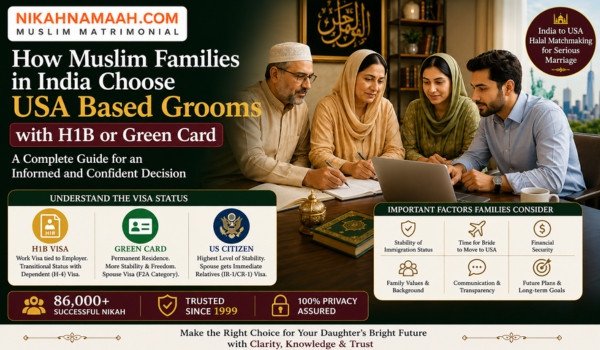
By NikahNamah | India's Most Trusted Muslim Matrimony Platform Since 1999
The proposal arrives from America.
The family considers it - carefully, cautiously, with the mixture of genuine interest and genuine uncertainty that defines the experience of a Muslim family in India receiving a matrimony proposal from a groom based in the United States.
The groom is from a known community. His family is respectable. He is educated - an engineer, perhaps, or a doctor or an IT professional - and he has built what appears, from this distance, to be a good life in America. His parents are here in India. His profile says H-1B visa. Or Green Card. Or, perhaps, US citizen.
And the family sits with the proposal, asking the questions that every family in this situation eventually asks. What does H-1B actually mean? Is the situation stable? What happens after the Nikah - when does their daughter go to America? What kind of life will she have there? How often will they see her? What if something goes wrong?
These are not small questions. They are the right questions. And they deserve honest, complete, specific answers - not the vague reassurances that sometimes substitute for real information in matrimony conversations, but the actual truth about what each visa status means, what the immigration timeline looks like, and what a daughter's life in America will realistically involve.
This guide is for every Muslim family in India navigating exactly this situation. Not to tell you to say yes or no. To give you the information you need to make the right decision for your daughter - with clarity rather than confusion, and with confidence rather than anxiety born from the unknown.
Part 1: Understanding the Visa Statuses - What They Actually Mean
Before anything else, the practical reality of what each immigration status means for your daughter's future.
H-1B Visa - What Every Indian Family Should Know
The H-1B is a non-immigrant work visa that allows skilled foreign workers to work in the United States for a specific employer. It is the most common path for Indian IT professionals, engineers, and other skilled workers who come to the US.
What it means practically:
- The H-1B is tied to the groom's employer. If he loses his job or changes employers, he must find a new H-1B sponsor or leave the country. This creates a degree of employment dependency that permanent residence does not have.
- The H-1B is granted in 3-year periods, renewable up to 6 years (and sometimes longer for those in the Green Card queue). It is not indefinite in itself - the groom is in the US legally and may remain as long as he maintains the visa requirements.
- An H-1B holder is in the US legally but in a transitional status. Most H-1B holders are working toward permanent residence (Green Card) - either through employer sponsorship (EB-2 or EB-3 categories) or through family petition. The timeline to Green Card can range from a few years to well over a decade, depending on the visa category and the applicant's country of birth.
- India-born applicants face the longest Green Card wait times of any country due to high demand and per-country limits. For EB-2 and EB-3 categories, the wait for Indian nationals has historically been extremely long - in some cases many years. This means an H-1B holder from India may remain on H-1B status for many years before receiving a Green Card.
What this means for your daughter:
If your daughter marries an H-1B holder, she would come to the US on an H-4 dependent visa. The H-4 allows her to live in the US as a dependent of the H-1B holder. H-4 holders may or may not have work authorization - the H-4 EAD (Employment Authorization Document) has been subject to policy changes and legal challenges in the US. Check current policy at uscis.gov, or consult an immigration attorney for the current status of H-4 EAD.
The key practical implication for families: An H-1B groom is in a legitimate but transitional status. His ability to remain in the US is employment-dependent. This does not mean he will leave - the vast majority of H-1B holders continue to renew and eventually receive permanent residence. But it does mean his situation is not yet permanently settled in the way that a Green Card or citizenship provides.
Questions to ask an H-1B groom:
- What is your employer sponsoring you for - are they filing for your Green Card? If so, what category (EB-2, EB-3) and what is your priority date?
- What is the current estimate for when your Green Card might be approved?
- What would happen if you changed employers - do you have a backup plan for maintaining status?
- Is your employment situation stable? How long have you been with your current employer?
Green Card - What It Means to Have Permanent Residence
The Green Card (Lawful Permanent Resident status) is a significantly more settled status than H-1B. It represents permanent residence - the right to live and work in the United States indefinitely, without employment dependency.
What it means practically:
- A Green Card holder can work for any employer, can change jobs freely, and cannot lose his US residence simply by changing employment. His presence in the US is not tied to any specific job.
- The Green Card is "permanent" in a meaningful sense - it does not expire with employment, and it can only be revoked in specific, narrowly defined circumstances.
- A Green Card holder is eligible to apply for US citizenship after 5 years of permanent residence (or 3 years if married to a US citizen). Citizenship is the final, irrevocable step - once naturalised, the groom is a US citizen permanently.
What this means for your daughter:
If your daughter marries a Green Card holder, she would need a spouse visa to come to the United States. Here is the important distinction:
- Spouses of Green Card holders (LPRs) are in the F2A preference category - not the same as the spouses of US citizens. F2A applicants wait in a preference queue, and for India-born applicants, this wait can be approximately 2 to 4 years.
- This means your daughter would marry in India, and then wait - in India - for approximately 2 to 4 years before her visa is processed and she can join her husband in the US.
- During this period, the couple would be in a long-distance marriage - conducting their relationship across time zones, meeting during the groom's annual India visits, and managing the particular emotional and practical demands of a marriage at distance.
- If the Green Card holder naturalises to US citizenship before or shortly after the Nikah, his spouse's category changes to "immediate relative" (IR-1), which processes significantly faster and without a quota wait.
Questions to ask a Green Card groom:
- When did you receive your Green Card? What category was it issued through?
- Are you approaching citizenship eligibility (5 years of permanent residence)? If so, are you planning to apply?
- Have you looked at the current F2A priority date for India? What does the timeline look like for our daughter's visa?
- What support would you provide for our daughter during the visa processing period - income, communication, frequency of India visits?
US Citizen - The Most Settled Status
A US citizen groom's spouse is an "immediate relative" - there is no quota wait and processing is simply a matter of documentation and the current processing time (approximately 12-24 months currently for the IR-1 spousal visa).
What this means for your daughter:
The IR-1 visa process is the most straightforward pathway - no priority date queue, faster processing relative to F2A, and upon arrival the spouse receives Green Card status. The K-1 fiancé visa (where the daughter comes to the US before the Nikah and marries within 90 days) is also available to US citizens.
Questions to ask a US citizen groom:
- Are you a naturalised citizen or a citizen by birth?
- What is the current IR-1 processing time from your state, and have you looked at the USCIS website for current estimates?
- Do you have a preference for K-1 (Nikah in the US) or IR-1 (Nikah in India)?
Part 2: The Real Questions Every Indian Family Should Ask
Beyond the immigration status, the questions that actually determine whether a USA-based groom is the right match for your daughter.
About the Life She Will Have in America
1. What city is he in, and what does that city's Indian Muslim community look like?
Not all US cities are equal for Indian Muslim family life. New York and New Jersey have large, established Indian Muslim communities with active mosques, halal food, Indian Muslim social circles, and a community infrastructure that can provide genuine support to a new bride. A city like Seattle or Denver may have a smaller, more dispersed Indian Muslim community where your daughter will need to build her own support network more independently.
Ask specifically: Is there a masjid near where he lives? Are there other Indian Muslim families in the area? What does a typical week's Islamic community engagement look like?
2. What does his daily life look like, and what will hers look like?
A husband who works 60-hour weeks in a demanding tech or finance role is a husband who will be significantly absent during working hours. What does your daughter's life look like during those hours - does she have work authorization and the interest to work? Will she be at home? What social engagement will she have? How far is she from any Indian Muslim community?
This is not a criticism of demanding professions. It is a practical assessment of whether your daughter's personality and temperament are suited to the specific daily life that this marriage involves.
3. How often will he visit India, and how will family connection be maintained?
US-based Indian Muslims typically have 2-3 weeks of annual leave. India flights from the US take 16-22 hours. The reality is that frequent India visits are genuinely difficult - and the expectation that your daughter will see her family in India frequently requires honest discussion rather than optimistic assumption.
Ask specifically: How often has he visited India in the past two years? What is his realistic expectation of annual India visits after marriage? Can he commit to a specific minimum frequency?
4. How does he maintain his Islamic practice in America?
This is a foundational question. The United States is a non-Muslim majority country with a secular social culture. The Muslim man who maintains genuine Islamic practice in this environment - who prays, who maintains halal food, who participates in the mosque community - has made a deliberate choice to do so. The man whose practice has attenuated because American life makes it easier to drift has made a different choice.
Ask specifically: What is his daily prayer routine? Does he attend Friday prayer? What mosque does he attend? How does he manage halal food? What is his relationship with his Islamic identity in the American context?
About His Character and Intentions
5. How does he speak about his parents and family?
A man's relationship with his parents tells you something real about his character - how he values family, how he handles obligation and gratitude, how he treats people who are in a position of dependence on him. A man who speaks about his parents with warmth and genuine connection is different from one who speaks about them with distance or obligation. This difference will appear in how he relates to your daughter's family as well.
6. How has he handled difficulty in his life?
The immigration journey - the H-1B lottery, the priority date wait, the professional establishment in a foreign country - has involved genuine difficulty for most US-based Indian Muslim men. How has he handled it? With equanimity and resilience? With bitterness or anxiety? The character that emerges under difficulty is the character your daughter will live with.
7. What is his vision for the marriage and the household?
Not in generic terms - specifically. Where does he want to live long-term? Does he plan to return to India eventually, or is America his permanent home? How does he envision the household's Islamic identity? How does he think about raising children in America with Islamic values? What is his expectation of your daughter's role - is he open to her working, or does he expect a more traditional household structure?
These questions are not confrontational. They are the information your family needs to make an informed decision.
About Your Daughter's Specific Fit
8. Does your daughter genuinely want to live in America?
This is the most important question of all - and it is about your daughter, not the groom.
There is a difference between a daughter who is enthusiastic about building an international life, who has thought about what living in America involves, who has the independence and adaptability to build a life in a new country - and a daughter who is agreeing to America because the match is otherwise suitable and her family is supportive.
Both situations exist. But they have meaningfully different outcomes. A daughter who genuinely wants the American life will thrive in it. A daughter who is primarily agreeing to it may find the distance, the independence required, and the cultural adjustment significantly more difficult than anticipated.
Have an honest conversation with your daughter about this - not to discourage her from the match, but to ensure she is making a genuinely informed and genuinely willing decision.
9. Does your daughter have the practical capacities that American life requires?
Life in America - particularly for a new bride in the early period before the visa is established and before a support network is built - requires a degree of practical independence that life in an Indian joint family does not necessarily develop. Can she cook and manage a household independently? Can she navigate unfamiliar systems? Can she manage loneliness and isolation periods - particularly in the months after arrival, before she has built relationships in the new country?
These are not judgments. They are honest questions that determine whether the match is genuinely set up for success.
Part 3: What NikahNamah Does to Support Indian Families Through This Search
The matrimony search involving a USA-based groom presents specific challenges for Indian families that NikahNamah is specifically equipped to address.
We explain the immigration status accurately. Your Relationship Manager will explain the specific immigration status of any proposed groom - H-1B, Green Card, US citizen - in terms that are honest and specific rather than optimistic and vague. The F2A timeline for a Green Card holder's spouse, the employment dependency of H-1B, the stability of Green Card versus visa - these realities are communicated clearly before your family invests emotionally in a match.
We prepare the groom's side for the family's genuine questions. The NikahNamah Relationship Manager works with both families. We ensure that the USA-based groom and his family have provided honest, specific answers to the immigration and lifestyle questions before the formal family meeting - so the meeting is a genuine conversation, not a management of uncertainties.
We assess the "life your daughter will have" dimension specifically. For every USA-based groom profile we propose to an Indian family, we have specifically looked at the city, the community infrastructure, the groom's daily life, his Islamic practice, and what your daughter's daily life in that situation would realistically look like. We present this picture accurately - not as a promotional narrative, but as the honest information your family needs.
We help your daughter assess her genuine readiness. Your Relationship Manager can facilitate a specific, honest conversation with your daughter about her genuine readiness for American life - not to discourage her, but to ensure her decision is genuinely informed and genuinely willing.
We coordinate the logistics across the India-US time zones. All family calls, video introductions, and coordination between the Indian family and the USA-based groom are managed by your Relationship Manager - scheduled at times that work for both sides, with follow-up managed professionally.
Real Stories: Indian Muslim Families Who Navigated the USA Groom Search Through NikahNamah
Story 1: The Karnataka Family - Clarity Before Yes
The family was from Bangalore - a practicing Karnataka Muslim family with a 25-year-old daughter who was a graduate and had never lived outside Karnataka. A proposal came from an H-1B holder in New Jersey - an IT professional from a compatible community, practicing, from a good family.
The family was interested. But they had never navigated a USA-based matrimony proposal before and did not know what questions to ask.
Their Relationship Manager walked them through the H-1B reality specifically: the employer dependency, the Green Card timeline (the groom's employer had filed an EB-3 petition and the priority date was approximately three years away), the H-4 visa for their daughter, the H-4 EAD situation, and what their daughter's daily life in New Jersey would realistically look like.
She also asked the family a question they had not thought to ask themselves: "Has your daughter ever lived independently - away from the family? Does she have the temperament for it?"
The family's honest answer was no - their daughter had never lived away from home and was not someone whose temperament was particularly independent.
The Relationship Manager's advice was direct: "This is not a reason to say no to this particular groom. It is a reason to have a very honest conversation with your daughter about what the first six months to a year in New Jersey will look like - and whether she has the genuine desire and capacity to build that life."
The conversation happened. Their daughter was honest: she was uncertain. She liked the groom and his family. She was less certain about America.
The family went back to the Relationship Manager. She suggested two things: more time for the daughter to genuinely reflect, and one specific question for the groom - how would he specifically support his wife in the adjustment period? What did that support look like in practice?
The groom's answer was specific and thoughtful. He described the New Jersey Indian Muslim community, the mosque ten minutes from his apartment, the Indian grocery store nearby, the two-week India visit he took every year and would continue to take, and his commitment to his wife's wellbeing as a primary responsibility.
The family said yes. The daughter said yes - genuinely, after honest reflection. The Nikah was in Bangalore. Their daughter is now in New Jersey, has been for eight months, and is, by her own account, building a life she is genuinely glad to be building.
Story 2: The Hyderabad Family - When the Right Questions Changed the Decision
A Hyderabad Muslim family received a proposal from a Green Card holder in California - an engineer, from a Hyderabad family, 31 years old, genuinely practicing. Everything about his profile was positive.
What they did not know - and what they needed to know - was the F2A timeline. When the Relationship Manager explained that, as a Green Card holder, their daughter's visa processing would take approximately 2-3 years after the Nikah - meaning their daughter would spend 2-3 years in a long-distance marriage, in Hyderabad, waiting - the family's reaction was immediate uncertainty.
The Relationship Manager did not dismiss this concern. She validated it: "This is a legitimate consideration. Let me give you the full picture - and also tell you what I know about this specific groom's situation."
The specific information: the groom was 31 months into his Green Card status. He was planning to apply for citizenship at the 5-year mark - 21 months away. If the Nikah happened within the next six months, his citizenship might be approved before or shortly after the wedding - converting his wife's visa category from F2A to IR-1 and significantly shortening the processing time.
The groom's own Relationship Manager - who was working the California side of the search - confirmed that the groom had been specifically advised about this timing and was planning his matrimony search with it in mind.
The family's decision changed. The citizenship timing strategy was not something they had known to ask about. NikahNamah's knowledge of the immigration landscape - and the Relationship Manager's honesty in presenting all relevant information - had turned a family's uncertainty into a specific, actionable understanding.
The Nikah was in Hyderabad. The groom applied for citizenship two months later. His wife's visa was processed as an IR-1 - immediate relative - rather than F2A. She joined him in California within a significantly shorter timeline than the family had originally anticipated.
Story 3: The Kerala Family - When No Was the Right Answer
Not every USA groom proposal ends in yes - and that is as it should be.
A Kerala Muslim family received a proposal from an H-1B holder in Chicago. The groom was from a respectable family. His Islamic practice was genuine. His professional situation was stable.
But when the Relationship Manager spoke with the family in detail, a specific picture emerged: the groom was in Chicago's tech sector, worked long hours, lived in a neighborhood with a small Indian Muslim community, and had not visited India in two years. The daughter was deeply connected to her extended family in Kerala, had never lived far from them, and had specifically told her Relationship Manager that family proximity was very important to her.
The Relationship Manager's assessment was honest: "This is not a question of character. This groom is a good man. The question is whether your daughter's specific needs - family proximity, community connection, the kind of life she has described wanting - are compatible with the specific life this groom's situation offers."
The family discussed it with their daughter. Her honest answer was that she was not sure she wanted to live so far from her family - and that Chicago's Indian Muslim community situation, as described, was not what she had been imagining.
They declined the proposal - respectfully, with genuine appreciation for the groom and his family. The Relationship Manager helped them articulate the decline in a way that was honest and kind.
Six months later, the same daughter was matched with a groom from a Gulf-based family - much closer to India, with frequent India visits, in a location with a large Kerala Muslim community. That match worked in every dimension that the Chicago match had not.
The Relationship Manager's willingness to give honest assessments - including assessments that led to a no - was the specific thing the family credited for eventually finding the right match.
Testimonials: Indian Muslim Families Who Navigated USA Groom Matrimony Through NikahNamah
"We had never navigated a USA-based matrimony proposal before and did not know what to ask. NikahNamah's Relationship Manager explained H-1B, the Green Card timeline, the H-4 visa, what our daughter's life in New Jersey would look like - all of it, specifically and honestly. We made our decision with real information, not assumptions." - Muslim Family, Bangalore, Karnataka
"The F2A timeline was something we did not know to ask about. When the RM explained that our daughter would spend 2-3 years in a long-distance marriage after the Nikah, we were uncertain. She then told us about the citizenship timing - that this specific groom was 21 months from eligibility and could convert our daughter's visa to IR-1. That complete picture changed our decision." - Muslim Family, Hyderabad, Telangana
"NikahNamah's RM helped us see that the right answer was sometimes no - and helped us say no kindly. The Chicago proposal was not the right life for our daughter. Six months later, the right match emerged. The RM's honesty about the Chicago situation is what led us to the right one." - Muslim Family, Kerala
"We asked our RM to explain what a US citizen's matrimony proposal means vs a Green Card holder's vs an H-1B holder's. She gave us a clear, simple explanation of each - the stability, the timeline for our daughter's visa, what each status means for our daughter's life. That clarity is what every family in our situation needs." - Muslim Family, Tamil Nadu
"Our daughter had never lived independently. The RM asked this question specifically before we got too invested in a USA proposal. It led to the most honest conversation we had had with our daughter about her genuine readiness for that life. The conversation was more valuable than the match itself." - Muslim Family, Mysore, Karnataka
The Complete Checklist: Questions for Indian Families Evaluating a USA-Based Groom
Use this as your practical guide - for the family conversations, for the questions to the groom and his family, and for the honest conversation with your daughter.
About Immigration Status:
- What is his current visa status - H-1B, Green Card, or US citizen?
- If H-1B: Is his employer filing for his Green Card? What category? What is the estimated timeline?
- If Green Card: When was it issued? When is he eligible for citizenship? What is the current F2A priority date for India?
- If US citizen: Is he a naturalised citizen? What is the current IR-1 processing timeline?
About the Life Your Daughter Will Have:
- What city is he in? What is the Indian Muslim community like there?
- How far is the nearest mosque from where he lives?
- What does his daily and weekly schedule look like?
- How often has he visited India in the past two years? What frequency does he commit to going forward?
- What will your daughter's daily life look like - does she have work authorization? What social engagement will she have?
- How far is she from any Indian Muslim community? What community does he participate in?
About His Character and Islamic Practice:
- How does he maintain his Islamic practice in America - does he pray consistently, attend Friday prayer, maintain halal food?
- How does he speak about his family and parents? What is his relationship with them?
- What is his vision for the household's Islamic identity and the Islamic raising of children?
- What does he envision for his wife's role - working, household, or both?
About His Stability and Plans:
- Is his employment situation stable? How long has he been with his current employer?
- Does he plan to stay in America permanently, or does he have a long-term return plan?
- What support does he commit to providing during the visa processing period?
About Your Daughter:
- Has your daughter ever lived independently away from family?
- Does she genuinely want to live in America - is this her choice, or primarily her family's?
- Does she have the practical independence that American life requires?
- Has she spoken to any Indian Muslim women who have made the same transition, to understand the reality from someone who has lived it?
Frequently Asked Questions for Indian Families
Q: Is an H-1B groom a risky choice compared to a Green Card holder?
H-1B is a legitimate and common status for accomplished Indian professionals in the US. The risk is not inherent to the visa itself - it is in the employment dependency it creates. An H-1B holder who has been with a stable employer for several years, whose employer is sponsoring his Green Card, and who has a specific timeline to permanent residence is not a high-risk proposal. An H-1B holder in an unstable employment situation, without a clear Green Card path, is a riskier proposition. Ask the specific questions and assess the specific situation rather than the status category alone.
Q: How long will our daughter have to wait to go to America if she marries a Green Card holder?
Currently, for India-born applicants in the F2A preference category, the wait is approximately 2 to 4 years from the filing of the I-130 petition to the immigrant visa interview. This changes based on the Visa Bulletin's monthly priority date movement - check travel.state.gov for current estimates. If the Green Card holder is approaching citizenship eligibility, the timeline may be significantly shorter if the Nikah is timed strategically with the naturalization.
Q: Is it safe for our daughter to go to America alone after marriage to join her husband?
This question is asked with genuine concern, and it deserves a genuine answer. Thousands of Indian Muslim women have made this transition - and the vast majority have built good lives in America. The specific factors that make it safer and more successful: a husband who is genuinely committed to his wife's wellbeing and adjustment, a city with an Indian Muslim community, a mosque nearby, other Indian Muslim women in the community who can be sources of support, and a daughter who has the practical independence and genuine desire for this life. These factors are assessable before the Nikah and are specifically things NikahNamah's matching process looks at.
Q: What if our daughter finds America difficult and wants to come home?
This is a real risk - not a small one - that deserves honest discussion before the Nikah rather than afterwards. A marriage where both parties have discussed this possibility honestly - and where the husband is committed to being genuinely responsive to his wife's wellbeing including in this scenario - is significantly better positioned than a marriage where the possibility was considered too painful to discuss. Have this conversation with your daughter, and have it (through the Relationship Manager) with the groom.
Q: Should we prefer a US citizen groom over a Green Card holder?
US citizenship provides the fastest and simplest visa pathway for your daughter. A Green Card holder's F2A process is slower and involves a longer post-Nikah separation period. Both statuses are stable and legitimate. If two equally compatible matches are available - one US citizen and one Green Card holder - the practical advantage lies with the US citizen for your daughter's visa timeline. But genuine compatibility matters more than visa status. A perfectly compatible Green Card holder is a better match than an incompatible US citizen, regardless of the visa timeline difference.
Q: What is NikahNamah's role in navigating this kind of match?
NikahNamah's Relationship Manager serves both families - the Indian family and the USA-based groom's family or the groom himself. We explain the immigration reality honestly to both sides. We assess the "life your daughter will have" dimension specifically. We prepare both families for the genuine questions that need to be asked. We facilitate the conversations that lead to a fully informed, fully honest decision on both sides. And we do this throughout the process - from the initial proposal through the formal meeting, the pre-Nikah discussions, and the practical logistics of the Nikah itself.
A Letter to Every Indian Family Considering This Decision
There is something we want to say to every Indian Muslim family who is reading this guide and holding a USA-based groom's proposal.
You are not required to say yes because the groom lives in America. The immigration status - H-1B, Green Card, citizen - is not a proxy for character, for Islamic practice, or for your daughter's future happiness. It is immigration status. Important, worth understanding, but not the primary criterion.
You are also not required to say no because of the immigration complexity, the distance, or the uncertainty of a life you cannot fully see from here. Thousands of Indian Muslim women have built genuinely good lives in the United States - as wives, as mothers, as professionals, as community members, as practicing Muslims in a country where that practice is deliberate and owned.
What you are required to do is gather real information, ask the real questions, and make a decision based on genuine knowledge of the specific situation - not vague optimism and not unfounded anxiety.
That is what this guide is for. That is what NikahNamah's Relationship Managers provide. And that is the kind of informed, clear-eyed, honest decision that leads to a Nikah that holds.
Register for free on NikahNamah today. Whether you are an Indian family considering a USA-based proposal, or a USA-based groom looking for the right match - speak with our team. We will give you the honest information you need, from both sides of the search.
May Allah give every Indian Muslim family the clarity they need, the courage to ask the right questions, and the wisdom to make the decision that is right for their daughter - and may every Nikah that results from an honest, well-informed decision be filled with sukoon, mercy, and the barakah of a truly blessed beginning. Ameen.
Also Read on NikahNamah Blog
- US Citizen Muslim Grooms Matrimony: Finding the Right Bride from India
- Green Card Holder Muslim Grooms: Trusted Matrimony Guide for Serious Marriage
- Muslim Grooms Matrimony: How to Find the Right Life Partner in 2026
- Benefits of Choosing a Personalized Matchmaking Platform for Nikah
- How Families Can Choose the Right Muslim Matrimony Platform
- The Importance of Compatibility in Nikah: Why It Goes Beyond Looks and Income
- From Profile to Nikah: Real Success Stories of Muslim Couples Who Found Love Through NikahNamah
- Muslim Matrimony in New York City - NikahNamah
About NikahNamah
NikahNamah is India's #1 Muslim Matrimony platform, trusted since 1999. With over 86,000 successful Nikah completed and 96,461+ registered members across India, UAE, Saudi Arabia, Qatar, Kuwait, UK, USA, Canada, and beyond - we serve both Indian families evaluating USA-based grooms and US-based Indian Muslim grooms searching for Indian brides, with the same depth of honest, personalised, community-aware guidance.
📍 Main Branch: Jayanagar 9th Block, Bengaluru – 560069 📍 Other Branch: Frazer Town, Bengaluru – 560069 📞 +91 98451 30331 | +91 90360 22522 🌐 www.nikahnamah.com | ✉️ support@nikahnamah.com ⏰ Monday to Sunday, 10:00 AM – 8:00 PM IST (Friday Off)

💬 Comments