By NikahNamah | India's Most Trusted Muslim Matrimony Platform Since 1999
India is now, for the first time, the largest source country of international students at German universities - 59,419 Indian students enrolled in Winter Semester 2024/25, edging ahead of China and reflecting the momentum of an Indo-German academic relationship that the Indo-German Higher Education Roadmap of January 2026 has formally committed both governments to deepening further. Of these 59,419 students, 60% are in engineering programmes - making India the primary source of engineering doctoral talent flowing into Germany's world-class research universities.
Within this large, growing, engineering-dominant Indian student population, Indian Muslim PhD students and researchers at TU Munich, Heidelberg University, RWTH Aachen, TU Berlin, and the Karlsruhe Institute of Technology (KIT) represent a specific, accomplished, and often quietly underserved matrimony cohort. Their search has Germany-specific dimensions that differ in important, practical ways from the UK PhD piece covered elsewhere in this series - the DAAD stipend structure, the A1 German language requirement for family reunification and its critical exceptions, the Blue Card post-PhD transition that changes the matrimony picture dramatically, and the specific challenge of building and maintaining Islamic practice in a country whose Muslim population is majority Turkish-origin and whose daily life is conducted in German, not English.
This guide addresses all of it - specifically and honestly.
Germany's Indian Muslim PhD Landscape - Who Is Studying and Where
The Research Universities That Draw the Most Indian PhD Students
Germany's research university system - unlike the UK's Oxbridge-dominated hierarchy - is more evenly distributed across institutions, with several universities of genuinely world-class standing in specific disciplines:
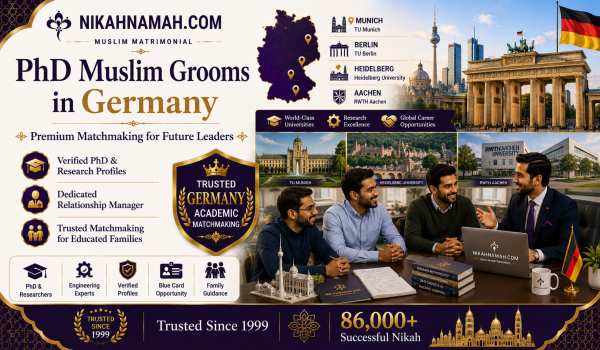
TU Munich (Technische Universität München): Consistently Germany's highest-ranked university, QS-ranked among the world's top 40, with particular strength in engineering, computer science, and natural sciences. The largest Indian student body among German universities, with a significant Indian Muslim engineering PhD presence.
Heidelberg University: Germany's oldest and consistently most highly ranked in humanities and life sciences, with the Klaus Tschira Institute for Computational Biology and strong medical research.
RWTH Aachen: Germany's most prestigious technical university after TU Munich, with renowned mechanical and electrical engineering programmes and strong industry partnerships with German automotive and manufacturing giants.
TU Berlin (Technische Universität Berlin): Located in Germany's capital and cultural centre, with strong engineering and computer science programmes and the cosmopolitan urban environment that Berlin's unique character provides.
KIT (Karlsruhe Institute of Technology): A fusion of the traditional University of Karlsruhe and a national research centre, particularly strong in physics, engineering, and materials science.
Humboldt University Berlin and LMU Munich: Leading non-technical research universities with strong natural sciences, mathematics, and humanities programmes.
The DAAD Scholarship - What the Stipend Actually Is
The DAAD (Deutscher Akademischer Austauschdienst - German Academic Exchange Service) is the primary funding body for international doctoral students in Germany, and a DAAD scholarship for doctoral candidates provides:
€1,400 per month stipend for doctoral candidates - somewhat higher than the UK UKRI's £18,622/year (~£1,552/month) on a monthly basis, and significantly more in purchasing power terms given Germany's lower cost of living relative to London or Cambridge.
Health insurance coverage - included in the DAAD scholarship package, an important practical provision.
Travel allowance - for one return flight to Germany.
Duration - typically three years for doctoral candidates, aligning with Germany's standard structured PhD timeframe.
Additionally, German universities often employ PhD candidates directly as wissenschaftliche Mitarbeiter (research associates) - salaried positions at TV-L E13 (approximately €3,000-3,500/month gross, €2,200-2,600 net after taxes and social contributions) that represent a higher and more stable income than the DAAD scholarship stipend for PhD candidates employed through this route.
The distinction between a DAAD-scholarship PhD candidate (stipend €1,400/month) and a TVL-E13 employed research associate PhD candidate (net approximately €2,200-2,600/month) is significant for matrimony planning and should be communicated specifically rather than collapsed into "PhD student in Germany."
The Family Reunification Mechanics - The Most Critical, Most Misunderstood Dimension
The A1 German Language Requirement - And Its Crucial Exception
Germany's family reunification law (§ 30 AufenthG) requires, as a general rule, that a spouse joining an expatriate in Germany demonstrate basic German language proficiency at A1 level before entering the country. This is the most commonly misunderstood dimension of the Germany-PhD matrimony search - and the one that, left unaddressed, creates the most avoidable planning failures.
What A1 German means practically: The Goethe-Institut's Start Deutsch 1 examination or an equivalent certified test. A1 represents the most basic level of German language competency - the ability to understand and use very familiar everyday expressions, introduce oneself, ask and answer simple personal questions. It is achievable with approximately 80-100 hours of focused study, but requires deliberate planning beginning months before any visa application.
The critical exception - Blue Card and qualified skilled worker: A spouse joining an EU Blue Card holder or a qualified skilled worker with a residence title under §§ 18a, 18b, or 18g of the German Residence Act does not need to demonstrate A1 German before entering Germany. This exception is specifically relevant for PhD grooms who have transitioned from their PhD to a qualifying post-PhD employment position - the Blue Card, obtainable with a German university degree and a job offer of €48,000+ annual salary (€37,440 for shortage occupations), exempts the joining spouse from the A1 language requirement and gives the spouse immediate full work rights upon arrival.
For PhD candidates still in their doctoral programme: The A1 requirement applies in principle. However, one immigration law source notes that when the joining spouse is doing so on a temporary basis (joining a student visa holder who has a temporary residence permit), some German consulates and missions apply a more flexible interpretation. This is an area of genuine legal complexity that varies by consulate and individual case - an immigration attorney specializing in German family law is the right resource for case-specific advice, not a general matchmaking guide.
The Income Threshold - Different From Other Gulf or Western Destinations
Germany's family reunification income requirement is calculated specifically:
€563 per adult per month (Bürgergeld standard rate for 2025/26), plus full warm rent, plus €471 per school-age child or €390 per child under 6. A couple without children in Munich would need approximately €563 + €563 + typical Munich warm rent (€1,200-1,800/month) = approximately €2,300-2,900/month minimum demonstrated income.
For a DAAD scholarship holder at €1,400/month: this falls below the income threshold for a couple in a major German city. A DAAD scholarship holder cannot typically meet Germany's family reunification income threshold without supplementary income or savings.
For a TVL-E13 research associate at €2,200-2,600/month net: this is closer to the threshold, and with budget accommodation and careful financial planning may be achievable - but is tight, and specific legal advice is important.
For a post-PhD Blue Card holder at €48,000+ annual salary (€4,000/month gross, approximately €2,600-2,800 net): this typically meets the income threshold comfortably, and combines with the A1 exemption to make the family reunification process significantly cleaner and more straightforward.
The practical conclusion for matrimony planning: For most Indian Muslim PhD candidates in Germany - particularly those on DAAD scholarships - the realistic family reunification pathway opens substantially after PhD completion and transition to qualifying employment (ideally EU Blue Card). This is the Germany-specific equivalent of the UK's £29,000 income threshold reality, and families in India deserve to understand it with the same clarity.
What This Means in Practice - The Three Scenarios
Scenario A - DAAD scholarship PhD candidate: Family reunification during the PhD is theoretically possible but practically challenging due to income threshold constraints. Most DAAD PhD candidates' realistic pathway is to plan for family reunification after PhD completion and Blue Card acquisition. Matrimony now, with a clear post-PhD timeline communicated, is entirely appropriate - but the A1 preparation and post-PhD income transition timeline should be the honest framing.
Scenario B - TVL-E13 employed research associate: Income is closer to the threshold; family reunification during the PhD may be achievable with careful financial planning, documentation, and budget housing. A1 requirement still applies. Individual assessment with an immigration attorney is advisable.
Scenario C - Post-PhD Blue Card holder: The cleanest, most straightforward scenario - A1 requirement waived, income threshold clearly met, spouse gets immediate full work rights. The Blue Card transition is therefore the critical milestone around which family reunification planning should be oriented.
What Makes a Germany PhD Groom's Search Distinctively Challenging
The German Language Dimension - Not Just for the Visa
Unlike the UK - where English is the language of both academic and daily life - Germany requires genuine German language engagement at every level beyond the campus laboratory. Daily shopping, interactions with authorities (Ausländerbehörde for residence permits, Einwohnermeldeamt for registration, Krankenkasse for health insurance), understanding rental contracts, navigating the healthcare system - all of this is primarily in German, and a bride arriving in Germany without some German language preparation faces a more significant daily navigation challenge than one arriving in the UK.
For matrimony planning, this means that a bride who has begun German language study - ideally to B1 level or beyond, beyond the A1 minimum the visa may require - will adapt to German life significantly more smoothly than one who has not. A compatible match for a Germany-based PhD groom is one who has engaged honestly with this language dimension as a preparation task, not as an obstacle to be worried about after arrival.
The Turkish-Majority Muslim Community Context
Germany's Muslim population of approximately 5.5 million is overwhelmingly Turkish-origin - a community with its own distinct language, cultural institutions (DITIB mosque network), and community infrastructure that is well-established but primarily oriented toward Turkish-speaking worshippers. Arab and Bosnian Muslim communities add to the picture. The Indian Muslim community is small by comparison.
This means a bride arriving in Germany to join a PhD groom is typically joining an Islamic community infrastructure that is genuine and well-established (mosques are accessible, halal food is widely available, particularly in cities with large Turkish communities), but one where the specifically Indian Muslim community infrastructure - the cultural familiarity, the Malayalam or Urdu conversations, the shared food traditions, the specific community associations - is limited in a way it is not in the UK or Gulf.
The City-by-City Variation - Munich vs. Berlin vs. Aachen
Munich: Germany's most expensive city but with the largest Indian student community and strong halal food and mosque infrastructure in the Turkish and Arab community areas. TU Munich's campus is in the northern city and residential suburbs, with the main Indian-oriented social life in the international student community.
Berlin: Germany's most diverse and culturally dynamic city, with significant Arab and Turkish Muslim communities in Neukölln, Kreuzberg, and Moabit - and the most developed English-language infrastructure among major German cities. A bride arriving in Berlin faces a somewhat less intense German-language-only daily environment than in Munich or smaller German cities.
Aachen, Karlsruhe, smaller university cities: Smaller, quieter, often more affordable, but with less developed Indian or specifically Muslim social infrastructure. A bride in Aachen is in a genuinely smaller city where the Indian student community is the primary social world and the Muslim community infrastructure is more limited.
Real Stories: PhD Muslim Grooms in Germany and NikahNamah
Story 1: The TU Munich Engineer - When the Blue Card Timeline Was the Honest Framing
Imran, 28, was in his second year of a PhD in mechanical engineering at TU Munich - DAAD scholarship, €1,400/month stipend, from a Hyderabad Muslim family. His family's matrimony conversations had been stalling on the same specific question: when exactly could a wife join him in Germany, and what would the process involve?
NikahNamah's Relationship Manager presented the honest, complete timeline: during the PhD on the DAAD stipend, family reunification was financially challenging and the A1 language requirement applied. Post-PhD - with a Blue Card from a German engineering firm at the €48,000+ qualifying salary (realistic within 12-18 months of his expected graduation) - A1 would be waived, income threshold would be met comfortably, and a spouse would arrive with immediate full work rights. The gap was roughly 24-30 months from the current point to a clean family reunification.
She also communicated the constructive side: the bride could begin German language study (Goethe-Institut A1 and then B1) during this period, could visit Germany on a visitor visa, and the marriage itself could take place in India on the next visit - with the Germany cohabitation timed to the Blue Card transition.
"Previous conversations had given families a vague 'he'll sort it out' answer on the visa question," Imran's father said. "The RM gave them the actual timeline - DAAD stipend now, Blue Card in 24 months, wife joins then - and the bride's preparation role in the interim. The family who said yes had actually thought through that 24-month period and was comfortable with it."
Story 2: The RWTH Aachen Research Associate - When TVL-E13 Changed the Picture
Tariq, 30, was on a TVL-E13 research associate contract at RWTH Aachen - net approximately €2,400/month, from a Lucknow Muslim family. His income was higher than a DAAD scholarship but still tight for Munich or Frankfurt-level costs; in Aachen's more affordable housing market, however, the mathematics of family reunification was considerably more workable.
NikahNamah's Relationship Manager engaged with the Aachen-specific picture specifically: housing costs in Aachen significantly below Munich (two-bedroom apartments at €800-1,000/month warm vs. Munich's €1,400-1,800+), meaning Tariq's net income of €2,400 left meaningful margin above the income threshold. She also noted that while A1 German was required, a bride who began studying immediately could complete A1 in three to four months with focused study.
"The RM presented Aachen's specific cost-of-living picture - not Germany generally, but Aachen specifically - and explained why our income threshold situation in Aachen was genuinely viable whereas the same salary in Munich would have been very tight," Tariq said. "That city-level specificity made the whole financial picture real and manageable."
Story 3: The Post-PhD Berlin Blue Card - When the Transition Completed the Story
Dr. Yusuf, 31, had just completed his PhD at TU Berlin and accepted a software engineering role at a Berlin tech company at €62,000/year - well above the Blue Card threshold. His family in Bangalore had been waiting for this transition to properly begin the matrimony search, knowing that the Blue Card would waive A1 and provide immediate spouse work rights.
NikahNamah's Relationship Manager presented the post-PhD Blue Card picture with specific confidence: A1 waived, income threshold clearly met, Berlin's Indian Muslim community context (the most cosmopolitan and English-friendly of German cities), and immediate spouse work authorization. She specifically sought families who understood the Blue Card distinction and appreciated the deliberateness of a family that had waited for the right immigration moment before beginning the formal search.
"We'd been waiting to begin the search seriously until after the PhD and Blue Card - and the RM understood exactly why that was the right decision, not a procrastination," Yusuf's father said. "She presented it to families as a sign of thoughtfulness, not delay."
Testimonials: PhD Muslim Grooms in Germany on NikahNamah
"The RM gave families the actual timeline - DAAD stipend now, Blue Card in 24 months, wife joins then - and the bride's preparation role in the interim. The family who said yes had actually thought through that 24-month period." - PhD Student, TU Munich
"NikahNamah presented Aachen's specific cost-of-living picture, not Germany generally - and explained why our income threshold situation in Aachen was viable. That city-level specificity made the financial picture real and manageable." - Research Associate, RWTH Aachen
"We'd been waiting until after the PhD and Blue Card to begin searching seriously. NikahNamah presented this as thoughtfulness, not delay - and found families who understood exactly why the timing was right." - Post-PhD Blue Card Holder, Berlin
"NikahNamah understood the Germany PhD groom's specific situation - DAAD vs. TVL-E13 income, A1 requirement and the Blue Card exemption, city-level cost differences, the Turkish-majority Muslim community context. That layered, Germany-specific understanding is what this search requires." - Indian Muslim PhD Groom, Germany
How NikahNamah Serves PhD Muslim Grooms in Germany
We communicate the A1 language requirement and the Blue Card exemption clearly. The single most misunderstood dimension of Germany PhD matrimony - what the A1 requirement means, who is exempt (Blue Card and qualified skilled worker holders), and what the practical implications are for family reunification timing.
We distinguish DAAD stipend, TVL-E13 salary, and post-PhD Blue Card as meaningfully different matrimony situations. Each with different income thresholds, different A1 applicability, and different spouse arrival timelines - communicated specifically rather than collapsed into "PhD student in Germany."
We present each university city's specific character and cost. Munich's premium costs, Berlin's cosmopolitan English-friendliness, Aachen's affordability - each described specifically so families can evaluate the actual life picture, not a generic Germany framing.
We contextualise the Turkish-majority Muslim community landscape. Genuine, well-established Islamic infrastructure alongside limited specifically Indian Muslim community - presented honestly as the real community context a bride would be entering.
We find families who understand and value the Blue Card transition milestone. For PhD grooms who are timing their matrimony search around the post-PhD Blue Card acquisition, we present this as thoughtful planning rather than delay.
For Families in India: The Complete Germany PhD Picture
India is now Germany's largest source of international students - 59,419 students in Winter 2024/25, with the Indo-German Higher Education Roadmap (January 2026) deepening this relationship further. A German university PhD from TU Munich, Heidelberg, or RWTH Aachen is a genuinely world-class academic credential.
DAAD scholarship stipend is €1,400/month for doctoral candidates - supplementary to many research associate positions at TVL-E13 (approximately €2,200-2,600/month net). The specific income type matters for family reunification planning.
A1 German language certificate is required for family reunification in most cases - achievable in 3-4 months of focused study but requiring deliberate planning before any visa application.
The EU Blue Card exempts the joining spouse from A1 and provides immediate full work rights - making the post-PhD Blue Card transition the critical milestone for clean family reunification for most PhD grooms.
Germany's daily life is conducted primarily in German - beyond the campus laboratory, German language competency is genuinely needed, and a bride who has begun language preparation will adapt to German life substantially more smoothly.
Frequently Asked Questions: PhD Muslim Grooms in Germany
Q: Does a wife joining a PhD student in Germany need to speak German before arriving? Generally yes - A1-level German is required for family reunification under German law. However, there are exceptions: Blue Card holders and qualified skilled workers are exempt from the A1 requirement. Some consulates may also apply flexibility when the student visa holder has a temporary residence permit, but this varies by consulate and individual case.
Q: Can a DAAD scholarship holder sponsor a wife to come to Germany? Technically possible, but financially challenging - the €1,400/month DAAD stipend typically falls below the income threshold (sponsor + spouse + warm rent in major German cities). The more practical pathway for most DAAD PhD candidates is to plan for family reunification after PhD completion and Blue Card acquisition.
Q: What is the EU Blue Card and why does it matter for matrimony planning? The EU Blue Card is a residence and work permit for highly qualified non-EU nationals earning €48,000+/year (€37,440 for shortage occupations). It exempts the joining spouse from the A1 German language requirement, provides the spouse with immediate full work rights upon arrival, and typically meets the income threshold comfortably. For Indian Muslim PhD grooms, the Blue Card transition after PhD completion is the key milestone that opens the cleanest family reunification pathway.
Q: How does Germany's Muslim community compare to the UK's for an Indian Muslim bride? Germany has approximately 5.5 million Muslims, predominantly Turkish-origin, with well-established mosque and halal food infrastructure in major cities. However, the specifically Indian Muslim community is significantly smaller than in the UK. A bride in Germany will find genuine Islamic community infrastructure but less specifically Indian Muslim community familiarity than in the UK's East London or Leicester communities.
Q: Is a German PhD from TU Munich or Heidelberg genuinely valued internationally? Yes - German engineering PhDs from TU Munich, RWTH Aachen, and KIT Karlsruhe are among the most valued globally in the automotive, mechanical, electrical, and materials engineering sectors. Heidelberg's life sciences PhDs have similar standing in biomedical research. A German PhD from a leading research university opens career doors in Germany's industrial economy (Siemens, Bosch, BMW, BASF, SAP) at the senior technical level.
Academic Achievement in Germany's Engineering Heartland
The Indian Muslim PhD student at TU Munich's engineering faculty or Heidelberg's research institute is building a credential in the country where modern engineering was systematised - where the Technische Hochschule tradition that gave the world industrial engineering, automotive manufacturing, and chemical engineering was born. Their matrimony search deserves guidance as specific and structured as the research itself: honest about the A1 language requirement and the Blue Card exemption, clear about DAAD stipend versus TVL-E13 income, specific about Munich versus Berlin versus Aachen, and genuinely helpful about the post-PhD Blue Card transition that opens the cleanest family reunification pathway.
At NikahNamah, we provide exactly this - with 27 years of NRI matrimony service, specific knowledge of Germany's visa and academic landscape, and the premium, honest approach that India's largest source of international students to Germany genuinely deserves.
Register for free on NikahNamah today. Whether you are completing a PhD at TU Munich, researching at Heidelberg, or building your early career on an RWTH Aachen engineering degree - speak with our team. Germany's engineering heartland deserves a matrimony search as rigorous as its research standards.
May Allah bless every Indian Muslim doctoral student in Germany - conducting original research in the country that gave the world modern engineering while holding firmly to their faith - and write for each of them a Nikah that brings the companion who is genuinely, specifically, and joyfully right for the life they are building. Ameen.
Also Read on NikahNamah Blog
- Germany Based Muslim Grooms: Premium Matrimony Services
- Building a Muslim Family in Germany: Finding the Right Marriage Partner
- PhD Muslim Grooms in the UK: Premium Matrimony Guide
- Highly Educated Muslim Grooms in Melbourne: Engineers, IT Professionals & Researchers
- Software Engineer Muslim Grooms in USA Looking for Marriage
- Explore all Muslim matrimony guides
About NikahNamah
NikahNamah is India's #1 Muslim Matrimony platform, trusted since 1999. With over 86,000 successful Nikah completed and 96,461+ registered members across India, UAE, Saudi Arabia, Qatar, Kuwait, UK, USA, Canada, Australia, Germany, and beyond - we serve Indian Muslim PhD students and researchers at Germany's leading universities with the A1-language-aware, Blue-Card-informed, city-specific, DAAD-versus-TVL-E13-specific matrimony guidance that Germany's largest international student community genuinely deserves.
📍 Main Branch: Jayanagar 9th Block, Bengaluru – 560069 📍 Other Branch: Frazer Town, Bengaluru – 560005 📞 +91 98451 30331 | +91 90360 22522 🌐 www.nikahnamah.com | ✉️ support@nikahnamah.com ⏰ Monday to Sunday, 10:00 AM – 8:00 PM IST (Friday Off)

💬 Comments