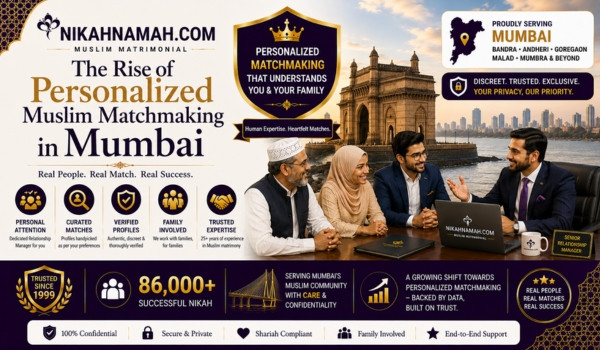
By NikahNamah | India's Most Trusted Muslim Matrimony Platform Since 1999
Something measurable is happening in Mumbai's Muslim matrimony landscape - and it is not simply a feeling or a preference. It is a documented, data-backed shift in how families and individuals approach the search for a life partner, visible in market numbers, in community conversations, and in the specific, real-world experiences that are driving families away from apps and mass-market portals toward something more human, more specific, and more genuinely useful.
The numbers are worth stating clearly before anything else. India's offline matrimony segment - the human-led, Relationship Manager-based, personalized matchmaking model - stood at approximately INR 4,500 to 5,000 crore in 2025, according to analysis by Redseer Strategy Consultants, growing at a steady 4 to 5% compounded annual rate. During the same period, a major swipe-based dating app reported a 7% year-on-year decline in monthly paying users as of Q3 2025. More than 75% of Gen Z users on swipe-based apps reported "swiping fatigue" - a specific, named phenomenon of burnout from superficial, photo-first matching. Meanwhile, apps that positioned themselves explicitly around serious, intentional matching showed 17% growth in paying users.
The direction of travel is clear. The question worth answering for Mumbai's Muslim families specifically is: why is this shift happening here, in this way, and what does it mean for how the matrimony search should be approached now?
What Changed - and When
The Post-COVID Reset of Matrimony Expectations
The COVID-19 period did something specific to how families thought about matrimony - and not in the direction most people would have predicted. Rather than driving a permanent shift toward purely digital, app-based matching, the prolonged period of physical isolation during 2020-2021 produced a sharp reassessment of what virtual connections were actually worth.
Families who had conducted entire courtship sequences through video calls - matched on an app, introduced virtually, engaged without a single in-person meeting - found, in many cases, that the compatibility they thought they'd established online didn't survive the first months of actually living together. The gap between who someone appeared to be on a curated profile and who they were in daily life was, for many families, more significant than the app model had implicitly promised.
The aftermath was a widespread return to the value of human judgment, family involvement, and genuine vetting - precisely what personalized matchmaking provides and what algorithm-based matching structurally cannot. Mumbai's Muslim families, who had historically maintained strong community-based matrimony networks even as they adopted digital tools, felt this reassessment acutely.
The Working Professional's Time Problem - Now Acute
The work-life reality of Mumbai's Muslim professionals has been covered in this series before - the UBS finding that Mumbai workers average more working hours annually than any other major city in the world, the two-hour daily commutes, the professional calendars that leave almost no consistent free time for a self-directed matrimony search.
What has changed in recent years is that this time scarcity has reached a threshold at which the self-directed, portal-based search model has simply stopped producing results for a meaningful cohort of Mumbai's Muslim professionals. Not because they are not serious about marriage - many are acutely serious about it - but because the portal model requires sustained, self-directed effort that a 70-hour working week and two hours of daily commuting physically cannot accommodate.
The arithmetic is unforgiving. A matrimonial portal requires the user to browse profiles, evaluate dozens of options, initiate or respond to contacts, manage ongoing conversations, and coordinate family introductions - all tasks that require real time and cognitive attention. A personalized matchmaking service requires the user to have a detailed initial conversation, respond to curated introductions, and attend meetings - tasks that can be scheduled, bounded, and fitted around a demanding professional life in a way that open-ended portal browsing cannot.
For Mumbai's Muslim professionals, this shift from self-directed browsing to curated, managed matching is not a luxury preference. It is increasingly a practical necessity.
The Muslim-Specific App Failure - Now Documented
The failure of Muslim-specific matchmaking apps - documented in the UK piece in this series, and further confirmed by Delhi's entrepreneurial response with the Barkat app - is particularly visible in Mumbai's Muslim community, where the general app landscape has added a further dimension to the problem.
General dating apps in Mumbai carry a well-documented safety concern for individuals searching alone - a reality discussed in the South America piece - but even the Muslim-specific apps have produced a growing list of documented problems. Misrepresented profiles. Non-serious users mixing with serious ones. A swipe-based interface that structurally produces superficial evaluation regardless of how the app is positioned. And, increasingly, the reported ownership and trust concerns - such as Salams' acquisition by Match Group - that have raised genuine questions about who is actually running the platforms Indian Muslim families are trusting with their personal information.
The specific cultural reality of Mumbai's Muslim matrimony also makes the app model a poor fit in ways beyond the general: the Bohra community's specific matrimony protocols, the Memon community's biradari considerations, the Konkan Muslim family's distinct cultural register - none of these are surfaced by an algorithm that optimises for profile-response rates rather than cultural and community compatibility.
The Five Forces Driving Mumbai's Personalized Matchmaking Rise
Force 1: Family Involvement Is Moving Back to the Centre
One of the most significant, least-discussed shifts in Mumbai's Muslim matrimony in recent years is the restoration of genuine family involvement - not as a formality at the end of an individual's app-based search, but as a structural presence from the beginning.
The app model pushed family to the periphery almost by design: a son or daughter searches alone, manages conversations alone, and introduces family only when individual interest has already advanced significantly. This sequence felt modern and independent - and created recurring friction in Muslim families where marriage is understood as a family covenant from the outset, not a personal decision communicated to family after the fact.
Personalized matchmaking naturally restores family to the centre. A Relationship Manager works with the family from the first conversation, understands the family's values and requirements as well as the individual's, and presents matches as family-level introductions rather than individual profile exchanges. For Mumbai's Muslim families - across the Bohra, Memon, Konkan, and Bhendi Bazaar trading communities - this family-centred structure is not a feature. It is the minimum of what the matrimony process should be.
Force 2: The Volume Problem Has Become Acute
India's matrimonial portal market has grown substantially in recent years. Shaadi.com alone reports over 80 lakh success stories, BharatMatrimony dominates in specific regional communities, and a growing array of smaller platforms each add to the total volume of available profiles.
For Mumbai's Muslim families, this volume growth has paradoxically made the search harder, not easier. The filtering tools available on general portals - religion, community, education, income - are blunt instruments that still leave a search result of hundreds of profiles for any reasonably common preference set. Evaluating these profiles meaningfully requires either an enormous investment of time that most Mumbai professionals cannot spare, or a superficial, rapid-dismissal approach that misses compatible matches and latches onto superficially attractive ones.
Personalized matchmaking solves the volume problem at its root: a Relationship Manager who knows both sides makes human-judgment-based filtering decisions that portal algorithms cannot replicate, presenting a small number of genuinely considered options rather than asking the family to manage their own filter through an overwhelming pool.
Force 3: Community-Specific Knowledge Cannot Be Automated
Mumbai's Muslim community diversity - Dawoodi Bohras, Memons, Khoja Ismailis, Khoja Ithna Asharis, Konkan Muslims, Sunni families from various North Indian and South Indian regional backgrounds - creates a matchmaking complexity that general portals and Muslim-specific apps alike consistently fail to address.
The Bohra community's matrimony protocols cannot be reduced to a profile filter. The Memon community's commercial-family compatibility considerations require human context to assess. The Konkan Muslim family's specific cultural register - the coastal Karnataka and coastal Maharashtra Muslim identity - is invisible to an algorithm scanning for "Muslim, Maharashtra."
A Relationship Manager who has worked with Mumbai's Muslim community for years carries this community-specific knowledge as professional expertise. She knows what "Bohra family from Bhendi Bazaar" means differently from "Memon family from Bandra" means differently from "Konkan Muslim family from Mahim" - and she uses this knowledge to make introductions that community members would recognise as genuinely appropriate rather than algorithmically plausible.
The rise of personalized matchmaking in Mumbai is, in significant part, the rise of community-specific human expertise over community-blind algorithmic matching.
Force 4: The Authenticity Premium Is Growing
The Redseer data documents a specific, named trend: users are increasingly willing to pay more for matching services that prioritise authenticity and seriousness over volume and convenience. Apps focused on "serious" matching showed 17% growth in paying users - precisely the segment that Muslim matrimony serves at its heart.
This authenticity premium reflects something real about how Mumbai's Muslim families are evaluating their options. A platform with a million profiles and basic verification is less valuable, to a family serious about matrimony, than a service with a thousand verified, seriously-intentioned profiles managed by a human professional who is personally accountable for every introduction. The numbers are lower; the value is higher.
For Muslim families specifically, the authenticity dimension has a further layer: the Islamic understanding of Nikah as a covenant - not a casual connection, not a trial arrangement, but a serious, spiritually significant commitment entered with genuine intent - naturally aligns with the intentionality that personalized matchmaking provides and that swipe-based apps structurally undercut.
Force 5: Mumbai's Specific Social Fabric Rewards Human Networks Over Algorithmic Reach
Mumbai's Muslim community is genuinely large - nearly a fifth of the city's population, spread across distinct neighborhoods with their own community characters - but within each community, the social network is surprisingly dense and personal. A Memon family in Bandra knows other Memon families in Bandra. A Bohra family in Bhendi Bazaar knows the dargah-connected families of Mohammed Ali Road. A Konkan Muslim family in Mahim has community ties stretching back through generations of the same neighbourhood.
This density means that within the relevant community, a trusted human matchmaker with genuine network access often outperforms an algorithm whose only information is what families choose to put in a profile. A Relationship Manager who has worked with Mumbai's Muslim communities can say "I know this family, they are exactly what they present as, and here is why I think there is real compatibility" - a statement no algorithm can make, and one whose value to a family evaluating a serious proposal is very high.
The rise of personalized matchmaking in Mumbai is partly the rediscovery of this truth: in a city whose communities are dense and socially networked, trusted human expertise with genuine community access is not an anachronism. It is a genuinely superior product.
What This Rise Looks Like in Practice - The Shift Mumbai Families Are Making
From Passive Portal Registration to Active, Managed Introductions
The most visible practical change is the shift from the model of "register on a portal and wait to be found" to active management by a Relationship Manager who is continuously, proactively searching on the family's behalf. For Mumbai's time-constrained Muslim professionals, the active management model means the search continues even when they are in a 12-hour working day - because the Relationship Manager is working, even when the individual cannot be.
From Volume-Based Browsing to Curated Consideration
Families who have made the shift from portals to personalized matchmaking consistently describe the same experience: they had been evaluating dozens or hundreds of profiles superficially, and the shift to evaluating five or six profiles deeply - with real background information, specific community context, and genuine compatibility reasoning provided by a human professional - produced better outcomes in less total time.
The counterintuitive reality: fewer options, considered more seriously, with better human context, produces more successful introductions than more options evaluated superficially. This is the core insight driving personalized matchmaking's rise - and it is backed by the market data showing that volume-based swipe apps are declining while intentionality-focused services are growing.
From App-Based Individual Search to Family-Centred Professional Process
The most significant structural change - and the one most specific to Mumbai's Muslim community - is the restoration of family centrality. Families who have moved to personalized matchmaking describe a qualitative difference in how the matrimony process feels: like a shared family undertaking rather than an individual's solo project that family is eventually consulted about.
This restoration of family to the centre is, in effect, a return to the deepest values of Islamic matrimony - marriage as a covenant involving both families from the outset - expressed through a modern, professionally managed process that respects both the Islamic tradition and the practical realities of 21st-century Mumbai professional life.
Real Stories: Mumbai Muslim Families Experiencing the Shift
Story 1: The Bandra Family - When the App Years Ended and the Right Process Began
Aisha, 29, had spent three years on two Muslim matrimony apps and a general portal simultaneously - managing profiles, conversations, and follow-ups across three platforms while working as a senior marketing manager in a Bandra-based company. The total time investment across three years was, by her own estimate, comparable to a part-time job - and the output was a handful of genuine conversations and no match.
The shift to NikahNamah's personalized service was, she said, immediately qualitatively different. "The first conversation with the RM lasted an hour and a half. She asked about my family, my actual daily life, what I was genuinely looking for versus what I'd been putting in profile filters, and what hadn't worked about previous conversations. By the end of it she knew more about what I actually needed than three years of portal browsing had produced."
Within four months - managing a full-time career and no longer spending evenings on app browsing - Aisha had been introduced to three families through NikahNamah. The third was her match.
Story 2: The Mumbra Trading Family - When Community Knowledge Made the Introduction Right
The Shaikh family in Mumbra - a well-established trading family with connections across North Mumbai's Muslim commercial community - had registered on a general matrimony portal for their son Tariq, 30, and received over fifty "interests" within the first month. Evaluating those fifty profiles had taken weeks of family time and produced mostly mismatches - families from significantly different economic backgrounds, different community identities, or different geographic horizons than the Shaikhs' own.
When they switched to NikahNamah's personalized service, the contrast was immediate. The Relationship Manager spent two conversations understanding the family's community identity - the specific trading community background, the Mumbra neighbourhood character, the expectations around a daughter-in-law's role in a family-business household - before presenting any introductions at all.
"She presented three families," Tariq's father said. "We could see immediately that she had understood our community and our family specifically. All three introductions were to families we could look at and think 'yes, this is a real possibility.' That's very different from fifty interests from families who had nothing to do with our world."
Story 3: The Bhendi Bazaar Professional - When the Market Data Played Out in One Family's Experience
Dr. Zafar, 32, a physician from an old Bhendi Bazaar Muslim family, had, by his own description, followed the exact pattern the Redseer data describes: started on portal, moved to app, experienced the 75% Gen Z swiping fatigue in his own life, moved to a more "serious" app, and then finally to personalized matchmaking. Each step had produced better results than the one before - but only personalized matchmaking had produced a genuine introduction process.
"The progression makes complete sense in retrospect," he said. "The portal was too much volume. The swipe app was too superficial. The 'serious' app was better but still couldn't account for the community complexity of a Bhendi Bazaar Muslim professional family. NikahNamah's RM was the first service that understood all three dimensions - the volume filtering, the seriousness, and the specific community context - at the same time."
Testimonials: Mumbai's Muslim Families on the Shift to Personalized Matchmaking
"Three years on apps produced nothing. One hour with NikahNamah's RM produced more genuine understanding of what I actually needed than all three years of profile browsing combined." - Marketing Professional, Bandra
"Fifty interests in a month on a portal meant fifty mismatches to evaluate. NikahNamah's RM gave us three introductions - all three were real possibilities. That's a fundamentally better product." - Trading Family, Mumbra
"I followed the exact progression Redseer describes - portal to app to 'serious' app to personalized matching. Each step was better. NikahNamah was the first that understood volume, seriousness, and community context simultaneously." - Physician, Bhendi Bazaar
"The shift to NikahNamah felt like a return to how matrimony is supposed to work - a family process, managed by someone who knows our community, with introductions that actually make sense. It shouldn't have taken three years to find this." - Muslim Family, Mumbai
What the Rise Means Going Forward
The shift toward personalized Muslim matchmaking in Mumbai is not a temporary reaction to a period of app fatigue. It reflects three durable realities that are not going away:
Mumbai's Muslim professional community will continue to have less free time, not more - and the portal-browsing model will continue to fail families whose working lives do not accommodate it.
Mumbai's Muslim community diversity - Bohra, Memon, Khoja, Konkan, and others - will continue to require community-specific human knowledge that algorithms are structurally incapable of providing.
The Islamic understanding of Nikah as a family covenant rather than an individual consumer choice will continue to make family-centred, human-managed matchmaking more appropriate than individual, app-based searching for the specific purpose it serves.
The INR 5,000 crore offline matrimony market is growing. The swipe app monthly active users are declining. The serious-matching segment is growing at 17%. These numbers will continue to move in the same direction - because the underlying forces driving them are structural, not cyclical.
NikahNamah has been on the right side of this shift since 1999 - not because we predicted a market trend, but because the human, family-centred, community-knowledgeable approach to Muslim matrimony has always been the right approach. The market is catching up to what this community has always needed.
Register for free on NikahNamah today. Whether you are in Bandra, Bhendi Bazaar, Mumbra, or anywhere across Mumbai - speak with our team. The rise of personalized matchmaking is not a trend to observe. It is a shift to join.
May Allah bless every Muslim family in Mumbai navigating this shift - finding their way through the noise of a hundred platforms toward the quiet, human, family-centred process that the search for a Nikah has always deserved - and write for each of them a marriage that brings genuine, lasting, joyful compatibility. Ameen.
Also Read on NikahNamah Blog
- Building a Successful Nikah in Mumbai: A Guide for Modern Muslim Families
- Finding the Right Muslim Life Partner in Mumbai's Fast-Paced Lifestyle
- VIP Muslim Marriage Bureau in Mumbai for Elite and High Profile Families
- Why Many UK Muslim Families Are Choosing Personalized Matchmaking Over Apps
- Why Muslim Professionals in Australia Are Turning to Personalized Matchmaking
- Explore all Muslim matrimony guides
About NikahNamah
NikahNamah is India's #1 Muslim Matrimony platform, trusted since 1999. With over 86,000 successful Nikah completed and 96,461+ registered members across India, UAE, Saudi Arabia, Qatar, Kuwait, UK, USA, Canada, Australia, Germany, and beyond - we serve Mumbai's Muslim families with the community-specific, family-centred, human-judgment-based personalized matchmaking that the market's own data confirms is what serious matrimony seekers actually need.
📍 Main Branch: Jayanagar 9th Block, Bengaluru – 560069 📍 Other Branch: Frazer Town, Bengaluru – 560005
📞 +91 98451 30331 | +91 90360 22522
✉️ support@nikahnamah.com ⏰ Monday to Sunday, 10:00 AM – 8:00 PM IST (Friday Off)

💬 Comments