By NikahNamah | India's Most Trusted Muslim Matrimony Platform Since 1999
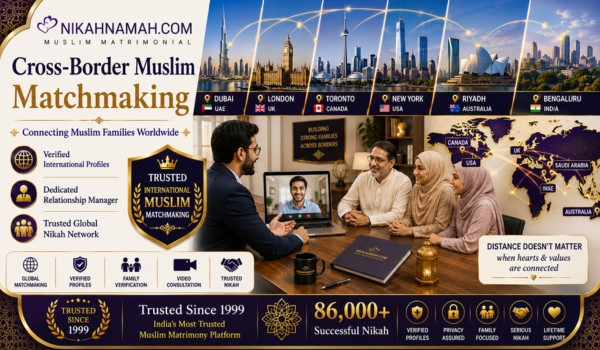
Of every complexity this matrimony series has covered - visa status, income trajectory, working hours, career ambition - one sits underneath almost all of them without ever being named directly: distance. A groom in Toronto and a bride in Lucknow. A bride in Dubai and a family in Chennai. A groom whose parents are in Karachi while he has lived his entire adult life in Manchester. Cross-border matrimony is not a subcategory of this series - it is close to the default condition of it, and yet it is rarely discussed on its own terms.
Two families separated by a continent, a nine-and-a-half-hour time difference, and sometimes a full generation of different lived experience are being asked to evaluate a marriage with the same instinctive confidence that families evaluating a match two streets apart have always had. That confidence does not transfer automatically across distance - it has to be specifically, deliberately rebuilt.
This guide exists because "marriage beyond borders" is not simply "marriage, but abroad." It is its own category of decision-making, with its own specific risks, its own specific advantages, and its own specific requirements for honesty - requirements that a generic, distance-blind matrimony process consistently underserves.
Who Is Searching for Marriage Across Borders
Not One Kind of Distance, But Several
"Cross-border matrimony" describes meaningfully different situations, each requiring a different approach:
- The diaspora professional searching in India - settled abroad for years, sometimes born or raised abroad, looking for a partner from the country of family origin, often to reconnect with roots as much as to marry.
- The India-based family evaluating a groom or bride abroad - a family with no direct, current experience of the destination country, evaluating a proposal almost entirely through secondhand information and the candidate's own account.
- The diaspora-to-diaspora match - both families settled abroad, sometimes in different countries entirely (a family in the UK matched with a family in Canada), where neither side has direct experience of the other's country of residence.
- The returning or relocating candidate - someone planning to relocate for marriage itself, either the bride moving to join the groom's country or, less commonly but increasingly, the groom relocating to join the bride's.
Each of these carries a different balance of unknowns, and premium matchmaking begins by naming, specifically, which situation a family is actually in.
Spread Across Every Continent, Rooted in Shared Origin
The families in this category are found in every major diaspora hub covered elsewhere in this series - the Gulf, the UK, the USA, Canada, Germany, Australia - as well as within India across cities and states that are themselves separated by real cultural and linguistic distance: a Hyderabadi family evaluating a Lucknow-based proposal is, in its own smaller way, navigating a cross-border conversation. What unites this category is not geography exactly, but the requirement to build trust and compatibility understanding without the shared daily context that proximity normally provides.
What Genuine Compatibility Requires Across Distance
Verified Information Replacing Physical Familiarity
When a family two streets away considers a proposal, decades of neighbourhood familiarity - who the family is, how they conduct themselves, what their reputation actually is - does a great deal of the verification work invisibly. Across borders, none of that ambient familiarity exists. A family's reputation, a candidate's actual circumstances, and a stated income or role cannot be casually confirmed through a shared social network - they have to be actively and specifically verified, or the family is proceeding on trust alone in a way they likely would not accept for a local match.
Honest Handling of Time Zones and Courtship Rhythm
A courtship conducted across a nine-to-twelve-hour time difference has a fundamentally different rhythm than one conducted in the same city. Video calls happen at the edges of one person's day and the middle of another's night. Response times that would be unremarkable locally can read as distant or evasive across a time zone gap, purely because of scheduling, not sentiment. Families and candidates who name this rhythm honestly upfront - rather than being surprised by it mid-courtship - navigate it far better than those who assume the process will feel the same as a local introduction.
Cultural Drift - What Distance Does to Shared Expectations Over Time
A candidate who left India fifteen years ago, or who was raised abroad from childhood, often shares a name, a language, and a faith with a candidate raised entirely in India - but not necessarily the same expectations about family involvement, gender roles in a household, festival and ritual observance, or the pace of major life decisions. This is not a flaw in either candidate; it is simply what years or a lifetime in a different cultural environment naturally produces. The honest question is not "are they both good Muslims from good families," which frequently they both are - it is "have the specific expectations each person holds actually been discussed and compared," rather than assumed to match because of a shared origin or label.
The Relocation Question - Who Moves, and What It Actually Costs Them
Nearly every cross-border match eventually requires one person to relocate, and this decision deserves the same specific, unflinching honesty as the F-2 work prohibition or the H-1B timeline discussed elsewhere in this series. Relocating is not simply a change of address - it typically means leaving an existing career, an established support network of family and friends, and a familiar cultural and linguistic environment, in exchange for starting substantially from zero in the new country. This cost is real regardless of how much love or commitment exists in the marriage, and a family that engages with it specifically - what the relocating spouse's professional plan will be, what their support system will look like, how visa timelines affect the transition - serves that person far better than a family that treats "she'll adjust" or "he'll settle in" as a sufficient plan.
Real Stories: Cross-Border Matches and NikahNamah
Story 1: The Melbourne Groom and the Kanpur Bride - When Verification Replaced Assumption
Adil, 32, had lived in Melbourne since finishing his master's degree eight years earlier, working as a data analyst, with his parents having since relocated back to Kanpur. Families approaching his parents in Kanpur had no independent way to confirm his actual circumstances in Australia beyond what was described to them, and several earlier conversations had proceeded largely on the strength of the family's local reputation alone.
NikahNamah's Relationship Manager treated verification as a first step rather than an afterthought - confirming Adil's employment, residency status, and standing through appropriate documentation and channels before any serious family conversation began, and presenting this verified picture clearly to interested families rather than asking them to simply trust a description. The match that followed was with a Kanpur-based family whose own daughter, a schoolteacher, had specifically asked for a process that did not require her family to take a stranger's account on faith.
"My parents are respected in Kanpur, but that doesn't mean a family across the world should just trust a description of my life in Australia," Adil said. "The RM verified things properly before any conversation got serious. That mattered more to the right family than anything we could have said ourselves."
Story 2: The Time-Zone Courtship - When Naming the Rhythm Honestly Made It Work
Nadia, 27, based in Toronto, and Bilal, 29, based in Sharjah, had a nine-hour time difference between them - meaning her evening was his early morning, and any real-time conversation required one of them to be significantly outside their normal waking hours. An earlier attempt at a cross-border introduction for Nadia had fizzled when both sides read the other's inconsistent response times as a lack of real interest, without either side naming the actual scheduling problem underneath it.
NikahNamah's Relationship Manager raised the time-zone reality directly at the outset of the introduction - suggesting a specific, workable weekly call schedule that both families agreed to in advance, and explicitly framing occasional slower responses as a function of the clock, not the relationship. This small, specific piece of honesty removed the ambiguity that had derailed the earlier attempt.
"Once someone actually said out loud that a slow reply on my end just meant it was 3 a.m. for me, not that I'd lost interest, the whole thing stopped feeling uncertain," Nadia said.
Story 3: The Second-Generation Groom - When Cultural Drift Needed a Real Conversation, Not an Assumption
Zain, 29, was born and raised in Birmingham to Pakistani-origin parents, spoke Urdu conversationally but had never lived outside the UK, and held expectations about household roles and family involvement shaped substantially by his upbringing in Britain rather than by his parents' own experience growing up in Pakistan. His family's initial search in Pakistan assumed that a shared origin and faith would be sufficient common ground, and an early introduction had struggled once it became clear the candidate's expectations of daily married life were quite different from Zain's own.
NikahNamah's Relationship Manager treated this not as a failed match but as a signal to make the cultural-expectations conversation explicit and specific from the outset of future introductions - covering language use at home, expectations of extended-family involvement, and views on a working wife's career, discussed directly rather than assumed from shared heritage. The eventual match was with a Karachi-based bride who had lived briefly in the UK herself during university and had thought through, specifically, what marrying into a British-raised family would actually involve day to day.
"We share a language and a religion with a lot of families, but that's not the same as sharing an idea of what a Tuesday evening at home looks like," Zain said. "The RM made us actually talk about that, specifically, instead of assuming it from where our parents were born."
Testimonials: Cross-Border Muslim Matches on NikahNamah
"The RM verified things properly before any conversation got serious. That mattered more to the right family than anything we could have said ourselves." - Data Analyst, Melbourne
"Once someone actually said out loud that a slow reply on my end just meant it was 3 a.m. for me, not that I'd lost interest, the whole thing stopped feeling uncertain." - Marketing Professional, Toronto
"We share a language and a religion with a lot of families, but that's not the same as sharing an idea of what a Tuesday evening at home looks like. The RM made us actually talk about that, specifically." - Second-Generation Groom, Birmingham
"NikahNamah understood that a match across countries needs its own honest process - not the same process as a local match with a passport added on. That specific understanding is what made this search actually work for us." - Bride's Family, Kanpur
How NikahNamah Serves Families Searching Across Borders
- We verify before we introduce. Employment, residency, and family background confirmed through appropriate channels, so families are not relying on description alone across distance.
- We name the time-zone reality directly. Suggesting workable call schedules and setting honest expectations about response times from the start of a courtship.
- We surface cultural-expectations questions explicitly. Language, family involvement, gender roles, and pace of decision-making discussed specifically, rather than assumed from shared origin or religion.
- We treat the relocation question as a first-class conversation. What the relocating spouse's professional plan, support system, and visa timeline will actually look like - discussed early, not left until after the Nikah.
- We match distance-specific circumstances, not just distance-blind credentials. A candidate's specific diaspora situation - born abroad, recently relocated, planning to return - shapes what kind of match will actually work.
- We stay honest about what distance cannot remove. Some uncertainty is inherent to a cross-border search; we aim to shrink it through verification and honesty, not to pretend it away.
For Families Evaluating a Cross-Border Proposal
- Ask for verification, not just description. Employment, residency status, and family standing deserve the same confirmation a local match would receive through community familiarity.
- Discuss the time-zone rhythm honestly and early. A workable communication schedule agreed upfront prevents ordinary scheduling friction from being misread as disinterest.
- Compare specific expectations, not shared labels. A shared origin, language, or religious observance does not guarantee shared expectations about daily married life - ask directly.
- Engage seriously with who relocates and what it costs them. Career continuity, support networks, and visa timelines for the relocating spouse deserve a real plan, not a hopeful assumption.
- Expect some irreducible uncertainty, and manage it deliberately. A cross-border search carries real unknowns that in-person, local courtship does not; the goal is to reduce them through diligence, not to expect them to disappear entirely.
Frequently Asked Questions: Marriage Beyond Borders
Q: How can a family verify a proposal from someone living in another country? Through direct confirmation of employment, residency or visa status, and educational credentials via appropriate institutional and professional channels, combined with speaking to extended family or community contacts who have direct, current knowledge of the candidate rather than secondhand accounts. A credible matchmaking service should be able to confirm these specifics before a family conversation becomes serious, rather than asking a family to proceed on description alone.
Q: Does a big time-zone gap mean a courtship is doomed to feel distant? No - but it does mean the rhythm needs to be named and planned for rather than left to chance. A specific, mutually agreed call schedule, and an explicit understanding that response delays often reflect the clock rather than interest, prevents the ordinary friction of time-zone differences from being misread as a lack of seriousness.
Q: How much does shared language and religious background actually predict compatibility across a cross-border match? Less than families often assume. Shared faith and language are a meaningful foundation, but they do not by themselves determine expectations about family involvement, household roles, or the pace of major decisions - especially between a candidate raised in the country of origin and one raised or long-settled abroad. These specifics deserve their own direct conversation regardless of how much common ground exists on paper.
Q: Who should be expected to relocate in a cross-border marriage? There is no universal answer - it depends on career stability, visa pathways, family circumstances, and the couple's own preferences. What matters is that the question is asked directly and answered specifically, with a genuine plan for the relocating spouse's professional and social life in the new country, rather than assumed by default along traditional lines without discussion.
Q: Is a cross-border match inherently riskier than a local one? It carries a different kind of risk - specifically, reduced ambient familiarity and a heavier reliance on verified information rather than community knowledge - rather than being simply "riskier." Families who actively verify circumstances, discuss cultural expectations explicitly, and plan the relocation question seriously address most of what makes cross-border matches harder than local ones, without needing to treat distance itself as disqualifying.
Distance Should Be Managed Honestly, Not Assumed Away
A Muslim family searching across a border - whether a diaspora professional looking toward India, or a family in India evaluating a proposal from abroad - deserves a matrimony process that treats distance as a real, specific factor requiring its own honest handling, not a detail to be smoothed over with reassurance. That means verifying circumstances that cannot be confirmed by community familiarity, naming the time-zone rhythm plainly, comparing actual expectations rather than assuming they match because of shared origin, and treating the relocation question with the seriousness it deserves.
At NikahNamah, we provide exactly this - with 27 years of NRI and international matrimony service connecting Muslim families across the Gulf, the UK, the USA, Canada, Australia, Germany, and India, and the specific, verification-first, honesty-led approach that a marriage beyond borders genuinely requires.
Register for free on NikahNamah today. Whether you are a family in India evaluating a proposal from abroad, or a diaspora professional searching for a partner rooted in your family's country of origin - speak with our team. Distance does not have to mean uncertainty. We help close that gap specifically.
May Allah bless every Muslim family building bridges of marriage across countries and continents - and write for each of them a Nikah that brings together, across whatever distance, the companion who is genuinely, specifically, and joyfully right. Ameen.
Also Read on NikahNamah Blog
- When Career Success Meets Marriage: Muslim Professionals Around the World
- Muslim PhD Grooms in USA Seeking Educated Brides
- Software Engineer Muslim Grooms in USA Looking for Marriage
- Living the American Dream but Still Searching for the Right Muslim Partner?
- PhD Muslim Grooms in the UK: Premium Matrimony Guide
- Explore all Muslim matrimony guides
About NikahNamah
NikahNamah is India's #1 Muslim Matrimony platform, trusted since 1999. With over 86,000 successful Nikah completed and 96,461+ registered members across India, UAE, Saudi Arabia, Qatar, Kuwait, UK, USA, Canada, Australia, Germany, and beyond - we connect Muslim families across borders with the verification-first, distance-honest, expectation-specific premium matchmaking that a genuinely global search requires.
📍 Main Branch: Jayanagar 9th Block, Bengaluru – 560069 📍 Other Branch: Frazer Town, Bengaluru – 560005 📞 +91 98451 30331 | +91 90360 22522 🌐 www.nikahnamah.com ✉️ support@nikahnamah.com ⏰ Monday to Sunday, 10:00 AM – 8:00 PM IST (Friday Off)

💬 Comments
I am interested sir single hon age 29 hai achi family se hon from Pakistan