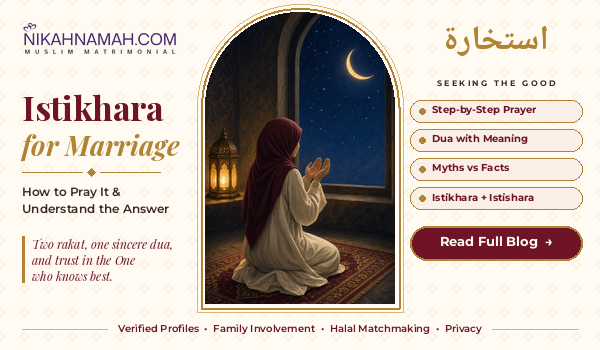
By NikahNamah | India's Most Trusted Muslim Matrimony Platform Since 1999
A proposal has come. The families have met, the conversations have gone well, and everyone is waiting for one answer. Then someone says, "Let us do istikhara first," and a new set of questions begins. How exactly do we pray it? Will there be a dream? What if we feel nothing? Should an aunt who is known for her istikhara do it for us?
Istikhara is one of the most beautiful gifts of the Sunnah for anyone facing a decision, and marriage is among the biggest decisions of all. Yet it is also surrounded by myths.
This guide explains what istikhara is, when it fits in the rishta process, how to pray it step by step, the words of the dua with their meaning, who should pray it, which popular beliefs have no basis, and how to understand what happens afterwards.
Our guide to 20 questions to ask before saying qubool mentions istikhara briefly as the final step after asking questions and consulting family. This article goes deeper into the prayer itself. For finding a partner whose values match yours, see our article on why compatibility in Nikah matters.
NikahNamah has been a Muslim matrimony platform and marriage bureau since 1999, from our offices in Jayanagar 9th Block and Frazer Town, Bangalore. With 86,000+ successful Nikah and 96,461+ registered members (figures as published on www.nikahnamah.com), we have walked with many families through this quiet, important stage of the search.
Please note: This article is general guidance for families, not a fatwa. Scholars differ on some details of istikhara, including praying on behalf of others and what to do during menstruation. For your own situation, please consult a qualified Alim or Mufti.
What Is Istikhara?
The Arabic word istikhara means seeking the good, or asking for what is best. In practice, it refers to a voluntary prayer of two rakat followed by a specific dua, in which a believer asks Allah to make a matter easy if it is good for them, and to turn it away if it is not.
The Prophet (peace be upon him) taught this prayer to his companions. In a narration recorded in Sahih al-Bukhari, the companion Jabir describes how the Prophet used to teach them istikhara for all their affairs, just as he taught them a surah of the Quran.
This shows that istikhara is not reserved for emergencies. It is for any matter, small or large.
At its heart, istikhara is an act of trust (tawakkul): you hand the outcome to Allah after doing your own part.
When to Pray Istikhara in the Rishta Process
The narration in Sahih al-Bukhari describes istikhara for when a person intends to do something. In the context of marriage, scholars generally understand this as the stage when you are seriously considering a specific proposal, but have not yet made a final commitment.
A common sequence in Indian Muslim families looks like this:
- A proposal arrives and the families make initial enquiries.
- Families meet, and the bride's wali and parents assess the proposal.
- The couple speak, with a mahram present, and ask the questions that matter.
- Facts are verified, such as education, work and marital status.
- The family consults trusted elders and people who know the other family.
- The person concerned prays istikhara about this specific proposal.
- A respectful answer is given within an agreed time.
Istikhara works best when it follows real effort. Our guide to the role of the wali explains how the family's role fits into this stage.
How to Pray Istikhara: Step by Step
Step 1: Make Your Intention
Be clear in your heart about the specific proposal you are asking about. Intention is in the heart and does not need to be spoken aloud.
Step 2: Perform Wudu and Pray Two Rakat of Nafl
After making wudu as you would for any prayer, pray two rakat of voluntary (nafl) prayer, separate from the obligatory prayers, as the narration describes. You may recite any surah after Al-Fatiha. Some scholars recommend particular surahs, but no specific surah is required.
Choose a time that is not one of the times when voluntary prayer is disliked, such as during sunrise or sunset. Many people prefer the night, after Isha or before Fajr, when the mind is calm, but istikhara may be prayed at other times too.
Step 3: Recite the Dua
After completing the two rakat, praise Allah, send blessings on the Prophet (peace be upon him), and then recite the dua of istikhara. Many scholars say it is best recited after the salam, while some also allow it before the salam. When you reach the words "this matter", bring to mind, or say, the specific matter: the proposal you are considering.
Step 4: Leave the Outcome to Allah
Then continue with your life. Keep talking with your family and watch how things unfold. There is no need to wait for a sign before you sleep.
The Dua of Istikhara: Words and Meaning
The text below is from the narration of Jabir in Sahih al-Bukhari, as presented on sunnah.com. If you can, learn it from the Arabic with a teacher.
Transliteration
Allahumma inni astakhiruka bi'ilmika, wa astaqdiruka biqudratika, wa as'aluka min fadlika-l-'azim. Fa innaka taqdiru wa la aqdiru, wa ta'lamu wa la a'lamu, wa anta 'allamu-l-ghuyub.
Allahumma in kunta ta'lamu anna hadha-l-amra khairun li fi dini wa ma'ashi wa 'aqibati amri (or: fi 'ajili amri wa ajilihi), fa-qdurhu li.
Wa in kunta ta'lamu anna hadha-l-amra sharrun li fi dini wa ma'ashi wa 'aqibati amri (or: fi 'ajili amri wa ajilihi), fasrifhu 'anni wasrifni 'anhu, waqdur liya-l-khaira haithu kana, thumma raddini bihi.
Meaning in English
O Allah, I seek Your guidance through Your knowledge, and I seek ability through Your power, and I ask You of Your immense bounty. For You have power and I have none, You know and I do not know, and You are the Knower of the unseen.
O Allah, if You know that this matter is good for me in my religion, my livelihood and the outcome of my affairs (or: in my affairs now and later), then ordain it for me.
And if You know that this matter is bad for me in my religion, my livelihood and the outcome of my affairs (or: in my affairs now and later), then turn it away from me and turn me away from it, and ordain for me the good wherever it may be, and then make me content with it.
The narration ends by saying that the person should then mention their need, that is, the specific matter.
The words in brackets reflect the narrator's note that the Prophet said one phrase or the other. Many people say both. The dua may also be made in your own language if you cannot yet recite the Arabic, while you work on learning it.
Notice that the dua asks Allah not only to turn away harm, but also to turn your own heart away from it, and to make you content with whatever He decides.
Who Should Pray Istikhara?
The Person Getting Married
The narration addresses the person who intends to do something. Scholars therefore generally hold that istikhara is best prayed by the person whose matter it is: the prospective bride or groom.
Can Parents Pray It for Their Children?
This is a common question in Indian families, where parents carry much of the search. Scholars differ. Many hold that istikhara in its specific form is for one's own matter, while parents can and should make heartfelt dua for their children, asking Allah to choose what is best for them. Some scholars allow a parent to pray istikhara regarding a matter in which they have a real role, such as the father as wali deciding whether to accept a proposal for his daughter.
In practice, the safest path is for the son or daughter to pray istikhara themselves, and for parents to add their own dua and, if their scholar advises it, their own istikhara. Please consult a qualified Alim or Mufti on this point.
Paying Someone to Do Istikhara
Some families approach individuals who offer to "do istikhara" on their behalf and report back with a verdict, sometimes for payment. There is no basis in the Sunnah for handing your istikhara to a stranger, and claims that someone can see the outcome on your behalf should be treated with great caution. Istikhara is a private conversation between you and Allah.
Common Myths About Istikhara
Myth 1: You Must See a Dream
The narration in Sahih al-Bukhari says nothing about dreams. A person may see a good or bad dream after istikhara, but dreams are not a required part of the answer, and many people never see one.
Myth 2: Colours Reveal the Answer
Some people believe that seeing green or white means yes, and red or black means no. This has no basis in the authentic texts.
Myth 3: You Must Pray It for Seven Nights
There is no authentic requirement to pray istikhara for a fixed number of nights. A narration about repeating it seven times is regarded as weak by many scholars. That said, many scholars say there is nothing wrong with repeating istikhara if you still feel unsure, as long as you do not turn it into a ritual of waiting for a sign.
Myth 4: Feeling Nothing Means It Failed
Many people pray istikhara and feel no dramatic change. That is normal. Istikhara is a dua, and Allah answers duas in ways we may not notice at once.
How to Understand the Answer
Scholars describe the result of istikhara not as a message to be decoded, but as Allah's arrangement of events and of your heart.
Ease or Difficulty in the Path
If the matter is good for you, you may find that things move forward smoothly: questions get answered, families agree, obstacles clear. If it is not, you may find doors closing: new information comes to light, one side withdraws, or practical problems keep arising.
Peace or Unease in the Heart
Many scholars mention that a person may feel an inclination or a sense of peace towards one option after istikhara. However, they also caution that a feeling must not be confused with personal desire, anxiety or pressure from others. Your heart's inclination is one sign among several, not the only test.
Contentment With the Outcome
The dua itself ends by asking Allah to make you content with what He decides. Sometimes the answer is the calm acceptance you feel when a proposal does not work out.
Pair Istikhara With Istishara
Scholars often say that a person who seeks Allah's guidance through istikhara and consults wise people through istishara will not regret their decision. Istishara means speaking to trusted elders, scholars and people who know the other family, and listening honestly to their advice. Our article on verified matrimony profiles explains why checking facts is part of this effort.
Special Situations
Praying for More Than One Proposal
Sometimes two or more proposals are being considered at once. Scholars generally suggest first narrowing the options through enquiries and consultation, then praying istikhara about the proposal you are leaning towards. Some people instead make istikhara about each proposal separately, naming one at a time. Either way, do not keep a family waiting longer than necessary.
When Families Disagree
It can happen that the son or daughter feels at peace with a proposal while the parents are uneasy, or the other way round. In this case:
- Talk openly about the reasons for each view.
- Separate facts from fears, and verify what can be checked.
- Consult a neutral scholar or elder whom both sides respect.
- Remember the wali's role and the bride's consent. Our guide to the role of the wali explains both. Neither should be ignored.
Istikhara should never become a weapon in a family argument, with one side claiming "my istikhara said no". It is a dua, not a verdict that overrules others.
Women During Menstruation
A woman cannot perform salah during menstruation, so she cannot pray the two rakat of istikhara at that time. Many scholars say that if the matter cannot wait, she may recite the dua of istikhara without the prayer, while others suggest waiting until she can pray. This is a point to confirm with a qualified Alim or Mufti.
Istikhara at a Glance
|
Question |
General guidance |
|
What is it? |
Two rakat of nafl prayer followed by the dua of istikhara |
|
When? |
When seriously considering a specific proposal, before a final commitment |
|
Who? |
Best prayed by the person getting married; parents add their dua (see scholar note) |
|
Dreams needed? |
No. Dreams are not required and should not decide alone |
|
How many times? |
No fixed number; it may be repeated if still unsure |
|
Signs of the answer |
Ease or difficulty in the path, inclination of the heart, contentment |
|
Paired with |
Istishara: consultation with trusted, knowledgeable people |
|
Paid services |
No basis in the Sunnah; pray it yourself |
How NikahNamah Supports Families at This Stage
Istikhara is between you and Allah, and we never ask families to rush it. Our premium members get a dedicated Relationship Manager who:
- Understands your family - your deen, values and expectations before suggesting anyone
- Shares verified profiles - so istikhara follows real facts, not guesses
- Arranges family introductions first - parents and walis speak before the couple
- Guides chaperoned conversations - with a parent, sibling or mahram present
- Hosts family meetings - at our Jayanagar 9th Block or Frazer Town offices if you wish
- Agrees a respectful timeline - so both families know when to expect an answer
- Communicates the answer with dignity - whether it is yes or a kind no
Profiles are manually verified, female members control their photo visibility, registration is free, and every step follows a 100% halal process. We are not a dating app. Read more about personalized matchmaking for Nikah, or register free when your family is ready.
Frequently Asked Questions
Q1: What is istikhara for marriage?
It is a two-rakat voluntary prayer followed by a dua taught by the Prophet (peace be upon him), asking Allah to make a proposal easy if it is good and to turn it away if it is not.
Q2: When should I pray istikhara for a rishta?
When you are seriously considering a specific proposal, after enquiries and family meetings, and before giving a final answer.
Q3: Do I need to see a dream after istikhara?
No. The narration says nothing about dreams. Look instead at how events unfold, the inclination of your heart, and the advice of trusted people.
Q4: How many times should I pray istikhara?
There is no fixed number. You may repeat it if you still feel unsure, without turning it into a wait for a sign.
Q5: Can my parents pray istikhara for me?
Scholars differ. It is best that you pray it yourself, while your parents make dua for you. Ask a qualified Alim or Mufti about your situation.
Q6: Can I make istikhara during my period?
You cannot pray the salah at that time. Many scholars allow reciting the dua alone if the matter cannot wait. Please confirm with a scholar.
Q7: What if I feel nothing after istikhara?
That is common. Continue with your enquiries and consultation, and trust that Allah will arrange what is best.
Q8: How do we contact NikahNamah?
Call or WhatsApp +91 98451 30331 or +91 90360 22522, email support@nikahnamah.com or info.nikahnamah@gmail.com, or register at www.nikahnamah.com. Our hours are Monday to Sunday, 10:00 AM - 8:00 PM IST (Friday Off).
Closing Reflection: Trusting the One Who Knows
Istikhara does not remove the need to think, ask and consult. When you have done your part and said the words the Prophet taught, you can move forward with a quiet heart, knowing that Allah will ordain the good wherever it may be.
May Allah guide every family to what is best, make the path easy for every sincere proposal, and fill every new home with sakinah, mawaddah and rahmah. Ameen.
Register today: www.nikahnamah.com
Call / WhatsApp: +91 98451 30331 | +91 90360 22522
Email: support@nikahnamah.com | info.nikahnamah@gmail.com
Also Read
- The Importance of Compatibility in Nikah
- Why Verified Matrimony Profiles Make Nikah Safer and Easier
- Benefits of Choosing a Personalized Matchmaking Platform for Nikah
- How Families Can Choose the Right Muslim Matrimony Platform
- Marriage Beyond Borders: Connecting Muslim Families Worldwide
About NikahNamah
NikahNamah is India's trusted Muslim matrimony platform and marriage bureau since 1999, combining the personal care of a Bangalore marriage bureau with online reach across India and the diaspora.
We offer personal Relationship Manager matchmaking, manually verified profiles, photo privacy for women, free registration and a 100% halal process from registration to Nikah, with 86,000+ successful Nikah and 96,461+ registered members (figures as published on www.nikahnamah.com).
Office and Contact
Main Branch: Jayanagar 9th Block, Bengaluru - 560069
Other Branch: Frazer Town, Bengaluru - 560005
Phone / WhatsApp: +91 98451 30331 | +91 90360 22522
Email: support@nikahnamah.com | info.nikahnamah@gmail.com
Website: www.nikahnamah.com
Office Hours: Monday to Sunday, 10:00 AM - 8:00 PM IST (Friday Off)
Service Area: All India | UAE | Saudi Arabia | Qatar | Kuwait | Bahrain | Oman | UK | USA | Canada | Australia | South Africa

💬 Comments