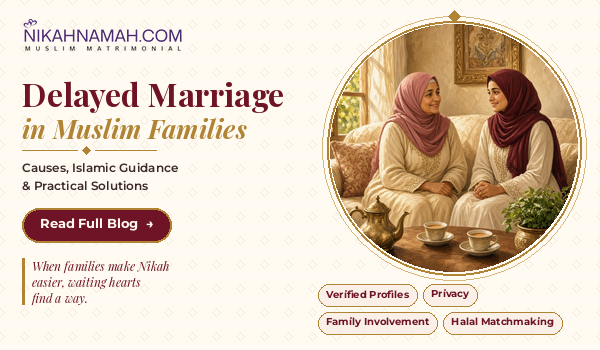
A mother sits beside her daughter's empty room after the guests leave another family function. Once again, relatives asked, "Any good news?" Once again, she smiled and changed the subject. Her daughter is educated, kind and devoted to her prayers. Proposals have come. Yet somehow, year after year, nothing has moved forward.
This quiet story plays out in many Muslim homes in India and abroad. Sons wait until they feel "settled enough." Daughters wait for a proposal that satisfies every relative. Families wait for the right biradari, the right city, the right month, the right moment. Meanwhile, years pass.
Delay is not always wrong. Sometimes it is wise, necessary or simply the decree of Allah. But many delays come from causes families can actually change. This guide looks at those causes honestly, sets out the Islamic guidance, and offers practical steps for parents and for those waiting.
NikahNamah has served Muslim families since 1999 from our offices in Jayanagar 9th Block and Frazer Town, Bangalore. With 86,000+ successful Nikah and 96,461+ registered members (figures as published on www.nikahnamah.com), we have met many families who felt stuck, and seen how small changes can open the way.
Please note: This article is general guidance, not a fatwa. When marriage becomes obligatory or recommended for a person, and how parents should weigh their children's wishes, depend on individual circumstances and scholarly views. For your own situation, please consult a qualified Alim or Mufti.
What Islam Says About Marrying and Making Marriage Easy
The Encouragement to Marry
Allah says: "Marry off the ˹free˺ singles among you, as well as the righteous of your bondmen and bondwomen. If they are poor, Allah will enrich them out of His bounty. For Allah is All-Bountiful, All-Knowing" (An-Nur 24:32, translation from quran.com).
The verse speaks to the community and to guardians, not only to the person seeking marriage. Helping the unmarried to marry is a shared responsibility.
The Prophet ﷺ said: "O young people! Whoever among you is able to marry, should marry, and whoever is not able to marry, is recommended to fast" (Sahih al-Bukhari 5065, translation from sunnah.com).
Patience When Marriage Is Not Yet Possible
The next verse adds: "And let those who do not have the means to marry keep themselves chaste until Allah enriches them out of His bounty" (An-Nur 24:33, translation from quran.com).
Islam therefore holds two truths together. Marriage should be made easy and pursued with sincerity. And when it is delayed for real reasons, the believer remains patient and chaste, trusting Allah.
A Note on Rulings
Scholars explain that the ruling on marriage can vary by person, from recommended to obligatory, for example when someone fears falling into sin and is able to marry. These details depend on circumstances, so please consult a qualified Alim or Mufti.
The Real Causes of Delayed Marriage
Delays rarely have a single cause. Usually several overlap.
1. Expensive Weddings and Social Pressure
Families often delay because they feel they cannot yet afford the wedding that relatives expect. Our guide on culture vs Islamic requirements in marriage explains how much of this spending is custom rather than religion. When the walimah and the Nikah are kept simple, this cause can often disappear.
2. Waiting to Be "Fully Settled"
Many young men wait for a particular job title, a home of their own or a level of savings. Some stability is sensible, because the husband carries the duty of nafaqah. But "settled" can keep moving. Families should ask: can he provide reasonably now, within his means? If yes, waiting for perfection may not be necessary.
3. Unrealistic or Rigid Expectations
Long lists of requirements on height, complexion, profession, city, family size or income narrow the field until almost no one fits. Sometimes parents hold these lists; sometimes the person does. Expectations about deen and character deserve firmness. Many others deserve flexibility.
4. Caste, Biradari and Community Restrictions
Insisting on a single community or sub-group can shrink the pool sharply. Our culture vs Islamic requirements guide explains why nobility in Islam rests on taqwa, and how kafa'ah differs from caste pride.
5. Elder Sibling and Other Family Customs
Some families will not consider a younger child's proposals until an elder sibling marries. Others wait for a family event, a property matter or a relative's approval. These customs come from love and respect, but they are not Islamic conditions, and they can hold several children back at once.
6. Education and Career Timelines
Long courses, professional exams and early career pressure push marriage later. Our guide on marriage for Muslim professionals discusses how careers and marriage can grow together. For many people, marrying during studies or early career is possible with planning and family support.
7. Fear, Past Hurt and Indecision
Some people delay because of a broken engagement, a parent's difficult marriage, a fear of losing freedom, or simple uncertainty. Others keep refusing reasonable proposals while waiting for a feeling of total certainty. Istikhara and consultation help, as our istikhara guide explains, but no proposal will remove every doubt.
8. Over-Reliance on Passive Searching
Some families wait for proposals to arrive through relatives alone. Others register online but rarely respond, follow up or present the profile well. A search that is not actively managed tends to stall.
9. Parental Control and Lack of Communication
Sometimes parents and children want different things and never discuss it openly. A child may hesitate to state preferences; parents may reject proposals without explaining why. Silence lets years slip away.
The Hidden Costs of Long Delay
Families sometimes see delay as harmless, as if waiting longer only improves the outcome. But long, unnecessary delay can carry real costs:
- Spiritual: guarding chastity and modesty can become harder over time
- Emotional: loneliness, low confidence and a sense of being left behind
- Family strain: blame between parents and children, and tension with relatives
- Social pressure: repeated questions at gatherings that wound rather than help
- Narrowing choices: preferences harden, and people at the same life stage may feel fewer
None of this means anyone should rush into an unsuitable marriage. It means families should take delay seriously and address what they can.
A Special Word About Daughters
Daughters often carry the heaviest weight of delay. In many communities, a woman in her late twenties or thirties faces comments and assumptions that a man of the same age does not.
Islam does not attach shame to a woman's age at marriage. Our guide on the Sunnah of choosing a spouse recalls that Khadijah (RA) married the Prophet ﷺ when she was older than him and had been married before. Families should:
- Stop comparing daughters with cousins or friends
- Protect them from hurtful remarks at gatherings
- Seek their views on proposals sincerely, since a woman's consent is required in Nikah
- Remember that the wali's role, explained in our wali guide, is to protect her interests, not to delay without reason
A Word to Sons and Their Parents
Sons also face pressure, often around income and readiness. Parents can help by:
- Valuing character and deen as much as income
- Accepting a modest start instead of waiting for a perfect home
- Supporting the couple in the early years where possible
- Not delaying a son's marriage for reasons of family prestige
A young man who is able to marry and fears for his modesty should not be told to wait years for a status milestone.
Practical Solutions for Families
1. Simplify the Wedding
- Agree with the other family on a simple Nikah and modest walimah
- Refuse dowry demands and avoid competitive gifting
- Spend within means, without debt
2. Review the Requirements List Together
Sit as a family and divide your list into three parts:
| Category | Examples | Approach |
|---|---|---|
| Essential | Deen, character, consent, kindness | Hold firm |
| Important | Education, family values, lifestyle fit | Discuss and weigh |
| Flexible | Height, complexion, exact city, community sub-group | Relax where possible |
Many families find that the "flexible" column was holding them back more than anything else.
3. Talk Openly as Parents and Children
- Ask your son or daughter what truly matters to them
- Explain your concerns calmly, without pressure
- Agree on a shared approach to proposals
- Revisit the conversation every few months
4. Search Actively, Not Passively
- Present a clear, honest profile; our guide to writing a strong matrimony profile can help
- Respond to proposals promptly and respectfully
- Use halal channels; our guide to halal ways to find a spouse covers trusted options
- Consider a matchmaking service with personal support
5. Ask the Right Questions Early
Instead of meeting many proposals briefly, explore suitable ones properly. Our guide to 20 questions to ask before saying qubool helps families reach clarity faster.
6. Address Fear and Past Hurt Gently
- Acknowledge past experiences without judgement
- Encourage small steps, such as a family meeting rather than an immediate decision
- Seek counselling from trusted, qualified people if fear is deep
- Make dua together, and trust Allah's timing
7. Set Aside Unhelpful Customs Respectfully
If an elder sibling custom or a family event is holding everyone back, discuss it kindly with elders. A respected scholar can help families agree. Each child's marriage can proceed in its own time.
8. Rely on Allah While Taking Steps
Allah says that whoever is mindful of Him, He will "provide for them from sources they could never imagine. And whoever puts their trust in Allah, then He ˹alone˺ is sufficient for them" (At-Talaq 65:3, translation from quran.com). Tawakkul means doing what is within your power and then trusting Allah with the outcome.
Guidance for Those Who Are Waiting
If you are the one waiting, the delay may feel personal. It is not a measure of your worth.
Protect Your Heart and Your Deen
- Keep your prayers, and make dua sincerely for a righteous spouse
- Guard your modesty, including online
- Fast when you can, following the Prophetic advice above
- Spend time with good company who uplift you
Use This Time Well
- Grow in knowledge of the deen, including the rights and responsibilities of marriage; our rights guide is a good place to start
- Build life skills such as cooking, managing money and communication
- Look after your health
- Serve your family and community
Be Open, Not Desperate
- Reflect honestly on whether your own expectations need adjusting
- Consider proposals you may have dismissed too quickly
- Avoid unsafe or haram shortcuts born of frustration
- Remember that after hardship, Allah brings ease, as He says in At-Talaq 65:7
For divorced or widowed members facing delay in a second marriage, our remarriage guide offers specific guidance.
How Relatives and the Community Can Help
- Stop the hurtful questions. "Any good news?" rarely helps. A sincere dua does.
- Suggest suitable proposals with care and honesty.
- Support simple weddings by attending happily and not criticising modest events.
- Speak up against dowry and display.
- Encourage imams and community leaders to address delayed marriage in khutbahs and gatherings.
Making marriage easy is a collective effort, as An-Nur 24:32 reminds us.
How NikahNamah's RM Helps Families Facing Delay
Our premium members receive a dedicated Relationship Manager who:
- Listens to the whole story - including past proposals, family concerns and fears
- Helps refine expectations - separating essentials from preferences, respectfully
- Searches actively - so the search keeps moving even when the family is busy
- Shortlists thoughtfully - prioritising deen, character and genuine compatibility
- Guides conversations - helping parents and children align, and families discuss expectations early
- Encourages simple, halal weddings - and discourages dowry demands
- Treats every member with dignity - whatever their age, history or circumstances
Registration is free, and every step follows a 100% halal process. Read more about personalized matchmaking for Nikah and how families can choose the right matrimony platform.
Frequently Asked Questions
Q1: Is it wrong to delay marriage in Islam?
Delay for genuine reasons is not wrong, but Islam encourages making marriage easy. Whether marriage is recommended or obligatory for you depends on your circumstances, so please consult a qualified Alim or Mufti.
Q2: What are the most common causes of delayed marriage?
Expensive weddings, waiting to be "settled", rigid expectations, community restrictions, family customs, career timelines, fear and passive searching.
Q3: Should a young man wait until he owns a home before marrying?
Not necessarily. He should be able to provide within his means. Waiting for every milestone can delay marriage unnecessarily.
Q4: Is there an age limit for a woman to marry in Islam?
No. Islam attaches no shame to a woman's age at marriage. Khadijah (RA) is a well-known example.
Q5: Can parents delay their child's marriage indefinitely?
Parents should act in their children's interests and not delay without good reason. For specific situations, please consult a qualified Alim or Mufti.
Q6: What can I do spiritually while waiting?
Pray, make dua, guard your modesty, fast when you can, and trust Allah while taking practical steps.
Q7: How can families make marriage easier?
Simplify the wedding, review requirements, talk openly, search actively and set aside unhelpful customs.
Q8: How do we contact NikahNamah?
Call or WhatsApp +91 98451 30331 or +91 90360 22522, email support@nikahnamah.com or info.nikahnamah@gmail.com, or register at www.nikahnamah.com. Our hours are Monday to Sunday, 10:00 AM - 8:00 PM IST (Friday Off).
Closing Reflection: Making the Path Easy
Every delayed marriage has its own story. Some delays are part of Allah's wise plan; others come from expectations and customs that families can gently change. When parents listen, expectations become realistic, weddings become simple and the search becomes active and halal, many closed doors begin to open.
May Allah grant every waiting son and daughter a righteous spouse, ease the hearts of their parents, and fill their homes with sakinah, mawaddah and rahmah. Ameen.
Register today: https://www.nikahnamah.com/
Call / WhatsApp: +91 98451 30331 | +91 90360 22522
Email: support@nikahnamah.com | info.nikahnamah@gmail.com
Also Read
- Benefits of Choosing a Personalized Matchmaking Platform for Nikah
- How Families Can Choose the Right Muslim Matrimony Platform
- Why Verified Matrimony Profiles Make Nikah Safer and Easier
- Muslim Matrimony for Doctors, Engineers and Professionals
About NikahNamah
NikahNamah is India's trusted Muslim matrimony platform and marriage bureau since 1999, combining the personal care of a Bangalore marriage bureau with online reach across India and the diaspora.
We offer personal Relationship Manager matchmaking, manually verified profiles, photo privacy for women, free registration and a 100% halal process from registration to Nikah, with 86,000+ successful Nikah and 96,461+ registered members (figures as published on www.nikahnamah.com).
Office and Contact
Main Branch: Jayanagar 9th Block, Bengaluru - 560069
Other Branch: Frazer Town, Bengaluru - 560005
Phone / WhatsApp: +91 98451 30331 | +91 90360 22522
Email: support@nikahnamah.com | info.nikahnamah@gmail.com
Website: www.nikahnamah.com
Office Hours: Monday to Sunday, 10:00 AM - 8:00 PM IST (Friday Off)
Service Area: All India | UAE | Saudi Arabia | Qatar | Kuwait | Bahrain | Oman | UK | USA | Canada | Australia | South Africa

💬 Comments