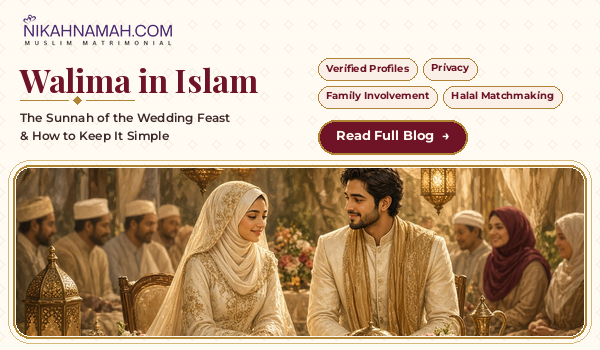
For many families, the walima has grown into the biggest and most stressful event of the wedding: endless guest lists, competing menus and worries about what people will say. Yet in the Sunnah, the walima is a simple act of gratitude. It announces a marriage and shares a meal for the sake of Allah.
NikahNamah has supported Muslim families since 1999, with 86,000+ successful Nikah and 96,461+ registered members (figures as published on www.nikahnamah.com). This guide focuses only on the walima: what the Sunnah teaches, and how to plan one that brings barakah rather than burden.
Please note: This article is general guidance. Rulings on the status, timing and conditions of the walima can differ between schools of thought. Please consult a qualified Alim or Mufti for your own situation.
What Is the Walima?
The walima is the wedding feast held to celebrate and announce a marriage. It is separate from the Nikah contract itself. Our complete guide to the Nikah process explains where the walima fits among the steps of a marriage, and our guide on culture vs Islamic requirements in marriage explains which wedding customs are Islamic and which are cultural.
The best-known hadith comes from the marriage of Abdur-Rahman bin Awf. The Prophet (ﷺ) said to him: "Give a banquet, even if with one sheep" (Sahih al-Bukhari 5167, translation from sunnah.com).
Note the words "even if": the instruction is to hold a walima, not a grand one.
Its Status
Most scholars describe the walima as a confirmed Sunnah, while some regard it as more strongly required. Almost all agree it is not a condition for the Nikah to be valid. For the ruling followed in your school, please consult a qualified Alim or Mufti.
Who Hosts the Walima?
The walima is traditionally the groom's responsibility, as the hadith addressed to Abdur-Rahman bin Awf shows. In practice:
- The groom and his family usually host
- Relatives may help out of love, without pressure or obligation
- The bride's family should not be expected or pressured to pay for it
Where families choose to share arrangements by mutual, happy agreement, that should be a free choice, never a demand.
When Is It Held?
Scholars mention a range of acceptable times, from after the Nikah contract to after the couple begins living together, and some prefer soon after the marriage is consummated. Local customs vary. For the preferred timing in your school, please consult a qualified Alim or Mufti.
Practically, choose a time that suits the couple, keeps travel easy for elders and avoids clashing with prayer times.
Whom to Invite: Including the Poor
The walima is not a status event. Abu Huraira said: "The worst food is that of a wedding banquet to which only the rich are invited while the poor are not invited" (Sahih al-Bukhari 5177, translation from sunnah.com).
So when planning your guest list:
- Invite family, neighbours and friends sincerely
- Make room for people in need, such as poorer relatives, neighbours and local families
- Do not build the list around influence or business benefit
- Consider sending food to those who cannot attend
A smaller walima that includes the poor is more in line with the Sunnah than a larger one that shuts them out.
Accepting a Walima Invitation
The Prophet (ﷺ) said: "If anyone of you is invited to a wedding banquet, he must go for it (accept the invitation)" (Sahih al-Bukhari 5173, translation from sunnah.com).
As a guest:
- Accept when you can, and attend with good intention
- Make dua for the couple
- Avoid complaining about food, seating or arrangements
- If something impermissible takes place, scholars discuss when it is acceptable not to attend; please consult a qualified Alim or Mufti
Avoiding Extravagance and Debt
The Quran is clear on moderation. Allah says: "Eat and drink, but do not waste. Surely He does not like the wasteful" (Al-A'raf 7:31, translation from quran.com). And He praises those "who spend neither wastefully nor stingily, but moderately in between" (Al-Furqan 25:67, translation from quran.com).
For a walima, this means:
- No debt for display. Borrowing to impress guests places a burden on the new couple.
- No food waste. Plan sensible quantities and arrange to share leftovers.
- No competition. Your walima does not need to match a relative's.
- No pressure on the bride's side. Keep expectations fair.
Simplicity is not stinginess: give generously, within your means.
Practical Planning Tips
- Set your intention first. Hold the walima to follow the Sunnah and thank Allah.
- Agree on a size together. The couple and both families should agree before invitations go out.
- Choose a modest venue. A home, a community hall or a masjid space can all work well.
- Keep the menu simple. A few good dishes are better than many wasted ones.
- Separate arrangements where your family and community follow that practice.
- Plan for prayer. Leave time and space for salah.
- Invite the poor. Put them on the list from the start, not as an afterthought.
- Avoid anything impermissible, as advised by your scholars.
Combining Both Families' Expectations
- Talk early. Discuss expectations openly before plans are fixed.
- Lead with the Sunnah. When disagreements come up, return to what the Prophet (ﷺ) taught.
- Let the couple speak. Their wishes for simplicity deserve respect.
- Use a trusted elder. A respected person can help both sides agree gently.
How a NikahNamah RM Can Help
Our Relationship Managers (RMs) focus on matchmaking, and good matches start with shared values:
- Understand each family's views on simplicity and customs early
- Share manually verified profiles
- Encourage open talk about wedding expectations before commitment
- Arrange respectful introductions with family involved
- Help clarify questions between families
- Keep your search private
- Support families through the process
Registration is free, and every step follows a 100% halal process. Learn more about personalized matchmaking for Nikah and verified matrimony profiles.
Frequently Asked Questions
Q1: Is the walima required for a valid Nikah?
No. It is a Sunnah, not a condition of validity. Please consult a qualified Alim or Mufti for details.
Q2: Who should host the walima?
Traditionally, the groom and his family.
Q3: Can the walima be small?
Yes. The Prophet (ﷺ) said "even if with one sheep" (Sahih al-Bukhari 5167).
Q4: Should we invite the poor?
Yes. A walima that excludes the poor is criticised in Sahih al-Bukhari 5177.
Q5: Must I accept a walima invitation?
The hadith strongly encourages it (Sahih al-Bukhari 5173). Ask a scholar about exceptions.
Q6: When should the walima be held?
Timing varies by scholarly view and custom. Please consult a qualified Alim or Mufti.
Q7: Can we hold the walima at home?
Yes. A home or simple venue is perfectly fine.
Q8: How do we contact NikahNamah?
Call or WhatsApp +91 98451 30331 or +91 90360 22522, or email support@nikahnamah.com or info.nikahnamah@gmail.com. Hours: Monday to Sunday, 10:00 AM - 8:00 PM IST (Friday Off).
Closing Reflection
The walima is a meal of gratitude, not a test of status. When it is simple, sincere and open to the poor, it carries the barakah of the Sunnah into the first days of a marriage.
May Allah bless every couple and their walima, accept it as an act of thanks, and place goodness and ease in their new home. Ameen.
Register today: https://www.nikahnamah.com/
Call / WhatsApp: +91 98451 30331 | +91 90360 22522
Email: support@nikahnamah.com | info.nikahnamah@gmail.com
Also Read
- Benefits of Choosing a Personalized Matchmaking Platform for Nikah
- Why Verified Matrimony Profiles Make Nikah Safer and Easier
- Muslim Matrimony for Doctors, Engineers and Professionals
- How Families Can Choose the Right Muslim Matrimony Platform
About NikahNamah
NikahNamah is India's trusted Muslim matrimony platform and marriage bureau since 1999. We offer personal Relationship Manager matchmaking, manually verified profiles, photo privacy for women, free registration and a 100% halal process, with 86,000+ successful Nikah and 96,461+ registered members (figures as published on www.nikahnamah.com).
Main Branch: Jayanagar 9th Block, Bengaluru - 560069
Other Branch: Frazer Town, Bengaluru - 560005
Phone / WhatsApp: +91 98451 30331 | +91 90360 22522
Email: support@nikahnamah.com | info.nikahnamah@gmail.com
Office Hours: Monday to Sunday, 10:00 AM - 8:00 PM IST (Friday Off)

💬 Comments