By NikahNamah | India's Most Trusted Muslim Matrimony Platform Since 1999
A father sits with a long list in front of him. Hall booking, catering for hundreds, jewellery for the bride, gifts for the groom's family, clothes for relatives, mehndi night, a sanchaq ceremony, rukhsati arrangements. Somewhere near the bottom of the list is the Nikah itself, the part that takes only a short time and that Allah actually requires.
Many Indian Muslim families feel this tension. Some customs are beautiful and carry generations of love. Others create debt, pressure and even injustice, yet families follow them because "this is how it is done." The result can be delayed marriages, strained families and weddings that look grand but feel heavy.
This guide separates what Islam requires from what culture adds, so families can keep what is good and set aside what harms, with respect and wisdom.
NikahNamah has served Muslim families since 1999 from our offices in Jayanagar 9th Block and Frazer Town, Bangalore. With 86,000+ successful Nikah and 96,461+ registered members (figures as published on www.nikahnamah.com), we have seen how simple, sincere weddings often bring the most peace.
Please note: This article is general guidance, not a fatwa. The validity of a Nikah, kafa'ah and the status of specific customs involve differences between the Hanafi, Shafi'i, Maliki and Hanbali schools and between scholars. For your own situation, please consult a qualified Alim or Mufti. Legal points are general; verify current law with a qualified lawyer.
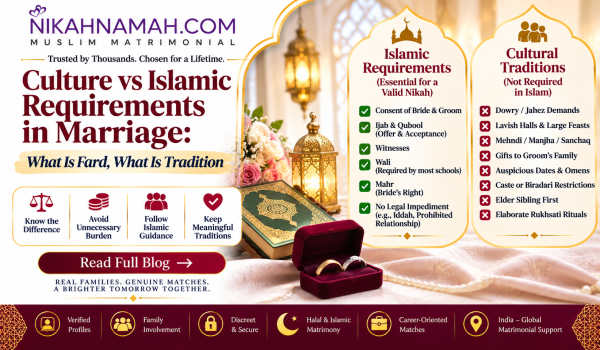
The Essentials of a Valid Nikah, in Brief
Our Nikah process guide explains each step in detail. In brief, scholars generally list these core elements:
- Consent of both the bride and the groom
- Offer and acceptance (ijab and qubool) in one sitting
- Witnesses, with conditions that differ between schools
- The wali for the bride, required by most schools, with the Hanafi school differing for an adult woman; see our wali guide
- Mahr, the bride's right, explained in our Mahr guide
- No legal impediment, such as a prohibited relationship or a woman still in her iddah
The walimah, a wedding meal given by the groom, is a strong Sunnah. Registration of the marriage is a legal and practical safeguard in India, and strongly advisable.
Almost everything else at a typical Indian Muslim wedding is culture.
At a Glance: Islamic Requirement or Cultural Custom?
|
Practice |
Status in Islam (general) |
Notes |
|
Consent of bride and groom |
Required |
No valid Nikah without it |
|
Ijab and qubool |
Required |
Offer and acceptance |
|
Witnesses |
Required |
Conditions differ between schools |
|
Wali |
Required by most schools |
Hanafi view differs for adult women |
|
Mahr |
Required, the bride's right |
Should not be a burden |
|
Walimah |
Strong Sunnah |
Simple meals are enough |
|
Khutbah al-Nikah |
Sunnah |
Recommended, not a condition |
|
Dowry or jahez demands from bride's family |
Not required; demands are wrong |
Also restricted under Indian law |
|
Lavish hall, decor, large guest lists |
Not required |
Wasteful spending is discouraged |
|
Mehndi, manjha, sanchaq |
Cultural |
Permissible or disputed, depending on content |
|
Caste or biradari restrictions |
Not an Islamic requirement |
Kafa'ah is a separate concept |
|
Complexion preferences |
Not Islamic |
Can cause real harm |
|
Auspicious dates and omens |
Not Islamic |
Superstitious omens are rejected |
|
Elder sibling first |
Cultural |
Not a condition |
|
Gifts to groom's family |
Cultural |
Never an obligation |
|
Rukhsati rituals |
Cultural |
The departure itself is natural |
The sections below explain these in more detail.
Dowry and Jahez Demands
In many Indian families, the bride's family is expected to provide jahez: furniture, appliances, jewellery, vehicles or cash for the groom or his family. Sometimes this is offered freely; often it is demanded or expected.
What Islam Says
Islam places the financial duty of marriage on the groom, not the bride's family. The groom gives mahr to the bride as her right, and he is responsible for providing for her afterwards. Our rights guide explains nafaqah in detail. There is no Islamic requirement for the bride's family to pay the groom or his family anything.
Parents may give their daughter gifts out of love, and these belong to her. But demanding goods or money as a condition of marriage, or pressuring the bride's family, is widely regarded by scholars as wrong and a form of injustice.
What the Law Says
India's Dowry Prohibition Act restricts giving, taking and demanding dowry. Families should read the current law and speak with a qualified lawyer for details; this article does not offer legal advice.
Practical Steps
- Say clearly, early and kindly that your family neither gives nor accepts jahez demands
- Let gifts be voluntary, modest and owned by the bride
- Treat any demand as a serious warning sign about the family's values
Lavish Weddings and Debt vs Simplicity
Many families borrow, sell property or delay marriages for years to afford grand weddings. The Quran describes the true servants of Allah as "those who spend neither wastefully nor stingily, but moderately in between" (Al-Furqan 25:67, translation from quran.com).
When Abdur-Rahman bin Awf married, the Prophet ﷺ told him: "Give a banquet, even if with one sheep" (Sahih al-Bukhari 5167, translation from sunnah.com). The walimah is a Sunnah, and its essence is gratitude and sharing, not display.
Why Simplicity Matters
- It makes marriage easier and earlier for young people
- It protects families from debt, including interest-based loans
- It keeps the focus on the Nikah and the couple
- It reduces competition and pressure between families
Ideas for a Simple, Beautiful Wedding
- Hold the Nikah at a masjid after a prayer
- Keep guest lists to close family, friends and neighbours
- Host a modest walimah within your means
- Invite people in need, not only the well-off
- Spend on the couple's future rather than one day of display
Mehndi, Manjha, Sanchaq and Other Ceremonies
Indian Muslim weddings include many regional customs: mehndi (henna), manjha or haldi-style ceremonies, sanchaq (sending gifts and clothes to the bride), sehra, joota chupai, aarsi mushaf and more.
How Scholars Generally Approach These
Scholars differ. Many hold that customs (urf) are permissible in principle if they:
- Do not involve shirk, superstition or imitation of other religions' rituals
- Do not involve free mixing, immodesty or haram music, according to their view
- Do not cause wasteful spending or debt
- Are not treated as religious obligations
- Do not burden or humiliate anyone
Other scholars are stricter and discourage some of these customs entirely, especially those with roots in other religious practices. Women applying henna among women, for example, is widely accepted, while some ceremonies are disputed. Please consult a qualified Alim or Mufti about specific customs in your family.
The key test: is this custom kind, modest and affordable, and is anyone being pressured or harmed by it?
Caste, Biradari and Complexion vs the Quran
Many Indian Muslim families restrict proposals by caste or biradari, such as Syed, Sheikh, Pathan, Ansari, Qureshi and others, or by skin colour. These preferences often limit good proposals and can wound people deeply.
What the Quran Says
"O humanity! Indeed, We created you from a male and a female, and made you into peoples and tribes so that you may ˹get to˺ know one another. Surely the most noble of you in the sight of Allah is the most righteous among you" (Al-Hujurat 49:13, translation from quran.com).
Nobility in Islam is based on taqwa, not lineage or complexion. Preferring a fair-skinned spouse as a sign of worth, or rejecting a righteous proposal only because of biradari, sits poorly with this verse.
Understanding Kafa'ah Carefully
Kafa'ah means suitability or compatibility between spouses. It is a genuine concept in Islamic law, but it is often misunderstood.
- What it is: a consideration mainly intended to protect the bride and her family from a match likely to cause hardship or harm
- What scholars consider: schools differ. Religious commitment is widely emphasised. Some schools, particularly the Hanafi school, also discuss factors such as lineage, profession or financial standing; others, such as the Maliki school, focus mainly on deen and freedom from serious defects
- How it works: in many views, kafa'ah is a right of the bride and her wali that they can waive; it is not a ban on marrying outside one's community
- What it is not: a religious basis for caste pride, looking down on others, or rejecting righteous people
Because the schools differ in detail, families should consult a qualified Alim or Mufti before relying on kafa'ah in a specific case.
Practical Steps
- Prioritise deen and character
- Consider genuine compatibility in culture and lifestyle without pride
- Never comment on complexion as a measure of worth
Horoscope-Style Beliefs and Auspicious Dates
Some families avoid certain months or days for weddings, consult numerology or star-matching, or treat certain events as bad omens.
The Prophet ﷺ said: "No 'Adwa nor Tiyara; but I like Fal." When asked what Fal was, he said, "A good word" (Sahih al-Bukhari 5776, translation from sunnah.com). Scholars explain tiyarah as drawing bad omens from events or signs, which Islam rejects.
What This Means for Weddings
- No month or day is unlucky for Nikah in Islam
- Horoscope or star-matching has no place in choosing a spouse
- Families may choose a convenient date, and some prefer Fridays or certain months for reasons of convenience or scholarly preference; please consult a qualified Alim or Mufti on specific views
- Rely on istikhara, consultation and trust in Allah
Age Gaps and "Elder Sibling First"
Age Gaps
Islam sets no fixed rule that the husband must be older, or by how much. Many families have strong preferences, but a sensible age difference is a matter of compatibility and consent, not religious requirement. Legal age requirements in India must always be respected; verify current law.
Elder Sibling First
Many families insist that an elder sibling marry before a younger one. This custom comes from respect, but it is not an Islamic condition. When it delays a younger sibling's marriage for years, it can create hardship. Families can discuss it kindly and remember that each person's rizq and timing are from Allah.
Gifts to the Groom's Family
Some customs expect the bride's family to give clothes, jewellery or other gifts to the groom's parents, siblings and relatives. Voluntary gifts within means can express affection. But when gifts become expected, listed or compared, they become a burden similar to dowry.
- Gifts should be voluntary and modest
- No one should keep score or criticise what was given
- Both families should agree in advance to keep things simple
Rukhsati Customs
Rukhsati, the bride's departure to her husband's home, is a natural and emotional moment. Customs around it, such as holding the Quran over the bride, specific rituals at the doorstep, or elaborate processions, are cultural.
- The departure itself is natural and can be marked with dua
- Customs with superstitious meanings should be avoided
- Reciting Quran and making dua for the couple is a beautiful way to mark the moment
- Avoid display, debt or anything that burdens either family
Scholars differ on some rukhsati customs, so consult a qualified Alim or Mufti if your family is unsure.
Keeping Good Culture, Dropping Harmful Parts
Islam does not ask families to abandon their cultural identity. Food, dress, language, poetry and warm family gatherings can all be part of a halal wedding. The goal is to filter culture through the Quran and Sunnah, not to erase it.
A Simple Filter
Ask about each custom:
- Does it contradict any Islamic principle?
- Does it cause debt, waste or pressure?
- Does it humiliate or exclude anyone?
- Is it being treated as a religious obligation when it is not?
- Would the family be at peace if it were left out?
Changing Customs Respectfully
- Start early: discuss expectations at the proposal stage
- Speak with respect: elders often follow customs out of love and fear of criticism
- Use knowledge, not mockery: share what scholars say, gently
- Involve a trusted scholar: a respected Alim can help families agree
- Agree as both families: so neither side fears social judgement
- Lead by example: simple weddings encourage others
For divorced or widowed members, our remarriage guide discusses how many customs that weigh on first weddings can be eased even further.
How NikahNamah Encourages Simple Halal Weddings
Our premium members receive a dedicated Relationship Manager who:
- Prioritises deen and character - in every shortlist, rather than biradari or complexion alone
- Raises expectations early - including jahez, gifts and wedding scale, so families agree from the start
- Discourages dowry demands - and flags any family that makes them
- Encourages simplicity - a masjid Nikah and a modest walimah within means
- Respects good culture - helping families keep the customs that bring joy without burden
- Supports scholar consultation - so families can resolve questions of fiqh properly
- Facilitates chaperoned meetings - by video or at our Bangalore offices, with a mahram present
Registration is free, and every step follows a 100% halal process. Learn more about personalized matchmaking for Nikah.
Frequently Asked Questions
Q1: What are the essential requirements of a valid Nikah?
Generally consent, ijab and qubool, witnesses, mahr and, in most schools, a wali. Details differ between schools, so please consult a qualified Alim or Mufti.
Q2: Is dowry (jahez) required in Islam?
No. The groom gives mahr to the bride. Demands on the bride's family are wrong and also restricted under Indian law; verify details with a lawyer.
Q3: Is a big wedding Sunnah?
No. The walimah is Sunnah, and the Prophet ﷺ said "even if with one sheep." Simplicity and moderation are encouraged.
Q4: Are mehndi and other ceremonies haram?
Scholars differ. Many permit customs free from shirk, immodesty and waste; others are stricter. Consult a qualified Alim or Mufti.
Q5: Does kafa'ah mean we must marry within our caste?
No. Kafa'ah is about suitability, and schools differ on its factors. It is not a basis for caste pride.
Q6: Are some days or months unlucky for Nikah?
No. Islam rejects bad omens (tiyarah). Choose a date that is convenient for both families.
Q7: Must the elder sibling marry first?
No. It is a cultural custom, not an Islamic condition.
Q8: How do we contact NikahNamah?
Call or WhatsApp +91 98451 30331 or +91 90360 22522, email support@nikahnamah.com or info.nikahnamah@gmail.com, or register at www.nikahnamah.com. Our hours are Monday to Sunday, 10:00 AM - 8:00 PM IST (Friday Off).
Closing Reflection: Easy Nikah, Blessed Home
When families separate fard from tradition, marriage becomes easier, earlier and lighter. Good culture can stay, adding warmth and identity. What burdens, excludes or contradicts Islam can be set aside gently. The result is a wedding that pleases Allah and a home that begins without debt or resentment.
May Allah make Nikah easy for every family, protect them from pressure and display, and fill their homes with sakinah, mawaddah and rahmah. Ameen.
Register today: www.nikahnamah.com
Call / WhatsApp: +91 98451 30331 | +91 90360 22522
Email: support@nikahnamah.com | info.nikahnamah@gmail.com
Also Read
- Benefits of Choosing a Personalized Matchmaking Platform for Nikah
- How Families Can Choose the Right Muslim Matrimony Platform
- Why Verified Matrimony Profiles Make Nikah Safer and Easier
- Marriage Beyond Borders: Connecting Muslim Families Worldwide
About NikahNamah
NikahNamah is India's trusted Muslim matrimony platform and marriage bureau since 1999, combining the personal care of a Bangalore marriage bureau with online reach across India and the diaspora.
We offer personal Relationship Manager matchmaking, manually verified profiles, photo privacy for women, free registration and a 100% halal process from registration to Nikah, with 86,000+ successful Nikah and 96,461+ registered members (figures as published on www.nikahnamah.com).
Office and Contact
Main Branch: Jayanagar 9th Block, Bengaluru - 560069
Other Branch: Frazer Town, Bengaluru - 560005
Phone / WhatsApp: +91 98451 30331 | +91 90360 22522
Email: support@nikahnamah.com | info.nikahnamah@gmail.com
Website: www.nikahnamah.com
Office Hours: Monday to Sunday, 10:00 AM - 8:00 PM IST (Friday Off)
Service Area: All India | UAE | Saudi Arabia | Qatar | Kuwait | Bahrain | Oman | UK | USA | Canada | Australia | South Africa

💬 Comments