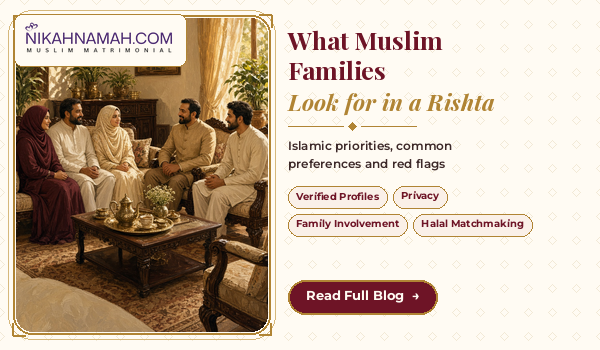
When a rishta arrives, the whole household leans in. The father asks about the family's background. The mother wants to know about their home and their ways. Elder siblings check what they can. Grandparents ask who knows them. And the son or daughter at the centre of it all quietly wonders: what are they all really looking for?
Every Muslim family evaluates proposals, but few stop to ask which of their questions come from the Quran and Sunnah and which come from habit, status or worry. When that difference is clear, families make wiser decisions, present themselves more honestly and spot genuine warning signs sooner.
This guide looks at a proposal from the family's side of the table. It covers what Islam places first, what bride's and groom's families commonly prefer, how to present your own family with dignity and honesty, and the red flags that deserve a pause.
NikahNamah has guided Muslim families since 1999 from our offices in Jayanagar 9th Block and Frazer Town, Bangalore. With 86,000+ successful Nikah and 96,461+ registered members (figures as published on www.nikahnamah.com), we have sat with many families as they weighed a rishta, and these are the patterns we see most.
Please note: This article is general guidance, not a fatwa. Questions about kafa'ah (suitability), the wali's role and what may be asked or stipulated in a proposal involve scholarly views and differences between schools. For your own situation, please consult a qualified Alim or Mufti.
Why the Family's View Matters in a Muslim Rishta
In Islam, marriage is a contract between two people, and the consent of the bride and groom is essential. Yet a Nikah also joins two families. Parents and guardians bring experience, community knowledge and protective care. For the bride, the wali has a recognised role, which our wali guide explains in detail.
A family's evaluation is therefore not interference when it is done well. It becomes a problem only when the family's preferences override Islamic priorities or the couple's own consent and wishes.
What Islam Places First
Deen and Character
The Prophet ﷺ said: "A woman is married for four things, i.e., her wealth, her family status, her beauty and her religion. So you should marry the religious woman..." (Sahih al-Bukhari 5090, translation from sunnah.com).
The hadith acknowledges that people naturally consider wealth, lineage and beauty. It does not forbid noticing them. But it tells us what should win when they compete: religion. Scholars apply the same principle when a bride's family evaluates a groom, looking for sound deen and good character.
Taqwa Over Lineage
Allah says: "O humanity! Indeed, We created you from a male and a female, and made you into peoples and tribes so that you may ˹get to˺ know one another. Surely the most noble of you in the sight of Allah is the most righteous among you" (Al-Hujurat 49:13, translation from quran.com).
Family background has its place, but it is not a measure of nobility before Allah. Our culture vs Islamic requirements guide explores how caste and biradari expectations can drift away from this teaching.
Compatibility and Mutual Inclination
Islam also allows the prospective spouses to see one another in a proper setting. The Prophet ﷺ advised a man who had proposed to look at the woman, saying it was more likely to create lasting affection between them (Jami' at-Tirmidhi 1087, graded Sahih on sunnah.com). Families should therefore make room for the couple's own sense of comfort and attraction, within halal limits.
Consent and Honesty
A Nikah without genuine consent is not what Islam intends. And a proposal built on concealed facts is not built on trust. These two principles shape every section below.
For the specific details of kafa'ah and how schools differ, please consult a qualified Alim or Mufti.
What the Bride's Family Commonly Looks For
Families of daughters tend to ask questions rooted in protection. Common priorities include:
1. The Groom's Deen and Practice
- Does he pray regularly?
- How does he speak about religion and about women?
- Is his practice sincere and balanced, not harsh or merely outward?
2. His Character and Temperament
- Is he calm, honest and respectful?
- How does he treat his mother, sisters and those who serve him?
- Does he handle disagreement with patience?
3. Ability to Provide
In Islam, the husband carries the duty of nafaqah (financial provision). A bride's family reasonably wants to know that he can provide within his means. This is a fair question about responsibility, not a demand for wealth. Our rights guide covers nafaqah more fully.
4. The Family She Will Join
- Are the parents kind and fair?
- Will she be respected as a new member of the home?
- What are the living arrangements, and will her right to suitable, private housing be honoured?
5. Openness to Her Goals
Many families ask how the groom's side views her studies, work, visits to her parents and her role in the home. These are best discussed openly and early.
What the Groom's Family Commonly Looks For
Families of sons often focus on harmony and continuity. Common priorities include:
1. The Bride's Deen and Character
The same hadith of the four things guides them: her religion and character should come first.
2. Family Values and Upbringing
- Does her family share similar values about religion, home and children?
- How do family members treat one another?
3. Temperament and Compatibility With the Household
Especially in joint families, parents want to know whether she and the household can live in harmony. Fairness requires that the groom's family also ask whether their own home is welcoming and just.
4. Education and Outlook
Many families today value an educated bride. It is wise to discuss expectations about work, studies and family life honestly, without assuming.
5. Respectful Communication
Families notice how the bride's side communicates: warmly, clearly and without pressure.
Islamic Priorities vs Common Preferences
Not every family preference is wrong. Many are reasonable. The problem arises when preferences push Islamic priorities aside. This table helps families sort them:
| Islamic Priority | Reasonable Preference | Preference That Often Causes Harm |
|---|---|---|
| Deen and practice | Similar level of practice | Judging only outward appearance |
| Good character | Similar temperament | Ignoring character for status |
| Consent of the couple | Parents' comfort with the match | Pressuring a son or daughter to agree |
| Ability to provide within means | Stable work or plans | Demanding a particular income or lifestyle |
| Honesty | Shared family values | Insisting on one caste or sub-group only |
| Kind treatment | Compatible languages or region | Fixating on complexion or height |
When families keep the left column firm and the middle column flexible, proposals move forward more smoothly. The right column deserves honest reflection.
How to Present Your Family Well
Families spend a lot of energy evaluating others and too little thinking about how they come across. A good presentation is about honesty and warmth, not image.
Be Honest About the Essentials
- Share accurate information about education, work and health matters that affect marriage
- Mention previous engagements or marriages openly
- Describe your family's practice of the deen as it really is
Concealing important facts can harm trust and, in serious cases, the marriage itself. Our guide to writing a strong matrimony profile explains how to present information truthfully and attractively.
Show Your Values, Not Your Possessions
- Talk about how your family lives: prayer, kindness, hospitality, respect for elders
- Avoid boasting about property, connections or status
- Let your character speak more than your décor
Prepare for the First Meeting
- Agree as a family on who will speak about what
- Keep the meeting simple and hospitable
- Allow the prospective couple a proper, chaperoned conversation
- Listen as much as you speak
Answer Questions Gracefully
The other family will ask questions, some of them personal. Answer honestly and calmly. If a question is inappropriate, decline politely. Our guide to 20 questions to ask before saying qubool covers what the couple themselves should discuss.
Represent Your Son or Daughter Faithfully
Parents sometimes overstate a child's qualities or understate their preferences. This leads to disappointment later. Present your child as they are, and let them speak for themselves too.
Red Flags Families Should Watch For
Allah says: "O believers, if an evildoer brings you any news, verify ˹it˺ so you do not harm people unknowingly, becoming regretful for what you have done" (Al-Hujurat 49:6, translation from quran.com). Verifying a proposal is part of acting wisely. Our guide to halal ways to find a spouse covers trusted channels.
Red Flags From the Other Family
- Dowry or gift demands, openly or through hints
- Pressure to decide quickly without time for inquiry or istikhara
- Inconsistent information about education, work or marital history
- Reluctance to meet or to allow references to be checked
- Disrespect towards the prospective bride or groom, or towards your family
- Excessive control, such as one parent answering every question for an adult child
Red Flags in the Prospective Spouse
- Disregard for basic religious duties that conflicts with your family's values
- Anger, rudeness or contempt during conversations
- Secrecy about past relationships, health matters that affect marriage, or commitments
- Unwillingness to discuss living arrangements, roles or future plans
- Indications of harmful habits, such as substance misuse
Red Flags Within Your Own Family
Sometimes the warning signs are at home:
- Rejecting good proposals over complexion, height or minor status differences
- Ignoring your son's or daughter's views
- Letting one relative's opinion decide everything
- Delaying endlessly in search of a "perfect" match
Our delayed marriage guide looks at these patterns more closely.
What to Do When You See a Red Flag
- Pause rather than rush
- Ask respectful, direct questions
- Verify through trusted references
- Pray istikhara, as our istikhara guide explains
- Seek advice from a scholar or experienced elder
- Step back politely if concerns remain
A polite "this is not right for us" protects both families' dignity.
The Couple's Voice in the Family Process
However thorough the family's evaluation, the final decision belongs to the two people who will marry, with the bride's wali fulfilling his role. Families should:
- Ask the son or daughter for their honest opinion after each meeting
- Respect a reasoned "no", even when the family liked the proposal
- Avoid emotional pressure or guilt
- Remember that a forced match helps no one
When families and children decide together, the marriage begins on a foundation of trust.
How NikahNamah's RM Helps Families Evaluate a Rishta
Our premium members receive a dedicated Relationship Manager who:
- Understands both your priorities and your preferences - and helps separate the two
- Shortlists with deen and character first - before secondary preferences
- Uses manually verified profiles - so families start from reliable information
- Coordinates respectful introductions - between families, at a comfortable pace
- Helps you present your family honestly - with a clear, dignified profile
- Flags common concerns early - such as dowry expectations or inconsistent details
- Keeps the couple's consent central - throughout every step
Registration is free, and every step follows a 100% halal process. Read more about personalized matchmaking for Nikah and why verified profiles make the search safer.
Frequently Asked Questions
Q1: What should a Muslim family look for first in a rishta?
Deen and good character, as taught in Sahih al-Bukhari 5090. Other qualities matter, but these should come first.
Q2: Is it wrong to consider family background or looks?
No. The hadith of the four things acknowledges them. They simply should not outweigh religion and character.
Q3: What does kafa'ah mean in a rishta?
Kafa'ah refers to suitability between spouses. Its details differ between schools, so please consult a qualified Alim or Mufti.
Q4: How can we present our family well?
Be honest about essentials, show your values rather than possessions, prepare for meetings and represent your child faithfully.
Q5: What are the biggest red flags in a proposal?
Dowry demands, pressure to rush, inconsistent information, refusal to allow inquiry, and disrespect or anger.
Q6: Should parents decide alone?
No. The couple's consent is essential, and the bride's wali has a recognised role. Decisions are best made together.
Q7: How do we decline a rishta politely?
Thank the family sincerely, give a brief and kind reason if appropriate, and avoid criticism or gossip.
Q8: How do we contact NikahNamah?
Call or WhatsApp +91 98451 30331 or +91 90360 22522, email support@nikahnamah.com or info.nikahnamah@gmail.com, or register at www.nikahnamah.com. Our hours are Monday to Sunday, 10:00 AM - 8:00 PM IST (Friday Off).
Closing Reflection: Looking With the Right Eyes
Every family wants the best for its son or daughter. The best, in the light of the Sunnah, is not the largest house or the most impressive title, but a spouse of sound deen and good character, from a family that will treat your child with kindness. When families look with those eyes, present themselves honestly and watch wisely for warning signs, the search becomes clearer and more blessed.
May Allah guide every family to a righteous match, place love and mercy between the couple, and unite both families in goodness. Ameen.
Register today: https://www.nikahnamah.com/
Call / WhatsApp: +91 98451 30331 | +91 90360 22522
Email: support@nikahnamah.com | info.nikahnamah@gmail.com
Also Read
- Benefits of Choosing a Personalized Matchmaking Platform for Nikah
- How Families Can Choose the Right Muslim Matrimony Platform
- Why Verified Matrimony Profiles Make Nikah Safer and Easier
- Cross-Border Muslim Marriage Matchmaking
About NikahNamah
NikahNamah is India's trusted Muslim matrimony platform and marriage bureau since 1999, combining the personal care of a Bangalore marriage bureau with online reach across India and the diaspora.
We offer personal Relationship Manager matchmaking, manually verified profiles, photo privacy for women, free registration and a 100% halal process from registration to Nikah, with 86,000+ successful Nikah and 96,461+ registered members (figures as published on www.nikahnamah.com).
Office and Contact
Main Branch: Jayanagar 9th Block, Bengaluru - 560069
Other Branch: Frazer Town, Bengaluru - 560005
Phone / WhatsApp: +91 98451 30331 | +91 90360 22522
Email: support@nikahnamah.com | info.nikahnamah@gmail.com
Website: www.nikahnamah.com
Office Hours: Monday to Sunday, 10:00 AM - 8:00 PM IST (Friday Off)
Service Area: All India | UAE | Saudi Arabia | Qatar | Kuwait | Bahrain | Oman | UK | USA | Canada | Australia | South Africa

💬 Comments